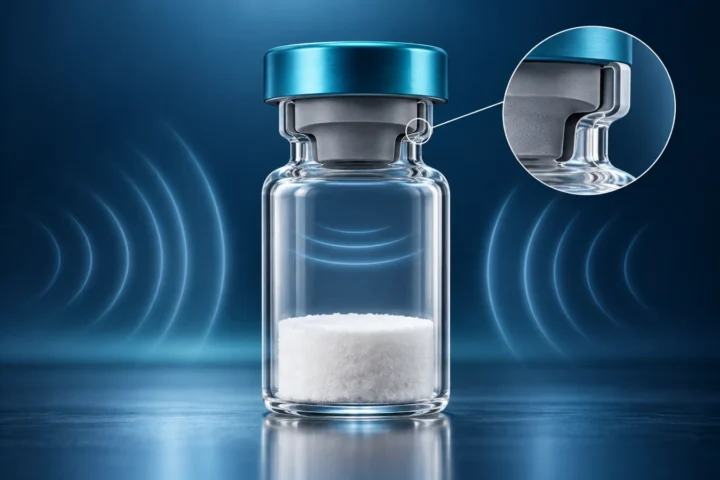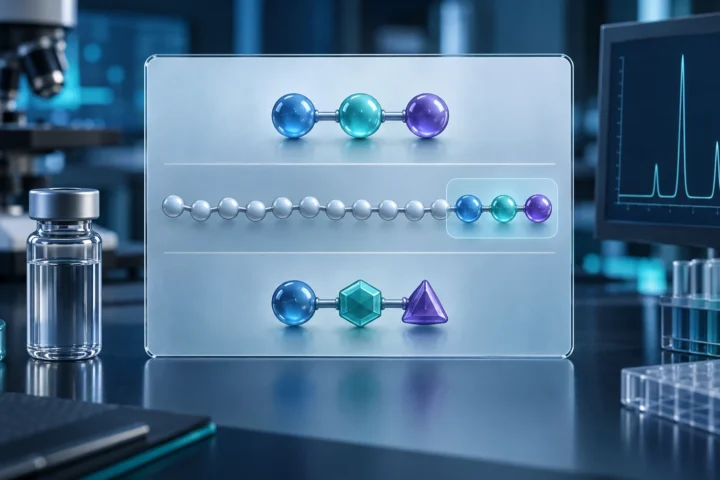
A broken peptide puck can be a transport or process observation, but appearance alone cannot prove content, purity or damage. Learn what B2B buyers should record and verify.
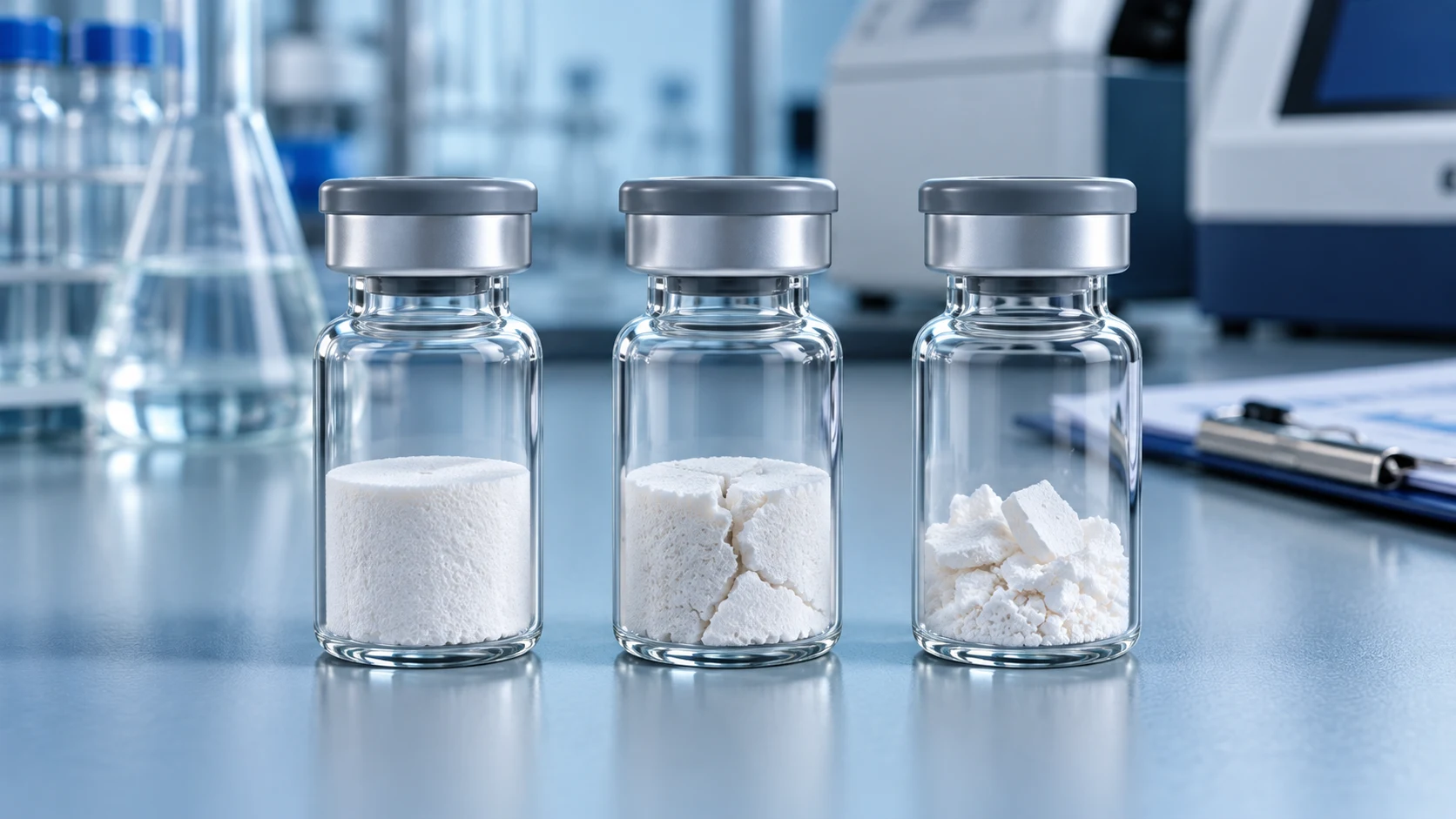
A buyer opens a ten-vial kit and notices that the vials do not all look alike. Four have a neat white puck. Three contain a cake split by a visible crack. The remaining vials hold loose pieces that move when the box is tilted. The labels show the same product and nominal content, but the visible amount appears different.
That is enough to open an appearance review. It is not enough to decide that the loose vials contain less peptide, that the intact pucks are more pure, or that any vial has passed or failed specification.
The direct answer is: a lyophilized cake is a porous structure left after freeze-drying. Cracking, chipping or loose powder can arise from the formulation, drying process or mechanical stress after drying. Cake appearance may be relevant, but it is not a measurement of identity, purity or quantitative content. Buyers should compare like-for-like photographs, packaging and lot records, then request the product-specific specification and analytical evidence needed for the actual question.[1–5]
This is a B2B research-material procurement guide. It does not provide reconstitution, injection, dosing or personal-use instructions.
What a “peptide puck” actually is
“Puck” is buyer language. Pharmaceutical literature usually calls the visible solid a lyophilized cake. A liquid formulation is frozen; ice is removed by sublimation during primary drying; additional bound water is reduced during secondary drying. What remains is a porous solid network that often retains the approximate shape of the frozen fill.[1,2]
That structure is not a compressed tablet. It can be light and mechanically fragile. Its visible volume can reflect the total formulation, fill configuration, solids concentration and freezing/drying history—not only the mass of the named peptide.[2,6]
This distinction explains why two statements can both be true:
- a cake’s appearance is worth documenting because it can reveal process or handling differences;
- appearance alone cannot quantify the active material in the vial.
The FDA inspection guide identifies cake volume and appearance as visual-inspection considerations and specifically treats meltback as a concern.[1] A major pharmaceutical review is more nuanced: a non-ideal cake can indicate a quality change, but some non-ideal appearances are inherent to a formulation or presentation and have no demonstrated effect on the critical quality attributes of that product.[2]
Broken, cracked, shrunken and collapsed are not synonyms
Buyers often use “broken puck” for every irregular vial. A supplier cannot investigate the complaint well if the description merges different observations.
| Observation | What it looks like | What remains unknown |
|---|---|---|
| Cracked cake | A coherent cake with one or more fissures | Whether the crack formed during drying, stoppering, storage or transport; whether any measured quality attribute changed |
| Chipped or broken cake | Several solid pieces still resembling the original cake | Cause, content, identity, purity and moisture |
| Loose powder or dusting | Fine material or fragments on the vial wall | Whether it is only mechanical fragmentation or accompanies another change |
| Shrinkage | Cake has pulled away from the glass or reduced in width while retaining structure | Whether shrinkage is within the product-specific visual specification |
| Collapse or meltback | Loss of the porous structure; dense, glassy, slumped or partially melted-looking material | Residual moisture, stability and the extent of any process deviation |
| Discoloration or wet appearance | Colour change, glossy/wet regions or visible liquid | Cause and product impact; these need a different investigation from a simple crack |
Experimental work on amorphous cakes found an inverse relationship between shrinkage and cracking under the tested formulations: when drying tension was relieved through shrinkage there was less cracking, while constrained shrinkage produced more cracking.[3] That is a useful warning against simplistic grading. A cracked cake is not automatically “worse” than a smooth but shrunken cake.
Can shipping break a lyophilized cake?
It can. The 2017 cake-appearance review discusses dusting, chipping and broken cakes after transportation and shaking stress.[2] Texture-analysis research also starts from the practical requirement that a freeze-dried cake have enough strength to resist cracking or powdering during transport and storage.[4]
But “shipping did it” should not become a universal answer. A photograph taken after delivery cannot show when the change occurred. The cake may have left the dryer cracked, fractured during stoppering or packing, or broken later in transit. The evidence needed is a timeline:
- release or packing photograph, if available;
- shipment and outer-package condition on arrival;
- kit-level photograph before the vials are moved;
- close photographs under consistent lighting;
- lot number and vial position within the kit;
- whether the stopper, crimp, vial or seal also looks abnormal.
One protein-formulation study deliberately used accelerated shipping-like shaking. Greater mechanical stress broke cakes down toward powder and, for that specific IgG1 formulation, was associated with changes including turbidity and subvisible particles after laboratory reconstitution testing.[5] The result should not be transferred automatically to every peptide or every parcel. It demonstrates why “only cosmetic” and “certainly damaged” are both overconfident without product-specific data.
Does loose powder mean the vial contains less product?
Not by sight alone.
A larger puck can contain more total formulation solids without containing more of the named peptide. A small-looking cake can be denser. Fine powder may spread over more glass surface and look like more material, while a compact cake occupies a smaller visual footprint. Vial diameter, fill volume, bulking agents and process conditions can all influence the geometry the buyer sees.[2,6]
The named peptide’s quantitative content is an analytical claim. A visual comparison cannot establish it. For a B2B lot review, separate four questions:
- Was the correct material identified? This requires suitable identity evidence.
- What proportion of chromatographic signal is assigned to the main component? This is a purity question under a stated method.
- How much intended material is present per vial? This is a quantitative content or assay question.
- Is fill performance consistent across the lot? This needs a defined sampling and acceptance plan, not a photograph of the largest and smallest cakes.
The peptide COA guide explains why identity, area purity and quantitative content should not be collapsed into one “99%” claim. The batch consistency guide shows how repeat orders can be compared through the same fields instead of visual memory.
An intact cake is not proof of purity
An elegant puck is visually reassuring. It may show that the formulation and drying cycle produced a coherent structure. It does not reveal the peptide sequence, distinguish an analogue, measure the main peak, quantify fill content or establish sterility.
The reverse is also important. A crack does not, by itself, prove chemical degradation. Patel and colleagues explicitly frame cake appearance as an attribute that may or may not be critical to product quality, depending on its relationship to the product’s critical quality attributes.[2]
The correct question is therefore not “Is a broken puck good or bad?” It is:
What appearance specification applies to this product, what changed from the release state, and which measured attribute could be affected?
That wording moves the discussion from online folklore to a traceable investigation.
What a buyer should send in an appearance complaint
A message saying “the powder looks wrong” creates several rounds of avoidable questions. A usable complaint record should include:
- product name exactly as quoted;
- per-vial specification and kit quantity;
- purchase order and supplier lot or batch number;
- number of vials inspected and number showing each appearance;
- untouched kit photograph plus close views of representative vials;
- neutral lighting and the same background for comparisons;
- description chosen from observable terms: intact, cracked, chipped, loose powder, wall deposit, shrunken, collapsed, wet-looking or discoloured;
- outer packaging condition and any visible vial, stopper or crimp damage;
- date received and when the photographs were taken;
- the answer requested: document clarification, replacement review, batch investigation or analytical comparison.
Do not turn the complaint photo into a chemical diagnosis. Write “three of ten vials contain loose white fragments on the wall,” not “three vials degraded in shipping.” The first sentence can be verified from the image. The second requires evidence not contained in the image.
What to ask the supplier
For a serious wholesale review, ask:
- What is the approved visual description for this specific product and specification?
- Are cracking, chipping or loose powder included in the supplier’s internal appearance categories?
- Was the lot photographed or inspected before dispatch?
- Does the lot record show any drying, stoppering, packing or transport deviation?
- What evidence supports identity, purity and quantitative content for the supplied lot?
- Is residual moisture part of the specification, and which method is used?
- If a visual deviation is accepted, which critical quality attributes were assessed before that decision?
- How is the complaint linked to retained samples, shipment records and the written resolution?
These questions do not demand that every supplier disclose a proprietary freeze-drying cycle. They ask the supplier to connect the observed vial to a defined specification and batch decision.
MY PEPTIDE’s confirmed wholesale unit is one kit per peptide, with ten vials of the same product per kit. Different products may appear in the same order as separate full kits; five vials of product A and five of product B do not form one kit. Current terms are on the MY PEPTIDE Wholesale Terms page.
When the issue is more than a broken cake
Escalate the description when the observation involves more than mechanical fragmentation, including:
- wet or glossy areas suggesting possible meltback;
- major collapse or loss of expected cake volume;
- new discoloration;
- material trapped at the stopper-sealing interface;
- damaged glass, stopper or crimp;
- foreign-looking particles;
- several vials showing the same change over time;
- mismatch between the vial label, report and batch record.
These observations still do not identify a cause by themselves. They change the risk question and the evidence required. The FDA guide notes that meltback can involve incomplete sublimation and pockets of moisture, with possible implications for physical form and stability.[1] A crack through an otherwise dry, coherent cake should not be described as meltback merely because it looks untidy.
FAQ
Is a broken peptide puck automatically unusable?
Appearance alone cannot answer that. A broken cake may reflect mechanical fragmentation, but acceptability must be determined against the product-specific specification and relevant measured quality attributes.[2,5]
Does a bigger puck mean more peptide?
No. Visible cake volume is influenced by the total formulation and process. Quantitative peptide content requires a suitable analytical method.
Does loose powder prove the vial lost vacuum?
No. Loose powder does not measure container pressure or closure integrity. Inspect and document the stopper, crimp and vial separately, and request the relevant packaging record.
Can a buyer compare powder height between two suppliers?
Only as an appearance observation. Different vial geometry, fill volume, formulation solids and drying processes make height an unreliable proxy for peptide content.
Is a cracked cake the same as a collapsed cake?
No. A cracked cake retains a porous structure but contains fissures. Collapse involves loss of structure and a dense or slumped appearance. The distinction should be recorded before discussing cause.[1–3]
The practical conclusion
A lyophilized cake is useful evidence, but it is evidence of appearance—not a built-in assay. An intact puck, a cracked cake and loose powder should be described accurately and tied to the lot timeline. None should be used alone to rank identity, purity or milligrams per vial.
For B2B purchasing, the best response is neither instant rejection nor casual reassurance. Preserve the record, define the visual category, compare it with the product-specific specification and ask which analytical or batch evidence resolves the real question.
For current wholesale requirements and documentation discussions, contact service@wholesalepeptide.xyz.
References
- U.S. Food and Drug Administration. Lyophilization of Parenteral (7/93): Guide to Inspections of Lyophilization of Parenterals. FDA inspection guide.
- Patel SM, Nail SL, Pikal MJ, et al. Lyophilized Drug Product Cake Appearance: What Is Acceptable? Journal of Pharmaceutical Sciences. 2017;106(7):1706–1721. doi:10.1016/j.xphs.2017.03.014.
- Ullrich S, Seyferth S, Lee G. Measurement of Shrinkage and Cracking in Lyophilized Amorphous Cakes. Part I: Final-Product Assessment. Journal of Pharmaceutical Sciences. 2015;104(1):155–164. doi:10.1002/jps.24284.
- Hackl EV, Ermolina I. Using Texture Analysis Technique to Assess the Freeze-Dried Cakes in Vials. Journal of Pharmaceutical Sciences. 2016;105(7):2073–2085. doi:10.1016/j.xphs.2016.05.016.
- Telikepalli S, Kumru OS, Kim JH, et al. Characterization of the Physical Stability of a Lyophilized IgG1 mAb After Accelerated Shipping-Like Stress. Journal of Pharmaceutical Sciences. 2015;104(2):495–507. Full text.
- Tang X, Pikal MJ. Design of Freeze-Drying Processes for Pharmaceuticals: Practical Advice. Pharmaceutical Research. 2004;21(2):191–200. doi:10.1023/B:PHAM.0000016234.73023.75.
Editorial and evidence note
This article contains no customer case, MY PEPTIDE batch result or fabricated laboratory finding. The opening is a generic procurement scenario, not a claim about an actual shipment. The article was prepared with AI assistance and source checking by the MY PEPTIDE Editorial Team; no independent laboratory or clinical expert review is claimed. Research use only; not medical advice.
This article is provided for supplier evaluation, research education, and business communication. It is not medical advice and does not provide dosage or treatment instructions.
Need supplier information for your business?
Discuss product availability, documentation, wholesale requirements, and shipping communication with our team.