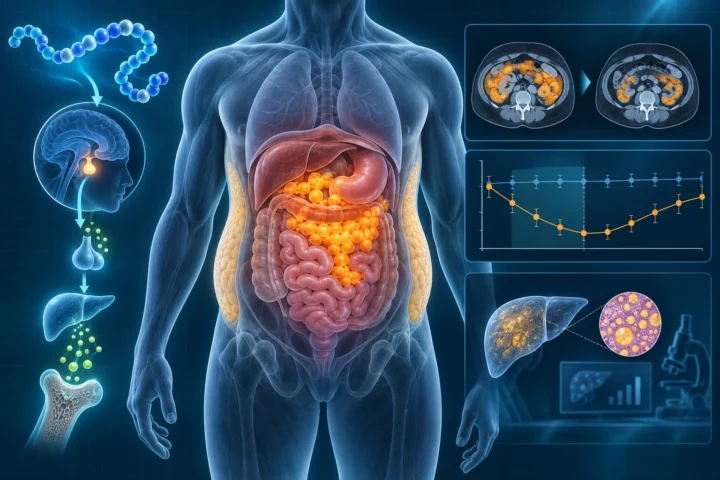
Review BPC-157 research on tendons, joints, gut models and older dogs, including pet-owner reports, veterinary cases and major evidence gaps.
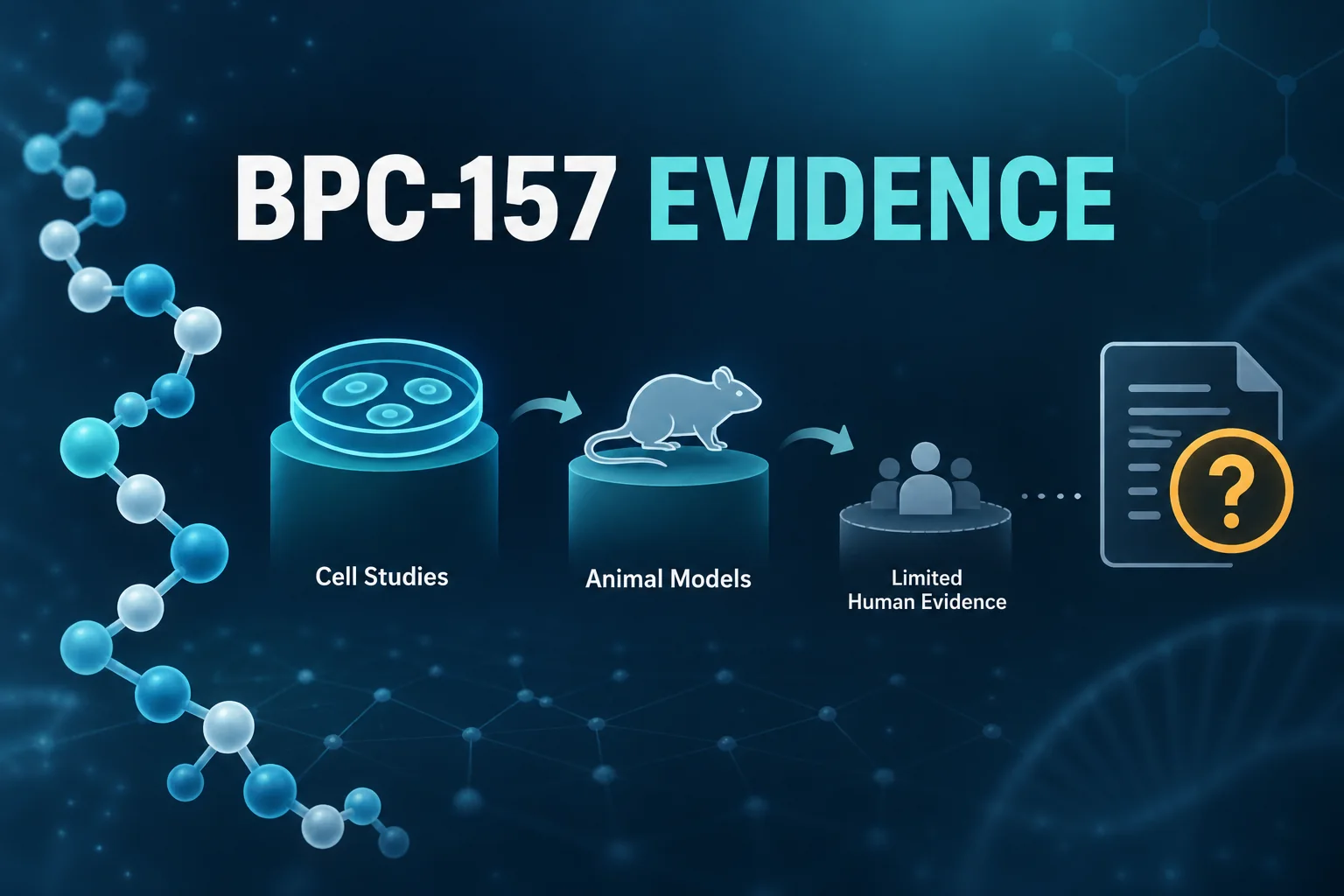
Search for “BPC-157 benefits” and the claims arrive quickly: tendon repair, ligament healing, gut protection, less inflammation, faster recovery and pain relief. A newer branch of the conversation concerns pets. Owners of older dogs describe arthritis, stiffness, difficulty rising or shorter walks, and some say mobility appeared to improve after they tried BPC-157.
Those reports are real as reports. They are not proof that BPC-157 treats canine arthritis.
The distinction matters because the evidence is unusually uneven. BPC-157 has produced positive findings in cell and animal models. One small uncontrolled human chart review reported improvement in some people with knee pain. A 2024 veterinary article described four canine stifle cases managed with integrative, multi-part treatment plans that included BPC-157. Online pet communities contain both perceived improvements and unresolved concerns. Yet, in the sources reviewed for this update, we did not find a randomised, placebo-controlled trial testing BPC-157 for naturally occurring osteoarthritis in client-owned dogs or cats.
That leaves a useful but narrower conclusion: BPC-157 has a broad preclinical research signal and a small number of human and veterinary observations, but reliable therapeutic benefit and safety have not been established for people or companion animals.
The short answer: which BPC-157 benefits have actually been studied?
| Claimed benefit or use | What has actually been studied | What remains unresolved |
|---|---|---|
| Tendon repair | Surgically injured rat tendons and laboratory endpoints | Human recovery, relevant formulation and clinical safety |
| Ligament and muscle healing | Mainly rat injury models | Controlled human efficacy and replication |
| Gut protection | Experimental gastrointestinal injury models, mostly in animals | Adequate controlled human evidence |
| Knee-pain relief | Small retrospective human chart review | Placebo effect, diagnosis, function and comparative efficacy |
| Older-dog mobility or arthritis | Pet-owner reports and a four-case veterinary article using multiple interventions | BPC-157-only effect, dosage validity, safety and controlled canine efficacy |
| Safety | Preclinical toxicology in several species and sparse short human exposure | Long-term, immune-related, product-specific and companion-animal risks |
The phrase “has been studied” is not interchangeable with “has been proven to work.” Study design, species, material identity, comparator and outcome all determine how far a conclusion can travel.
What exactly is BPC-157?
BPC-157 is a synthetic 15-amino-acid peptide commonly represented by the sequence GEPPPGKPADDAGLV. Online descriptions often call it a fragment of a gastric “body protection compound.” That naming history does not define a finished material.
For a research buyer, a catalogue name leaves basic questions open. Is the quoted substance the free base or an acetate-associated form? What sequence and expected molecular mass does the supplier use? Does the labelled amount refer to target peptide, salt-associated material or total vial contents? Which analytical method supports identity, and which supports content?
This matters whenever a published paper is used to discuss a commercial vial. Research findings belong to the material, formulation, route, model and conditions used in that study. The name BPC-157 alone does not establish equivalence between a paper’s test article and a supplier’s batch.
Tendon, ligament and muscle findings: a strong animal narrative, not a human result
A frequently cited 2003 study used rats whose Achilles tendons had been surgically transected. Investigators reported differences in functional, biomechanical, microscopic and macroscopic measures between treated and control animals.[4] A 2010 rat study reported positive measures after medial collateral ligament transection.[5] Other animal and cell studies have examined muscle, tendon-to-bone healing, endothelial behaviour and blood-flow-related signalling.
These findings are relevant to research hypotheses. They do not show that BPC-157 heals a person’s tendinopathy, post-operative injury or degenerative joint disease. A surgically created injury in a young laboratory animal differs from a chronic condition shaped by age, body mass, activity, prior injury and concurrent treatment.
The 2025 systematic review of musculoskeletal BPC-157 literature makes the imbalance visible: 35 of 36 eligible studies were preclinical, while only one was clinical.[2] More animal papers can strengthen a preclinical signal, but they do not replace controlled human trials.
What does the human knee-pain report tell us?
The best-known human musculoskeletal publication retrospectively reviewed 17 people who received an intra-articular intervention for different kinds of knee pain. Sixteen were reached by telephone; some reportedly received BPC-157 alone and others received it with thymosin-beta-4.[3]
Most of the BPC-157-only respondents reported improvement. That observation is worth recording, but the design cannot establish a treatment effect. There was no randomised control group, blinding, consistent diagnosis, standardised functional instrument or uniform follow-up. A telephone report after an intervention can generate a hypothesis; it cannot supply a dependable success rate for the general population.
The same rule applies to individual testimonials. An improvement that follows an intervention may be genuine, yet timing alone cannot identify the cause. Natural fluctuation, changed activity, rehabilitation, pain medicine, weight loss, caregiver expectations and other interventions can all affect what is observed.
Why are pet owners discussing BPC-157 for older dogs?
The motivation is easy to understand. Arthritis and degenerative joint disease can make an older dog slower to rise, reluctant to climb, less willing to walk or visibly stiff after activity. Owners who feel that conventional options have not restored the mobility they remember often search beyond established veterinary care. BPC-157 enters that search because human-oriented peptide communities repeatedly associate it with “repair.”
Public discussions reviewed for this article show three recurring patterns:
- owners ask whether anyone has tried BPC-157 for an elderly dog with arthritis or reduced mobility;
- some owners report a visible or “huge” improvement after use;
- other threads contain no clear benefit, mixed interventions, requests for dosing help or possible adverse-event concerns.
These posts help explain the language and urgency behind the query. They do not estimate how common use is, confirm what product was administered, verify the diagnosis, rule out other treatment or measure an objective response. Community observations are therefore listed separately from scientific references at the end of this article.
Is there veterinary evidence in dogs?
There is more than “nothing,” but much less than a treatment claim requires.
A 2024 article in the Journal of the American Holistic Veterinary Medical Association described four canine stifle cases managed without surgery using integrative plans.[9] BPC-157 appeared in the treatment history, and owners or clinicians recorded mobility improvements at points during follow-up. One case involved an aging large-breed dog with degenerative changes whose owner reported resolution of lameness after a BPC-157 period.
The article is clinically interesting, but it is a four-case series, not a randomised trial. The dogs also received varying combinations of weight management, diet changes, herbs, pain medicines, photobiomodulation, physical therapy, platelet-rich plasma, supplements or TB-500. Diagnoses and follow-up differed. Because the interventions changed together, the cases cannot isolate how much, if any, improvement came from BPC-157.
The article itself says dog studies using BPC-157 are scarce and characterises the therapy as experimental. That is a much narrower evidence category than a placebo-controlled study of naturally occurring canine osteoarthritis.
Two other kinds of dog data are often mistaken for efficacy evidence:
- A 2022 study measured pharmacokinetics, metabolism and excretion in rats and beagle dogs.[6] It tells us how the parent peptide and related radioactivity behaved under those experimental conditions. It did not test whether elderly pets walked farther or experienced less osteoarthritis pain.
- A preclinical safety programme included dogs alongside mice, rats and rabbits.[7] Toxicology observations can inform development, but they do not establish long-term safety in older pets with spontaneous disease, concurrent medicines and variable commercial products.
The missing study is important: client-owned dogs with confirmed, naturally occurring osteoarthritis, prospectively assigned to a defined BPC-157 preparation or an appropriate control, with blinded veterinary assessment, validated owner-reported outcomes, objective mobility measures and adequate safety follow-up.
Why a pet testimonial can feel convincing—and still be uncertain
Owners know their animals well. A dog rising more easily or wanting a longer walk can be meaningful. Dismissing every observation would be unhelpful. Treating it as proof would be equally unhelpful.
Several factors make attribution difficult:
- Symptoms fluctuate. Stiffness and activity can change with rest, exercise, weather or a recent flare.
- The diagnosis may be incomplete. Lameness can arise from joints, ligaments, spine, nerves, muscle or more than one site.
- Several things often change at once. Owners may adjust pain medicine, supplements, exercise, food, body weight or rehabilitation at the same time.
- Caregiver observation is not blinded. Expectation can influence how changes are noticed and reported, even when the owner is careful and sincere.
- The material is uncertain. An online label does not verify identity, amount, sterility or batch consistency.
- Positive stories travel farther. People who see no change may be less likely to write a detailed post.
This is why a community story is best treated as a question generator. It can tell researchers what owners care about—rising, stairs, walking distance, stiffness and quality of life—and help define outcomes for a proper trial.
Why rat injury research does not answer the senior-dog question
The leap from rat tendon repair to an old dog’s arthritis crosses several boundaries at once.
First, the disease is different. A clean surgical transection tests repair after an acute experimental injury. Canine osteoarthritis is often chronic, progressive and influenced by joint conformation, cartilage, synovium, subchondral bone, prior injury and body condition.
Second, the species and life stage are different. Pharmacokinetic data from healthy beagles cannot define benefit or safety for an elderly dog with kidney, liver, cardiac or endocrine disease.
Third, the outcome is different. Histology or tensile strength in a laboratory model is not the same as less pain, safer movement or better quality of life in a companion animal.
Finally, the product may be different. Sequence, form, concentration, impurities, aggregation, sterility and handling can vary. A result associated with one defined research material cannot authenticate an untested vial purchased online.
Gastrointestinal research and the wider benefits list
BPC-157 also has a long preclinical history in experimental gastric, intestinal and inflammatory injury models. Those findings underpin many “gut healing” claims. Cell and animal studies involving endothelial signalling have also been used to support broader repair narratives.[8]
The clinical bridge remains weak. In July 2026, the US Food and Drug Administration reviewed BPC-157-related bulk drug substances for a pharmacy-compounding advisory meeting and described major gaps in physicochemical characterisation, effectiveness and clinical safety.[1] That process was not drug approval, and it does not establish an authorised therapeutic indication.
The responsible description is therefore limited: gastrointestinal and vascular-related signals have been studied, mainly preclinically. They do not establish that BPC-157 treats human or animal gastrointestinal disease.
What is known about safety?
Safety cannot be inferred from “natural,” “peptide” or “used by others.” A peptide can create immune, formulation, contamination or route-specific risks, and rare effects are especially difficult to detect in small studies.
Animal pharmacokinetic and toxicology publications exist.[6,7] Human exposure data remain sparse, and the 2026 FDA review found the available clinical information inadequate to characterise safety.[1] For pets, the four published cases and online reports are far too small and uncontrolled to define uncommon or long-term harms.
In the United States, intended use matters. FDA states that a product intended to diagnose, cure, mitigate, treat or prevent disease in animals—or to affect an animal’s body structure or function—meets the drug definition. A new animal drug without approval, conditional approval or indexing lacks legal marketing status.[10] A “research use only” label does not erase a therapeutic intended use.
This article is not veterinary prescribing information. It does not recommend giving BPC-157 to a pet. An older animal with pain, lameness or reduced mobility needs assessment by a licensed veterinarian, because an online testimonial cannot identify the cause or rule out conditions requiring established care.
What has not been proven?
Current evidence does not establish that BPC-157:
- reliably heals tendon, ligament, muscle or bone injuries in people;
- treats arthritis or reliably relieves pain in dogs or cats;
- is safe for long-term use in humans or companion animals;
- has a validated pet formulation, route or exposure profile;
- treats ulcerative colitis, ulcers or other gastrointestinal disease;
- shortens recovery after surgery or sports injury;
- is equivalent across products carrying the same name.
This list does not say every proposed effect is impossible. It marks the questions that adequate evidence has not answered.
Why a published benefit does not verify a wholesale vial
A biological result and a material-quality result answer different questions. A rat tendon paper cannot confirm a vial’s contents. A chromatogram cannot prove a therapeutic benefit.
For a B2B research purchase, the specification should connect at least five items:
- Defined identity: name, sequence, form and expected molecular mass.
- Stated content: amount attributed to the target peptide, not merely total fill.
- Identity evidence: a suitable method interpreted against an appropriate reference.
- Purity and related substances: what the method separates, detects and reports.
- Batch traceability: a coherent link among quotation, label, analytical record and received lot.
Our guide to reading a peptide COA explains why identity, purity and content are separate fields. Researchers reviewing BPC-157 research material should request the specification for the quoted batch. Published human, rat or dog observations do not establish equivalence to any catalogue material, including material sold by MY PEPTIDE.
Under MY PEPTIDE Wholesale Terms, one kit contains 10 vials of the same product and the standard MOQ is one kit per peptide. An order may combine complete kits of different products, but different products cannot be mixed within one kit. Quotations depend on the product, per-vial specification and number of kits.
A five-question test for any BPC-157 benefit claim
Before repeating a claim, ask:
- Was the evidence from cells, laboratory animals, client-owned pets, retrospective records or a controlled trial?
- What condition was actually studied: acute injury, chronic osteoarthritis, gastrointestinal damage or something else?
- Was BPC-157 the only intervention, and was there a credible comparator?
- Were outcomes objective, validated and assessed without knowing treatment assignment?
- Does the tested material match the identity, formulation and quality of the product being discussed?
If an article cannot answer these questions, its headline is probably more confident than its evidence.
FAQ
Does BPC-157 help dogs with arthritis?
Some owners report perceived improvements, and a veterinary four-case article includes dogs whose multimodal treatment plans contained BPC-157. In the sources reviewed here, no randomised placebo-controlled BPC-157 trial in client-owned dogs with naturally occurring osteoarthritis was found. Benefit and safety therefore remain unproven.
Can BPC-157 be given to an older dog?
This article cannot recommend or explain administration. BPC-157 is not an FDA-approved animal drug, and an older dog’s stiffness may have several causes and concurrent health risks. A licensed veterinarian should evaluate pain or mobility changes.
Do pet-owner stories prove that it works?
No. They can reveal questions and possible signals, but they cannot verify product identity, diagnosis, other treatments, placebo or caregiver effects, or causation.
Have dogs been included in BPC-157 studies?
Yes. Published work includes beagle-dog pharmacokinetics, a multispecies preclinical safety study and a four-case veterinary article. These are different evidence types; none is a randomised BPC-157 efficacy trial for spontaneous canine osteoarthritis.[6,7,9]
Does BPC-157 heal human tendons?
Positive tendon findings exist mainly in animal models. Robust controlled human trials establishing tendon-healing benefit have not been published.[2,4]
Is BPC-157 FDA approved?
No. A 2026 pharmacy-compounding advisory process was not approval of BPC-157 as a human drug.[1] FDA’s animal-drug framework also distinguishes approved, conditionally approved and indexed products from unapproved new animal drugs.[10]
Does a high purity percentage prove the vial contains the stated amount?
No. Purity, identity and content are different analytical questions. A batch claim needs methods and traceability appropriate to each question.
Bottom line
BPC-157 is scientifically interesting because laboratory and animal studies show signals across several tissue-injury models. The pet angle is not imaginary: owners discuss it, some report meaningful improvements, and a veterinary case article documents its inclusion in multimodal canine care.
But the evidence ladder still has missing rungs. Community reports are uncontrolled. Four veterinary cases cannot isolate one component from diet, weight change, medicines, rehabilitation, laser therapy, PRP or other peptides. Dog pharmacokinetics does not prove arthritis relief. Rat injury models do not establish benefit in an elderly pet.
For B2B research-product availability, per-vial specifications, whole-kit quantities and batch documentation, contact service@wholesalepeptide.xyz.
References
- US Food and Drug Administration. FDA Briefing Document for BPC-157-Related Bulk Drug Substances (BPC-157 Free Base and BPC-157 Acetate). Pharmacy Compounding Advisory Committee Meeting; July 23–24, 2026. FDA meeting page
- Vasireddi N, Hahamyan H, Salata MJ, et al. Emerging Use of BPC-157 in Orthopaedic Sports Medicine: A Systematic Review. HSS Journal. 2025;21(4):485–495. PubMed
- Lee E, Padgett B. Intra-Articular Injection of BPC 157 for Multiple Types of Knee Pain. Alternative Therapies in Health and Medicine. 2021;27(4):8–13. PubMed
- Staresinic M, Sebecic B, Patrlj L, et al. Gastric pentadecapeptide BPC 157 accelerates healing of transected rat Achilles tendon and in vitro stimulates tendocytes growth. Journal of Orthopaedic Research. 2003;21(6):976–983. PubMed
- Cerovecki T, Bojanic I, Brcic L, et al. Pentadecapeptide BPC 157 improves ligament healing in the rat. Journal of Orthopaedic Research. 2010;28(9):1155–1161. PubMed
- He L, Feng D, Guo H, et al. Pharmacokinetics, distribution, metabolism, and excretion of body-protective compound 157 in rats and dogs. Frontiers in Pharmacology. 2022;13:1026182. PubMed
- Xu C, Sun L, Ren F, et al. Preclinical safety evaluation of body protective compound-157. Regulatory Toxicology and Pharmacology. 2020;114:104665. PubMed
- Hsieh MJ, Liu HT, Wang CN, et al. Therapeutic potential of pro-angiogenic BPC157 is associated with VEGFR2 activation and up-regulation. Journal of Molecular Medicine. 2017;95(3):323–333. PubMed
- Watson SAM. An Integrative Approach to Canine Stifle Injuries and Degenerative Conditions: Four Cases of Successful Non-Surgical Outcomes. Journal of the American Holistic Veterinary Medical Association. 2024;77:26–38. Article PDF; doi:10.56641/NOAM7514
- US Food and Drug Administration. Unapproved Animal Drugs. FDA animal-drug guidance
Community observations reviewed — not efficacy evidence
- BPC-157 for senior pets — an owner reports perceived mobility and pain-control improvement in an elderly dog.
- BPC-157 for an older dog with arthritis — an owner seeks experiences and later reports an observation; product, diagnosis and other variables are unverified.
- BPC-157 and osteoarthritis in a Labrador — a discussion containing uncertainty and mixed experience, illustrating why anecdotes cannot define efficacy or safety.
This article is provided for supplier evaluation, research education, and business communication. It is not medical advice and does not provide dosage or treatment instructions.
Need supplier information for your business?
Discuss product availability, documentation, wholesale requirements, and shipping communication with our team.