A clear guide for B2B buyers to HPLC purity, net peptide content and mg per vial: what each number measures, and what to ask before comparing suppliers.
Fictional procurement scenario: Daniel, his business and the dialogue below are invented. The scenario illustrates a purchasing mistake; it is not a customer testimonial or a report about a real supplier.
Daniel was responsible for replenishment at a UK research-material distributor. On Friday afternoon, he was comparing two quotations for the following month’s stock. His supplier conversations were open beside a spreadsheet that was supposed to make the decision easy.
Both quotations described the same research peptide at 10 mg per vial. Both were for sealed, freeze-dried material. The second supplier had attached a certificate of analysis, or COA: a document recording analytical information about an identified material or sample. Daniel opened it before he opened the shipping terms.
One line caught his attention: Purity, HPLC: 99.4%.
That looked reassuring. HPLC was a laboratory method, the number was close to 100, and the PDF looked more substantial than a message saying “good quality”. He put a tick in the spreadsheet under “quantity checked”.
Later that afternoon, his colleague read the file and asked where the measured milligrams were shown.
“Right there,” Daniel said, pointing at the percentage.
She left the document open. “Then why is the result a percentage, not milligrams?”
He went back to the supplier. The reply was another screenshot of the same line.
No money had disappeared. No laboratory had declared the sample counterfeit. Yet Daniel could no longer justify the tick in his spreadsheet. He had asked a document one question and accepted its answer to a different one.
For a business buying repeat stock, that difference matters. “How dominant is the target peak?” and “How much target peptide is in this vial?” are separate questions. A high HPLC purity result does not, on its own, establish the labelled quantity. [1, 2]
First, separate the number from the thing being measured
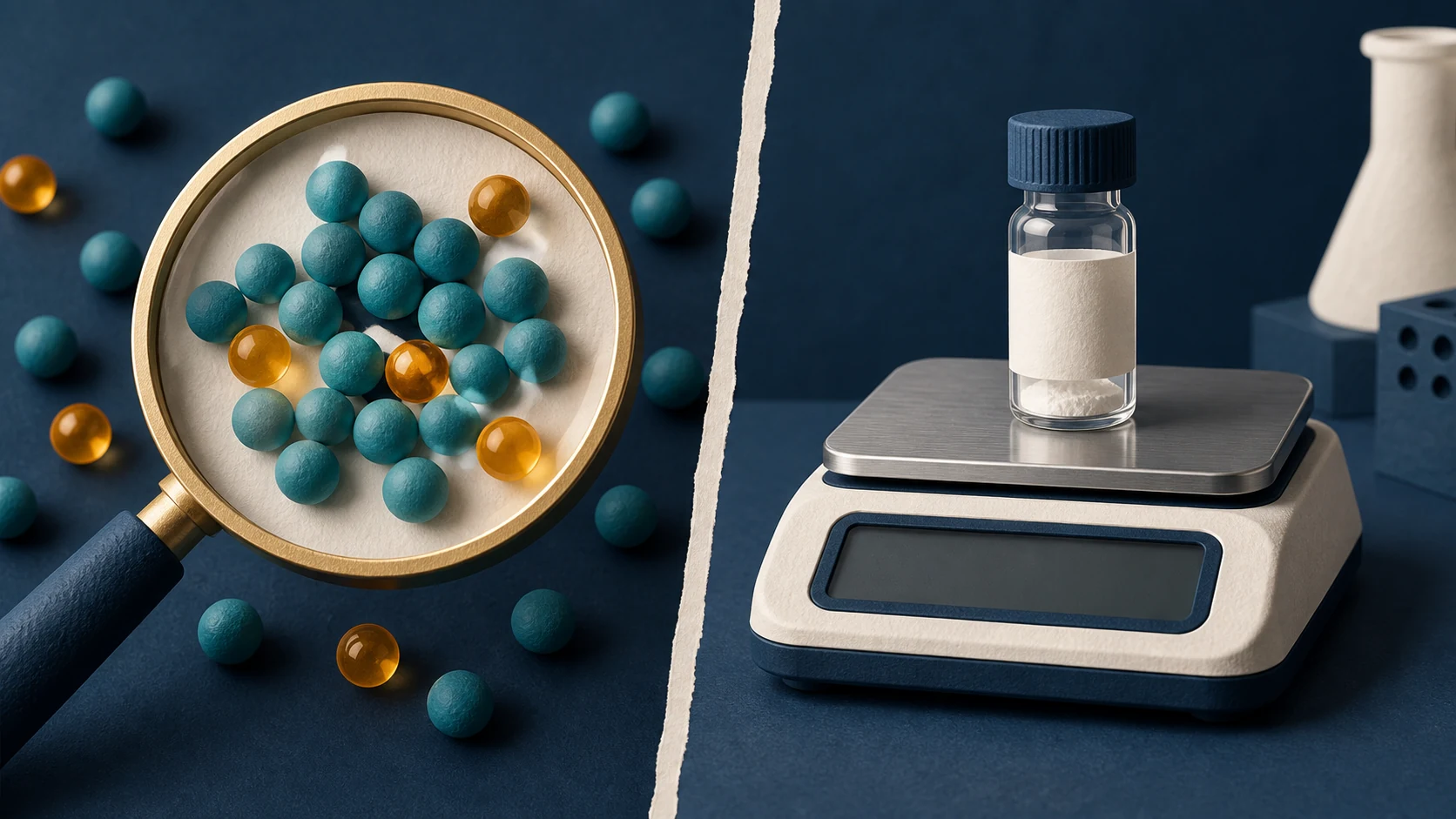
When a supplier says “purity”, ask what follows that word. An HPLC area percentage describes a relative detector response under a specified chromatographic method. A mass percentage uses material mass as its basis. A result in mg per vial describes an amount assigned to a container. They cannot be swapped simply because all three sound like quality numbers. [1, 2]
Here is the distinction to keep beside a quotation:
| Reported item | The question it helps answer | What still needs its own evidence |
|---|---|---|
| Identity result | Does the analytical evidence support the claimed peptide identity? | Quantity in the vial and other quality attributes |
| HPLC area purity, % | How much of the included chromatographic peak area is assigned to the target component? | Target peptide mass in the vial |
| Net peptide content, % by mass | What fraction of the supplied material is peptide, under the issuer’s definition? | Whether peptide-related impurities are included; target amount per vial |
| Quantitative target result, mg/vial | What quantitative result was assigned to the specified target in the tested vial? | Representativeness of the sample and agreement with the order specification |
The distinctions above follow the analytical categories in the technical sources; the purchasing questions are editorial guidance. Report terminology is not completely uniform. [1, 2]
Daniel replaced one spreadsheet column with three: identity, purity, quantity. “Pending” appeared in the last column. It was less satisfying than a row of ticks, but it was accurate.
What “99% by HPLC” is actually telling you
In a typical peptide HPLC purity analysis, components are separated and detected as peaks. For an area-percentage result, the integrated target peak area is commonly divided by the sum of all peak areas included in the calculation—including the target peak—and expressed as a percentage. Bachem’s technical explanation describes reversed-phase HPLC purity in terms of the target peptide and impurities detected through ultraviolet absorption. [1]
The important detail is the basis of the comparison: detected chromatographic response, not a direct weighing of everything inside the vial.
That makes HPLC purity useful. It does not make it a complete inventory. Nor does an attractive peak, by itself, finish an identity investigation: AnaSpec lists HPLC peak-area purity and mass-spectrometric identity as separate QC attributes. [2]
The practical question is therefore more specific than “Was it HPLC tested?” Ask whether the service measured area purity only, or also carried out a quantitative assay with a stated reference and reporting basis. The instrument name alone does not answer that.
Why peptide content can be lower without contradicting high purity
Freeze-dried peptide material can contain counterions and residual moisture alongside its peptide components. Counterions are charged species associated with the peptide’s salt form. They contribute mass; so does water. Bachem’s handling note explicitly distinguishes HPLC purity from the peptide fraction of the solid for that reason. [3]
This is why “the powder weighs 10 mg” and “the vial contains 10 mg of the target peptide” should not be treated as interchangeable statements.
There is another wrinkle. Net peptide content does not always mean target-peptide-only content. AnaSpec’s definition includes peptide-related contaminants in the total peptide component. Before using a value labelled “content” or “assay”, establish exactly what the laboratory counted, and whether the result is stated for the material as received or on a corrected basis. [2]
A smaller content percentage is not automatically evidence of a short-filled order. The contract might specify net target amount, gross material amount or another explicitly defined basis. The result must be compared with the promise actually made.
Conversely, a supplier cannot settle a quantity dispute merely by saying “that is normal salt and water”. The explanation needs to match the supplied material, the stated specification and the analysis. Otherwise, it is still an unanswered question.
The 10 mg and 5 mg example: what you can conclude
Consider a deliberately simplified, hypothetical case. No figures below are measurements of MY PEPTIDE material.
The written order specifies 10 mg of the identified target peptide per vial. A suitable independent quantitative analysis reports 5 mg of that target in the tested vial. A separate HPLC area-purity result is high.
The buyer has a quantity discrepancy to investigate. They do not have a basis for rewriting the purity result as “50% pure”. Five milligrams compared with a ten-milligram specification addresses the supplied amount; it does not recalculate the chromatogram.
Before treating that comparison as conclusive, confirm that the order and report refer to the same target, unit and reporting basis; that the laboratory measured the submitted finished vial; and that method limitations or sample handling do not invalidate the comparison. A confirmed discrepancy in one tested vial also does not, by itself, measure every vial in the shipment.
This distinction changes the supplier conversation. “Your purity is fake” starts an argument about a number that may not be disputed. “The finished-vial quantity result does not meet the written target amount; please review these matching records” identifies the issue that needs an answer.
Why you cannot solve the problem with “label × purity”
Daniel’s next instinct was to reach for a calculator: 10 mg on the quotation multiplied by the purity percentage.
That would have converted an assumption into a more precise-looking assumption. He still did not know what the quoted 10 mg represented, whether the quantity had been independently measured, or what the content calculation included.
Bachem’s own content calculator requires separate inputs for sample mass, purity and assay, using its analytical data-sheet definitions. It is not a way to discover unknown contents from a label and a screenshot. [1]
For procurement, the useful request is: “Please identify the result that measures the target amount per vial, and explain its basis.” Do not silently fill missing fields with 100%, or combine values from different batches to produce a reassuring answer.
What to ask a laboratory when you need mg per vial
Daniel had previously written “please test purity” when requesting a quotation for analysis. This time, he drafted the question around the business decision:
We need to assess the amount of the specified target peptide in submitted finished vials against our written per-vial specification. Please confirm whether your proposed service includes identity, chromatographic purity and quantitative target amount as separate reported results. What material, reference information and number of unopened vials do you require?
That is a request for a scope of work, not instructions for running the test. The laboratory should decide which method is suitable for the actual material.
Quantitative amino acid analysis, quantitative NMR and appropriately designed chromatographic assays can contribute to peptide quantity assignment, but their names are not interchangeable guarantees. In original research on an angiotensin II reference material, Melanson and colleagues had to account for related-peptide interference when combining amino acid analysis and quantitative NMR. The study illustrates why a defensible quantity needs method-specific interpretation; it does not validate an unrelated commercial vial. [4]
A useful follow-up conversation covers four points:
- The measurand: Is the result total peptide, the identified target alone, or another defined quantity? Will it be reported per submitted vial?
- The reference: What is the calibration basis, and how is the reference quantity assigned? An identity spectrum is not a substitute for a quantitative calibration.
- The method’s limits: Are recovery, interference and uncertainty addressed for this material? Ask the laboratory to explain the limitations in language you can use in a purchasing decision.
- The sample: Will vials be examined separately or combined? What will the result allow you to say about the submitted units, and what will remain unknown about the rest of the lot?
These are editorial questions for scoping a test, not a universal laboratory checklist. An instrument manufacturer’s amino-acid-analysis technical note, for example, uses standards and response factors and discusses recovery rather than treating an uncalibrated peak as a quantity. [5]
A bulk-material report is not a finished-vial filling study
A supplier may have useful analytical evidence for a bulk batch. That can still leave a different procurement question unanswered: what amount was placed into each finished vial?
As a concrete illustration of the distinction, NIST’s certificate for its angiotensin I reference material describes separate work on ampoule filling and total peptide amount, using multiple selected ampoules. Those procedures apply to that reference material; they are not a prescribed sampling plan for your order. [6]
For a repeat buyer, the lesson is to ask where the evidence chain stops. Does the submitted sample come from bulk powder, one finished vial, or several individually tested vials? If the laboratory reports an average, do not relabel it as proof that every unit contains that amount.
Agree the sampling plan before sending material. Keep the selection and shipment record, retain the original report, and decide with a qualified reviewer what the result supports. There is no universal “test one vial and clear the whole batch” rule in this article.
What Daniel changed before the next order
The original supplier eventually clarified that the document covered chromatographic purity, not an independent measurement of the finished-vial amount. Daniel kept the document. He removed the quantity tick.
He did not need to decide, from that email alone, whether the supplier was dishonest. He needed to decide whether the available evidence supported the purchase he was about to approve. For that order, quantity remained unresolved.
His next enquiry named the peptide, the requested per-vial specification and the number of kits, then added a separate question about quantity evidence. Packaging and minimum-order terms stayed in the commercial section; the laboratory questions had their own space. Buyers preparing the commercial part can use MY PEPTIDE Wholesale Terms.
He also stopped forwarding an unexplained purity screenshot to his own customers as though it answered every quality question. If a record supported purity only, that was how he described it. If the quantity evidence was missing, he said it was missing.
That made his conversations a little longer. It also made the next action clearer: clarify the specification, obtain an appropriate test, or pause the unresolved purchase. A supplier’s response to those precise questions became more useful to him than another round of reassuring adjectives.
Two questions that often follow
Can I judge the milligrams from the amount of visible powder?
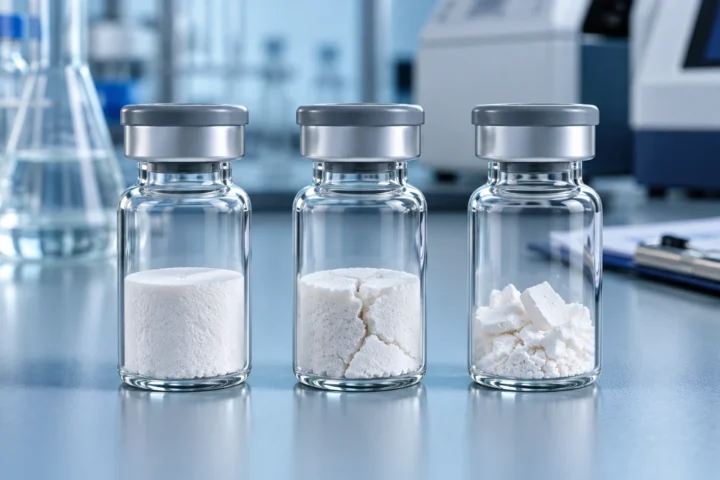
A photograph does not provide the material composition or quantitative measurement needed to assign target-peptide mass. Do not turn cake size into a substitute assay. If the concern is a change in appearance rather than a quantity claim, treat it as a separate enquiry; our guide to cloudy retatrutide, clumps and particles explains how to record that problem without diagnosing a vial from its appearance.
Does a high purity result settle sterility or suitability for human use?
No. A chromatographic area percentage is not those assessments. AnaSpec’s QC list, for example, treats HPLC purity and microbiological attributes as different test categories. This article concerns research-material procurement, not human or veterinary use. [2]
The question worth keeping at the top of an order file is simple: Which result supports which promise? Once identity, purity and quantity have their own answers, “99%” can do its actual job without being asked to do all the others.
References
- Bachem. Peptide Content & Concentration Calculator. Technical resource, 2021; accessed 9 September 2026. Official technical page.
- AnaSpec. Frequently asked questions — Peptides. Sections on gross/net weight, QC testing, peptide content versus purity, and MS; publication date not stated; accessed 9 September 2026. Official technical FAQ.
- Bachem. Care and Handling of Peptides. Technical note, 2021; “Net peptide weight” section. Official technical note.
- Melanson JE, Thibeault M-P, Stocks BB, Leek DM, McRae G, Meija J. Purity assignment for peptide certified reference materials by combining qNMR and LC-MS/MS amino acid analysis results: application to angiotensin II. Analytical and Bioanalytical Chemistry. 2018. DOI: 10.1007/s00216-018-1272-7. NRC author-repository record and abstract. The discussion here is limited to the accessible abstract, not a review of the full experimental methods.
- Hanko V, Rohrer J; Dionex. Determination of the Amino Acid Content of Peptides by AAA-Direct. Technical Note 50, 2001 edition. Technical note hosted by Thermo Fisher Scientific. Authors are identified in the manufacturer’s application record.
- National Institute of Standards and Technology. Certificate of Analysis: Standard Reference Material 998, Angiotensin I (Human). Certificate issued 19 May 2021; original certification 1983. NIST certificate. Used only to illustrate separately documented chemical and ampoule-quantity assessments, not as current MY PEPTIDE evidence.
Review notes — not website body
- Fact: The technical distinctions have named sources; their scope does not extend to MY PEPTIDE batches. MY PEPTIDE quotation inputs are owner-confirmed business facts.
- Fiction: Daniel, the Friday-afternoon quotation review, all dialogue, the two quotations, 99.4% story value and the hypothetical 10 mg/5 mg comparison are invented explanatory material. They are not test results, prevalence estimates or customer evidence.
- Pending: Owner’s bilingual/style approval, appropriate analytical-professional review before treating this as a technical purchasing standard, and separate WordPress cover/body checks. The actual illustration has been inspected; Wholesale and the Retatrutide guide are confirmed live by authenticated REST readback on 9 September 2026. Recheck their public rendering before publication. No COA upload is authorised by this article.
- Product association: Generic quality-interpretation topic; no automatic assignment to every product. A passing mention of Retatrutide does not make this a Retatrutide-specific guide.
Alternative titles:
- Peptide Purity vs Content: The Number Missing from a 99% Result
- HPLC Purity and mg per Vial: Two Different Questions for Peptide Buyers
Alternative CTAs:
- Preparing an enquiry? Send the peptide name, requested per-vial specification and kit quantity, and state the analytical question you need answered.
- Review MY PEPTIDE Wholesale Terms, then keep your requested quantity and documentation questions separate in the enquiry.
This article is provided for supplier evaluation, research education, and business communication. It is not medical advice and does not provide dosage or treatment instructions.
Need supplier information for your business?
Discuss product availability, documentation, wholesale requirements, and shipping communication with our team.