Glutathione changed from clear to yellow or smells different? Learn what sensory changes cannot prove and which lot records and tests a B2B case needs.
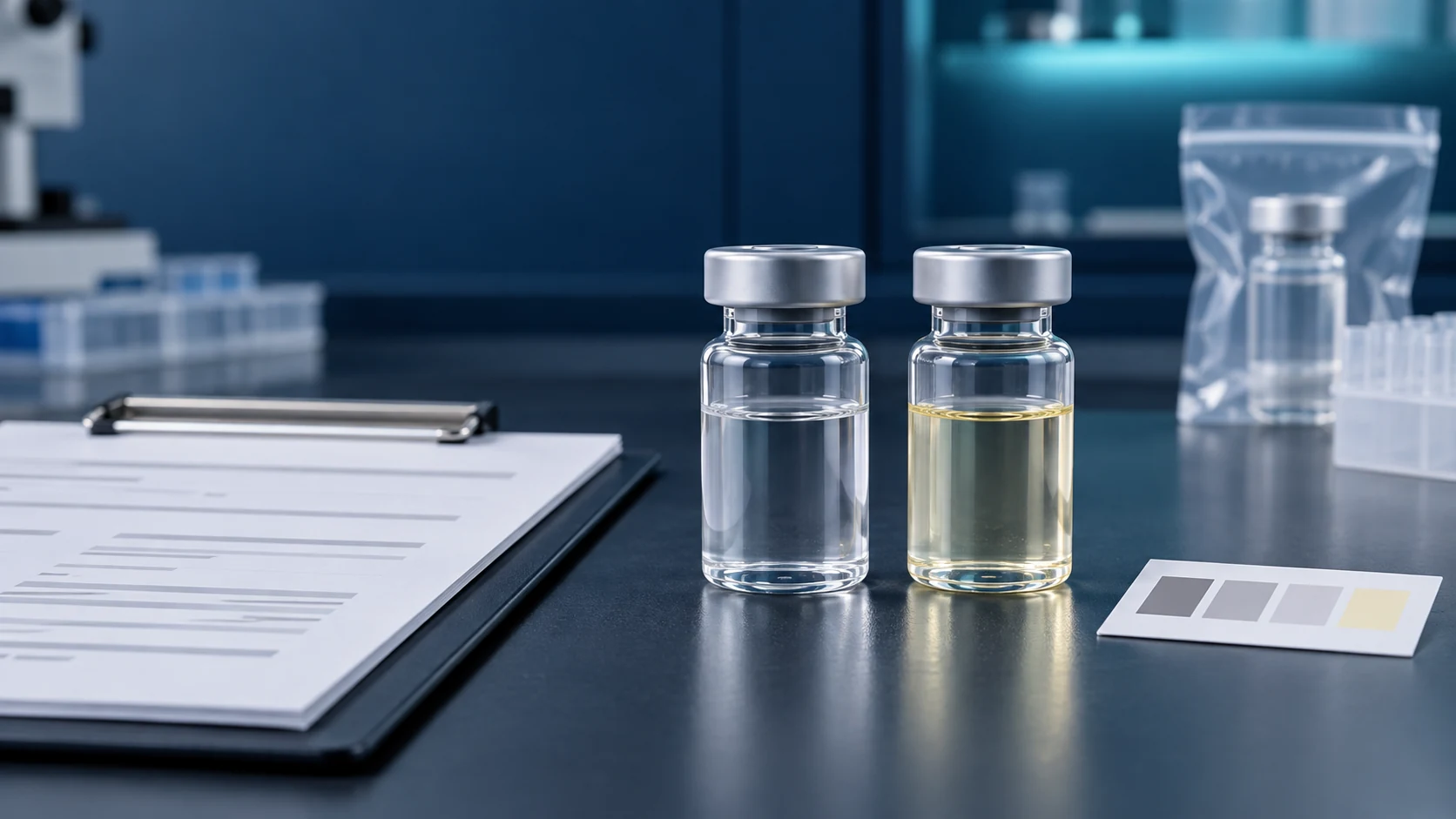
A seller opens a quality ticket after receiving two photographs of the same glutathione vial. In the first, the liquid looks clear. In the second, taken weeks later under a kitchen light, it looks pale yellow. The buyer also writes that it now has a “burnt smell,” although no one recorded the odour when the vial was first opened.
There is a real change to investigate, but the evidence is thinner than it first appears. The photographs were taken with different cameras, backgrounds and lighting. The original odour has no baseline. The lot number is cropped out. Nobody has yet measured reduced glutathione, oxidised glutathione or any other component.
A colour or odour change can justify holding a glutathione lot and opening an investigation. It cannot, by itself, prove oxidation, contamination, identity, content, purity or suitability for any use. Yellow does not automatically mean degraded, and a sulfur-like or burnt description is not an authenticity test.
For a research peptide seller, distributor or group-order organiser, the useful response is to preserve the evidence, reconstruct the timeline, match it to the exact lot and define what a laboratory would need to measure. This article covers that B2B process. It does not provide reconstitution, dosing, injection, administration or do-it-yourself correction instructions.
The question is not just “What colour is it?”
Colour is highly sensitive to the conditions under which it is observed. A pale tint may disappear against a warm background and become obvious against white. Phone cameras alter white balance, exposure and contrast. Reflections from glass and the liquid meniscus can make one area look darker. Even two honest photographs can therefore exaggerate or hide a difference.
A useful record separates several observations:
- Was the dry material white, off-white, pale yellow or uneven before any laboratory preparation?
- Was the liquid colourless at first and visibly different later?
- Is the change uniform throughout the liquid, or limited to a layer, deposit or material on the glass?
- Are there separate particles, flakes, haze or sediment in addition to the colour?
- Does the appearance change when the same vial is photographed against a white and a neutral-grey reference under the same light?
“It turned yellow” is a reasonable opening statement. It is not a complete case file. The investigation needs the before, the after and the conditions that connect them.
What glutathione chemistry supports—and what it does not
Glutathione is a thiol-containing tripeptide. The reduced form is commonly abbreviated GSH, and oxidation can convert it to glutathione disulfide, GSSG.[1] That chemistry is well established.
It is also routinely overextended online. Once a buyer mentions yellowing, replies often jump directly to “oxidised glutathione.” The chemical pathway may be plausible, but plausibility is not a result from that vial.
A controlled forced-degradation study exposed glutathione-containing nutraceutical formulations to defined oxidative stress and monitored GSH loss and GSSG formation using analytical methods, including HPLC. GSSG was a major product under those experimental conditions, while the authors also reported that the degradation pathway was more complex than one product alone.[2]
That study supports two practical points:
- GSH and GSSG can be measured rather than inferred by eye.
- Even in a designed oxidation experiment, the chemistry should not be reduced to a single visual shortcut.
It does not show that every yellow research vial has oxidised, that GSSG must be responsible for the colour, or that a photograph can quantify the remaining GSH. The tested matrices and forced conditions were defined nutraceutical systems, not MY PEPTIDE vials or the community sample described above.
Yellow is an observation, not a degradation assay
A strong quality record can say, “The same labelled vial appeared colourless on day one and pale yellow under matched lighting on day twenty.” It cannot say, “The vial lost a specific percentage of GSH,” unless an appropriate quantitative test produced that result.
The colour could be associated with the target material, a related substance, another formulation component, the container or closure, a contaminant, or the interaction of several variables. The record may also be distorted by photography. Those are investigation categories, not proposed diagnoses.
This is why a seller should reject both extremes:
- “Yellow always means bad glutathione.” The appearance alone does not establish identity, composition or cause.
- “A slight yellow colour is always normal.” A repeated slogan does not define the specification for the shipped lot.
The relevant comparison is the supplier’s written specification and the actual lot history. If colour is a release attribute, the expected range, observation method and acceptance language should be defined. If it is not specified, the supplier still needs a documented way to investigate a reported change instead of improvising a rule in chat.
Odour is even weaker evidence
Odour reports are difficult to compare. “Sulfur-like,” “burnt,” “chemical” and “strong” are subjective descriptions, not analytical identities. People differ in sensitivity and vocabulary. Packaging, headspace, a stopper, another formulation component or the surroundings can influence what is perceived. Without an initial record, a buyer cannot establish that the odour actually changed.
Glutathione contains a cysteine-derived thiol group.[1] That structural fact does not prove that any particular smell confirms genuine glutathione. It also does not turn a “burnt” description into evidence of one degradation pathway.
Quality staff should not deliberately sniff an unknown or questioned research material to create a test result. If an odour was noticed during ordinary handling, record the wording, time, container state and whether the observation occurred before or after opening. Then stop treating the nose as an instrument. A laboratory question should be based on composition, volatile analysis when genuinely relevant, and the product specification—not on a salesperson’s claim that “real glutathione smells like this.”
Start with a matched image record
A before-and-after comparison is most useful when the images are actually comparable. Ask for:
- The same vial and lot in both images. Show the label separately without exposing unnecessary personal information.
- A white and a neutral-grey background. A simple colour reference card can help show whether the camera shifted the scene.
- The same light source and camera settings where possible. Avoid coloured room lighting and beauty filters.
- A wider frame and a close view. The wider image documents the setup; the close image documents the material.
- A timestamp and sequence. Record when the vial was received, first inspected and later photographed.
- Separate notes for colour, clarity and visible material. Do not use “yellow” to hide haze or particles.
Images are still not chemistry. Their purpose is to establish that an observable difference may exist and to help the supplier select the correct retain sample and lot documents.
Build the lot file before discussing causes
An investigation becomes useful when another person can reconstruct it without reading a long chat history. The case file should include:
- exact product name and stated amount per vial;
- order, kit and lot identifiers;
- number of kits and vials inspected, affected and unopened;
- appearance of the dry material before preparation;
- first-observed appearance and later change, with dates;
- any odour noticed during ordinary handling, with the absence of a baseline clearly stated where applicable;
- preparation record: liquid identity and source, recorded amount, equipment and steps already used;
- storage and transport records, including known delays or excursions;
- photographs and video under consistent conditions;
- the report or COA supplied for the lot, including its report number and verification route;
- supplier retain-sample status and other same-lot complaints;
- whether downstream distribution has been paused.
This is evidence preservation, not a request to repeat or change the procedure. Manipulating the questioned vial to make the colour lighter or the smell less noticeable could remove information and still would not prove identity, content or microbiological quality.
Match each concern to a measurement
“Send it to a laboratory” is only helpful after the commercial question is translated into an analytical one.
Is the claimed material present?
This is an identity question. The laboratory should state the method, reference material and decision rule appropriate to the submitted sample.
How much reduced glutathione remains?
This is a quantitative GSH or assay question. The method must distinguish the quantity being reported from a chromatographic purity percentage.
Has oxidised glutathione increased?
This is a GSSG measurement question, not a colour judgement. Reviews of GSH/GSSG analysis discuss separation and detection choices and emphasise sample pretreatment because glutathione can change during handling and analysis.[3] A test plan should therefore address sample preservation and method suitability, not just the name of an instrument.
Are there other related substances or contaminants?
That requires a method with an appropriate scope and detection capability. A test designed only for GSH and GSSG does not automatically identify every unknown peak or contaminant.
Is visible material present?
Particles, haze and sediment are separate from colour and odour. They may require visual, particulate or material-characterisation work that a basic purity report does not answer.
Is there a microbiological concern?
Sterility, bioburden and endotoxin are different claims with different sampling and methods. A yellow colour, a clear appearance or a high purity percentage cannot substitute for them.
The MY PEPTIDE guide to reading a peptide COA explains why the product, lot, method, result and laboratory identity need to be read together. A report may support part of a case, but it should never be presented as a complete explanation for an appearance or odour change unless its methods actually investigated that question.
What a credible supplier response looks like
A useful supplier does more than send an old report and reply “normal.” Its response should show a repeatable complaint workflow:
- Acknowledge the case and assign an identifier.
- Confirm product, specification, lot and affected quantity.
- Request a matched chronology and images.
- Hold relevant inventory when the evidence warrants it.
- Review release records, retain samples and same-lot complaints.
- State which facts are confirmed and which explanations remain hypotheses.
- Agree on any third-party test question, sample and chain of custody.
- Record the commercial outcome under the agreed replacement or credit terms.
For repeat orders, compare the event with other lots rather than treating it as an isolated screenshot. The peptide batch consistency guide explains how release results, deviations, complaints and changes across lots provide a stronger purchasing picture than one attractive COA.
A copyable supplier enquiry
Product: Glutathione
Stated amount per vial: [specification]
Order / kit / lot: [identifiers]
Vials inspected and affected: [counts]
Dry-state appearance: [observation]
Initial liquid appearance: [observation and time]
Later appearance: [observation and time]
Odour noticed during ordinary handling: [exact words / not recorded]
Photography conditions: [light, background, camera]
Storage and transport record: [known facts]
Unopened same-lot units available: [yes/no]
Attached lot document: [report number and verification route]
Requested action: [document review / investigation / testing discussion / commercial resolution]
This format does not declare the lot defective. It gives the supplier enough information to distinguish a photography issue, a single-vial complaint and a possible same-lot change that needs escalation.
Questions to ask before a wholesale glutathione order
Before adding glutathione to a research catalogue or group order, ask:
- Which exact per-vial specification is being quoted?
- Which lot will ship, and which report belongs to it?
- Does the supplier define the expected dry and prepared appearance for that product?
- How should a colour-change complaint be photographed and reported?
- Are unopened retain samples held for the lot?
- Which tests can distinguish identity, GSH content, GSSG and related substances?
- What evidence is required before replacement or credit is considered?
- How are storage and transport records communicated?
Check current options on the MY PEPTIDE Glutathione product page. The wholesale information page explains the ordering rule: one kit contains ten vials of the same product. A single order may include complete kits of different products, but one kit cannot be split into five vials of product A and five of product B.
The practical rule: sensory change opens the case; analysis answers it
A yellow tint or unusual odour is worth recording because it may reveal that something changed. It is not a shortcut to the cause. The defensible B2B sequence is to preserve the material, reproduce the observation under controlled viewing conditions, link it to the exact lot, review the supplier’s specification and then select measurements that address the actual question.
That approach prevents two costly mistakes: dismissing a meaningful complaint as “normal,” and rejecting or redistributing a lot based only on a photo or smell. It also gives a supplier a fair chance to produce evidence instead of marketing reassurance.
For a Glutathione wholesale enquiry, email service@wholesalepeptide.xyz with the per-vial specification, required number of complete kits and destination. For a quality concern, include the lot identifier and the structured observation record above.
References
- European Bioinformatics Institute. ChEBI:16856 — glutathione. Defines glutathione as a thiol-containing tripeptide and provides its chemical identity. https://www.ebi.ac.uk/chebi/searchId.do?chebiId=CHEBI%3A16856
- Tsiasioti A, Zacharis CK, Zotou A-S, Tzanavaras PD. Study of the oxidative forced degradation of glutathione in its nutraceutical formulations using zone fluidics and green liquid chromatography. Separations. 2020;7(1):16. https://doi.org/10.3390/separations7010016
- Monostori P, Wittmann G, Karg E, Túri S. Determination of glutathione and glutathione disulfide in biological samples: an in-depth review. Journal of Chromatography B. 2009;877(28):3331–3346. https://doi.org/10.1016/j.jchromb.2009.06.016
Community observation source
The following public post was used only to establish that buyers describe a clear glutathione liquid later becoming yellow and may call its odour “burnt.” The sample identity, cause and condition were not verified; replies are not treated as technical evidence.
- Reddit, r/Peptides. “bad glutathione?” Posted 14 July 2023; accessed 12 September 2026. https://www.reddit.com/r/Peptides/comments/14zrww1/bad_glutathione/
MY PEPTIDE supplies products for laboratory research use only. This article does not provide medical, dosing, injection, administration or safety-use advice.
This article is provided for supplier evaluation, research education, and business communication. It is not medical advice and does not provide dosage or treatment instructions.
Need supplier information for your business?
Discuss product availability, documentation, wholesale requirements, and shipping communication with our team.