Buying CJC-1295 wholesale? Learn why “with DAC,” “without DAC” and “CJC-1295” alone can describe different materials—and what to put in an RFQ.
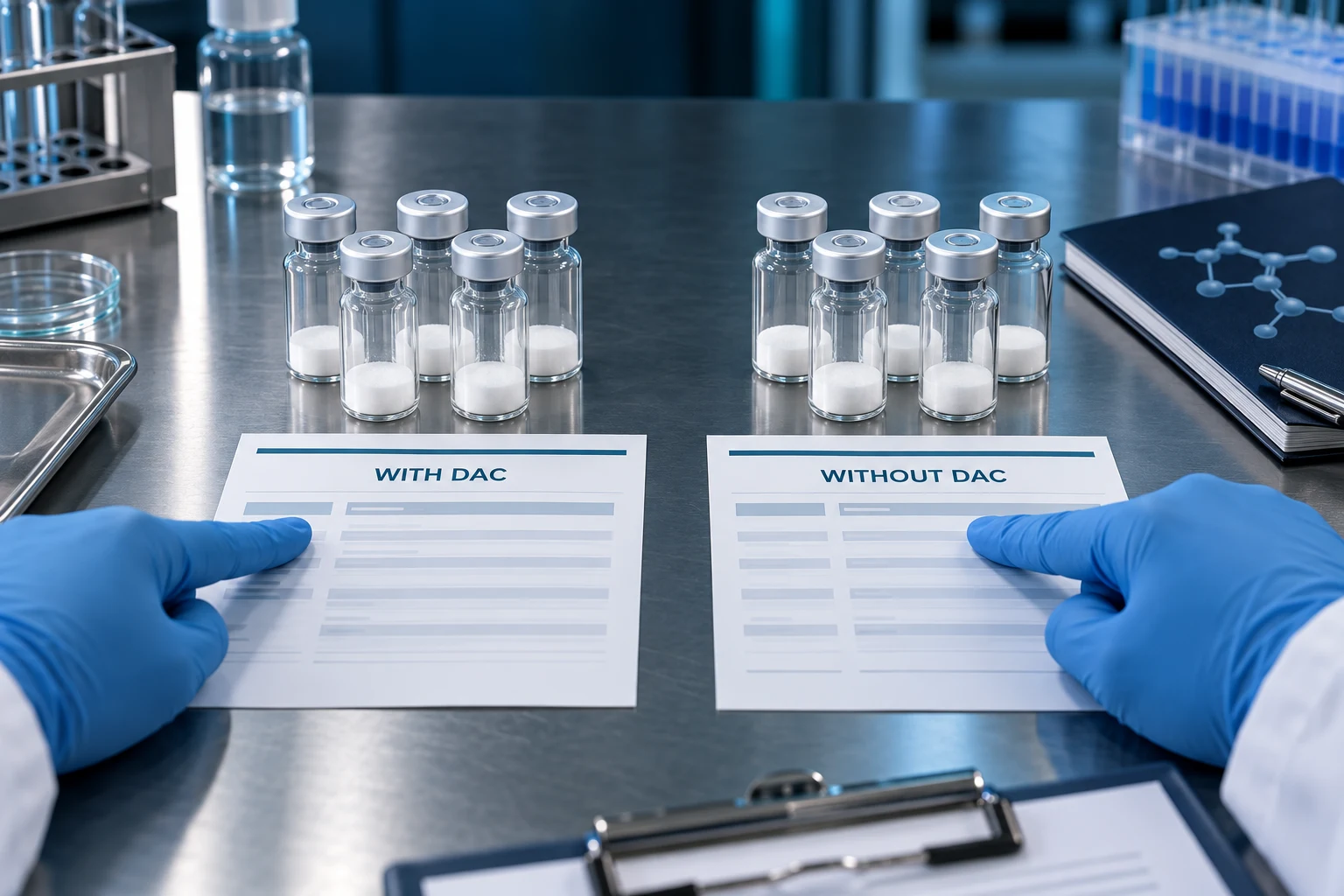
A buyer sends an enquiry for “CJC-1295.” The supplier replies with a price, the buyer compares it with two other quotes, and everything appears straightforward—until one quotation says with DAC, another says without DAC, and the third repeats only CJC-1295. All three might show the same nominal vial content. Their product photos may be almost indistinguishable. Yet the names do not necessarily point to the same research material.
That is the practical problem behind searches for CJC-1295 with DAC vs without DAC. It is not merely a question about which label sounds better. It is an identity and specification problem. A wholesale buyer cannot compare prices, documentation or later test results until every supplier is quoting the same intended compound.
The short answer
In the original scientific literature, CJC-1295 is the long-acting hGRF(1-29) analogue carrying an albumin-binding Drug Affinity Complex. The paper that identified CJC-1295 describes a tetrasubstituted hGRF(1-29) core with an added maleimide-bearing lysine derivative at the C-terminus.[1] A later human pharmacokinetic study also investigated CJC-1295 as a long-acting GHRH analogue.[2]
The research-peptide market often uses “CJC-1295 without DAC” for a related 29-residue modified GRF material without that albumin-binding addition. It may also be called Modified GRF(1-29) or Mod GRF 1-29. Because commercial naming is not always used consistently, the phrase on a price list should be treated as the start of a specification—not the end of one.
A defensible RFQ should therefore state whether DAC is present, request the exact sequence or structural description, record the expected molecular mass, specify nominal content per vial and ask which analytical result supports identity. “CJC-1295, 5 mg” alone is not enough for a clean comparison.
Why one familiar name creates two purchase orders
The naming problem comes from the relationship between the two materials. The original CJC-1295 construct contains the modified hGRF(1-29) peptide plus a reactive group designed to form a conjugate with serum albumin. Jetté and colleagues described that design and observed albumin-associated immunoreactivity in their rat experiments.[1] PubChem’s CJC-1295 record likewise describes a maleimido derivative of hGRF(1-29) and lists the DAC-bearing molecular formula and molecular weight.[3]
Remove the albumin-binding addition and the requested molecule is no longer structurally identical. That difference changes the expected mass and is central to the original long-acting design. It also means a document for one form should not be presented as evidence for the other.
None of this allows a buyer to identify the contents by looking at a vial. White lyophilised material labelled “with DAC” and “without DAC” can look alike. Appearance does not establish sequence, molecular mass, content or purity.
A practical comparison for procurement teams
| Procurement field | CJC-1295 with DAC | Product commonly sold as CJC-1295 without DAC |
|---|---|---|
| Name to place on RFQ | CJC-1295 with DAC | CJC-1295 without DAC, with intended identity clarified |
| Structural distinction | Modified hGRF(1-29) construct with the albumin-binding DAC addition described in the original CJC-1295 literature | Market term commonly used for the related modified GRF(1-29) material without that addition |
| Naming risk | A list may say only “CJC-1295,” leaving the form unstated | “No DAC,” “without DAC” and “Mod GRF(1-29)” may be used as if automatically interchangeable |
| What the buyer should request | Exact sequence/structural description, expected molecular mass and identity method | Exact sequence/structural description, expected molecular mass and identity method |
| What not to rely on | Product photo, vial label or purity percentage alone | Product photo, vial label or purity percentage alone |
This table is deliberately about purchasing records, not about selecting a form for a human protocol. The buyer’s task is to make the requested identity unambiguous and to compare like with like.
The five fields that should appear before you compare prices
1. The complete product name
Write with DAC or without DAC in the enquiry subject, quotation and purchase record. If the supplier uses another synonym, preserve both expressions in writing. For example: “CJC-1295 without DAC—supplier also identifies this as Modified GRF(1-29).” That creates a record of what the supplier meant rather than forcing a later analyst to infer it.
MY PEPTIDE maintains separate catalogue entries for CJC-1295 with DAC and CJC-1295 without DAC. Their separation is useful, but the buyer should still ask for the current specification and available documentation for the quoted material.
2. The sequence or structural description
A name can be abbreviated; a sequence or sufficiently precise structural description is harder to misunderstand. For the DAC form, the documentation should account for the C-terminal albumin-binding addition described for CJC-1295. For a no-DAC quotation, the supplier should define what its “without DAC” name represents rather than simply deleting three letters from the product title.
This is particularly important when a broker, reseller and laboratory use different naming conventions. The purchase order, sample submission and test report should all refer to the same expected identity.
3. Expected molecular mass
The two requested structures should not have the same expected molecular mass. Ask the supplier to state the value used for identity matching and whether it is reported for the neutral molecule, a salt or another defined form. The purpose is not to reward whichever quotation contains the most decimals. It is to detect whether the product name, structure and analytical target agree.
PubChem currently lists CJC-1295—the DAC-bearing maleimido derivative—with a molecular weight of 3647.2 g/mol.[3] That database value can orient a documentation review, but it does not authenticate a supplied vial and should not be copied into a COA as though it were a measured result.
4. Nominal content per vial and quotation unit
Record content per vial separately from purity. A statement such as “5 mg, 99%” contains two different claims: how much target material is represented in the vial and how the reported chromatographic purity was calculated. One percentage does not answer both questions.
For MY PEPTIDE, quotations are based on product name, requested per-vial specification and whole-kit quantity. Under the current MY PEPTIDE wholesale rules, one kit contains ten vials of the same product. A buyer may order one complete kit of product A and one complete kit of product B in the same order, but cannot construct one kit from five vials of each.
5. The identity method and its acceptance criteria
Ask what measurement is intended to support identity. A chromatographic purity trace can show the relative area of detected peaks under the stated method, but a clean-looking main peak does not by itself prove that the main peak is the requested DAC or no-DAC compound. An intact-mass result, when the method is suitable and the expected mass is correctly defined, addresses a different question.
The report should connect the method, observed result, acceptance criterion, sample or batch identifier and requested structure. Our guide to reading a peptide COA explains why a document title and a purity percentage are not a complete evidence chain.
What changes when the product is a blend
The naming problem becomes more serious when CJC-1295 appears in a blend. A quotation for “CJC-1295 + Ipamorelin” should not leave the buyer guessing whether the CJC component includes DAC, what the two nominal component contents are or whether the available testing distinguishes them.
Do not infer the formulation from a forum convention or from another seller’s product page. Ask the supplier to write the identity of each component and the nominal content allocated to each one. MY PEPTIDE’s CJC-1295 + Ipamorelin catalogue page is a separate enquiry entry; current composition and documentation questions should be confirmed in the quotation conversation.
A total number on the front of a blend vial can also be ambiguous. “10 mg blend” might mean a stated total across components, while another quotation may present each component separately. Without a component-level breakdown, the two prices cannot be compared responsibly.
What a useful supplier reply looks like
A useful reply does more than say “yes, available.” It closes the identity gaps in a form that can travel through the rest of the procurement process. The response should let the buyer copy the same material definition into the quote comparison, purchase record, incoming log and laboratory submission.
At minimum, look for:
- the exact quoted form: with DAC or without DAC;
- the supplier’s synonym, sequence or structural identifier;
- expected molecular mass and any relevant defined form;
- nominal content per vial and vials per kit;
- whole-kit quantity and lead-time basis;
- batch or lot documentation available before or with supply;
- analytical methods and what each result is intended to establish;
- a process for reporting a mismatch between order, label, documents and independent results.
Long documents are not automatically better. Consistency across the name, structure, mass, batch identifier and result is more useful than several pages of generic specification language.
Red flags that are specific to this comparison
Some warning signs can be found before any payment or laboratory submission:
- The seller insists that “CJC-1295” always means both forms and refuses to specify which one is quoted.
- The with-DAC and without-DAC lines use identical structural information without explanation.
- A COA is sent for “CJC-1295” but the quotation is for “without DAC,” with no sequence, mass or batch connection.
- The supplier treats HPLC purity as proof of identity, exact vial content and every other quality attribute.
- A blend quotation gives only a total weight and will not identify the CJC component.
- The label, invoice, batch file and laboratory submission use different names.
- A price changes dramatically when the wording is clarified, but the supplier cannot explain whether the original quote covered another material or specification.
One red flag does not by itself establish fraud. It tells the buyer which ambiguity must be resolved before the order advances.
A copyable RFQ paragraph
The following language keeps the request commercial and analytical:
Please quote the requested CJC-1295 form as a whole-kit quantity. State explicitly whether the material is with DAC or without DAC; provide the exact sequence or structural description, expected molecular mass, nominal content per vial, vials per kit, available batch documentation and the method used to support identity. If you use “Modified GRF(1-29)” as a synonym, please confirm that relationship in writing. For any blend, list each component and its nominal content separately.
Then add the required number of whole kits, shipping destination and documentation timing. There is no need to turn the first message into a scientific essay. The aim is to remove the fields that would otherwise cause two suppliers to quote different things under a similar name.
How to compare the returned quotations
Build the comparison sheet from identity outward, not price inward. First group quotations that define the same form. Next check sequence or structure, expected mass, content per vial, kit configuration, documentation and delivery basis. Only then compare price.
If one supplier has not answered an identity field, mark it unconfirmed. Do not fill the blank from another vendor’s catalogue or from a community post. A blank is useful information: it shows exactly what must be clarified.
For repeat orders, keep the initial approved definition alongside later batch records. Our article on peptide batch consistency explains why a result tied to one submitted sample should not be silently stretched across future lots.
Frequently asked procurement questions
Is CJC-1295 without DAC simply the same product with a shorter name?
No. In market usage, “without DAC” commonly points to a related modified GRF(1-29) material that lacks the albumin-binding addition present in the original CJC-1295 construct. Because names are used inconsistently, confirm the actual sequence or structure and expected mass.
Can HPLC purity distinguish with DAC from without DAC?
Not by the percentage alone. A purity result reports within the scope of its method and data processing. Identity requires an appropriate identity measurement and a correct expected target. Ask what each method establishes.
Can the two versions be distinguished from a product photograph?
No. Similar vial appearance cannot establish sequence, structural modification, molecular mass, content or purity.
Should “CJC-1295” without a qualifier be accepted on a quotation?
It should be clarified before price comparison or ordering. In the original literature, CJC-1295 refers to the DAC-bearing construct, while commercial lists may use the name more loosely.
What should a buyer ask about a CJC-1295 + Ipamorelin blend?
Ask which CJC form is present, the identity and nominal content of each component, the total presentation, and which methods support identity and composition. Do not infer the answer from the blend name alone.
The buying decision starts with identity
“With DAC” and “without DAC” are not decorative suffixes. They change the material the buyer is asking a supplier to quote and the analytical target a laboratory expects to examine. When those words disappear from an enquiry, price list or COA, the rest of the evidence can become difficult to interpret.
The practical fix is simple: preserve the complete name, require a structural identifier and expected mass, separate content from purity, and carry the same identity through quotation, order, batch records and testing. Buyers can then discuss current availability and documentation with the MY PEPTIDE team at service@wholesalepeptide.xyz without asking three suppliers to price three different meanings of “CJC-1295.”
References
- Jetté L, Léger R, Thibaudeau K, et al. Human growth hormone-releasing factor (hGRF)1-29-albumin bioconjugates activate the GRF receptor on the anterior pituitary in rats: identification of CJC-1295 as a long-lasting GRF analog. Endocrinology. 2005;146(7):3052–3058. doi:10.1210/en.2004-1286.
- Teichman SL, Neale A, Lawrence B, et al. Prolonged stimulation of growth hormone (GH) and insulin-like growth factor I secretion by CJC-1295, a long-acting analog of GH-releasing hormone, in healthy adults. Journal of Clinical Endocrinology & Metabolism. 2006;91(3):799–805. doi:10.1210/jc.2005-1536.
- National Center for Biotechnology Information. PubChem Compound Summary for CID 91971820, CJC-1295. Accessed 13 September 2026. PubChem record.
Community question used for language discovery
- Reddit, r/Peptidesource. “CJC-1925” discussion asking how CJC-1295 no DAC, Mod GRF(1-29) and an unqualified no-DAC listing differ. The post is used only to document buyer confusion; it does not verify identity, safety or product quality. View discussion.
This article is provided for supplier evaluation, research education, and business communication. It is not medical advice and does not provide dosage or treatment instructions.
Need supplier information for your business?
Discuss product availability, documentation, wholesale requirements, and shipping communication with our team.