A BPC-157 + TB-500 blend marked 10 mg may be unclear. Learn how to confirm each component, total content, identity testing and wholesale kit terms.
A buyer asks three suppliers for a BPC-157 + TB-500 blend. One price list says 10 mg blend. Another says 5 mg / 5 mg. A third says 10 mg + 10 mg. If the buyer sorts the spreadsheet by price before resolving those labels, the cheapest line may simply contain a different stated quantity.
This is why the search BPC-157 TB-500 blend 10mg hides a procurement problem. “10 mg” could be presented as the total nominal peptide content, or a seller may use it as shorthand around a component amount. A slash, plus sign and total are not interchangeable. The only reliable comparison is one that records the stated amount of each component and then calculates the stated total.
The short answer
A listing that says only “BPC-157 + TB-500 blend, 10 mg” is incomplete for a wholesale quotation. The buyer should ask whether it means:
- 5 mg BPC-157 plus 5 mg TB-500, giving 10 mg total;
- 10 mg BPC-157 plus 10 mg TB-500, giving 20 mg total; or
- another ratio that the supplier has not yet stated.
The same clarification must appear on the quotation, product specification, batch record and laboratory request. A COA showing a single purity percentage or the name “BPC/TB blend” does not by itself establish the amount of each component.
There is a second identity question: the supplier should define what its TB-500 name represents. A published analytical study identified an N-terminal acetylated fragment of thymosin beta-4 in a product described as TB-500.[1] That finding does not prove that every current TB-500 product contains that fragment, but it shows why a commercial name alone should not substitute for a sequence or molecular target.
Why blend arithmetic gets lost on price lists
Single-product listings usually give one product name and one nominal content per vial. A blend adds at least three quantities:
- the nominal amount of component A;
- the nominal amount of component B;
- the nominal total across both components.
If a seller publishes only the third number, a buyer cannot recover the first two without assuming the ratio. If the seller publishes “10/10,” the buyer still needs to know that the notation means 10 mg of each component rather than 10 mg total divided in an unspecified way.
The problem becomes larger in wholesale orders because a small per-vial misunderstanding is repeated across every vial and every kit. It also passes into label artwork, customer listings, inventory systems and laboratory submissions. Correcting the spreadsheet after goods arrive is much harder than correcting the RFQ before a quotation is accepted.
Four labels that may look similar but are not equivalent
| Listing text | What it may intend to say | What is still needed |
|---|---|---|
| BPC-157 + TB-500 10 mg | Possibly 10 mg combined | Exact BPC-157 amount, exact TB-500 amount and stated total |
| BPC-157 / TB-500 5/5 mg | Commonly read as 5 mg of each | Written confirmation that the slash values are per component and total is 10 mg |
| BPC-157 + TB-500 10/10 mg | Commonly read as 10 mg of each | Written confirmation and total of 20 mg |
| BPC/TB blend, 20 mg | Possibly 20 mg combined | Component identities, ratio and amount of each component |
These are reading possibilities, not universal labelling rules. Different sellers can use the same shorthand differently. The buyer’s job is to turn shorthand into three explicit fields before comparing quotations.
Start by defining both components
BPC-157 should have a sequence-level identity
PubChem lists BPC-157 as a 15-amino-acid peptide with the sequence GEPPPGKPADDAGLV and a computed molecular weight of 1419.5 g/mol.[2] That database record gives a useful reference identity. It does not prove what is in a supplied vial, and it does not establish the amount in a blend.
For procurement, ask the supplier to state the sequence or another sufficiently precise identifier used for its BPC-157 component. If the quote includes a salt or another defined form, that should be recorded because the reference mass and content calculation need a consistent basis.
“TB-500” needs more than a familiar product name
The term TB-500 has not always pointed to one clearly documented molecular target in the market. Esposito and colleagues analysed a product suspected of being used as a doping agent and reported identifying the acetylated thymosin beta-4 17–23 fragment, Ac-LKKTETQ.[1] Their paper concerns the product they examined; it is not a universal certificate for other suppliers or present-day stock.
That limitation is exactly why a buyer should request the expected sequence, molecular mass and identity method for the quoted TB-500 component. Writing “thymosin beta-4” beside “TB-500” without an exact target can create a second layer of ambiguity inside an already ambiguous blend label.
The three-line specification that prevents most confusion
Every quotation should contain a small block like this:
| Field | Supplier response |
|---|---|
| BPC-157 nominal content per vial | ___ mg |
| TB-500 nominal content per vial | ___ mg |
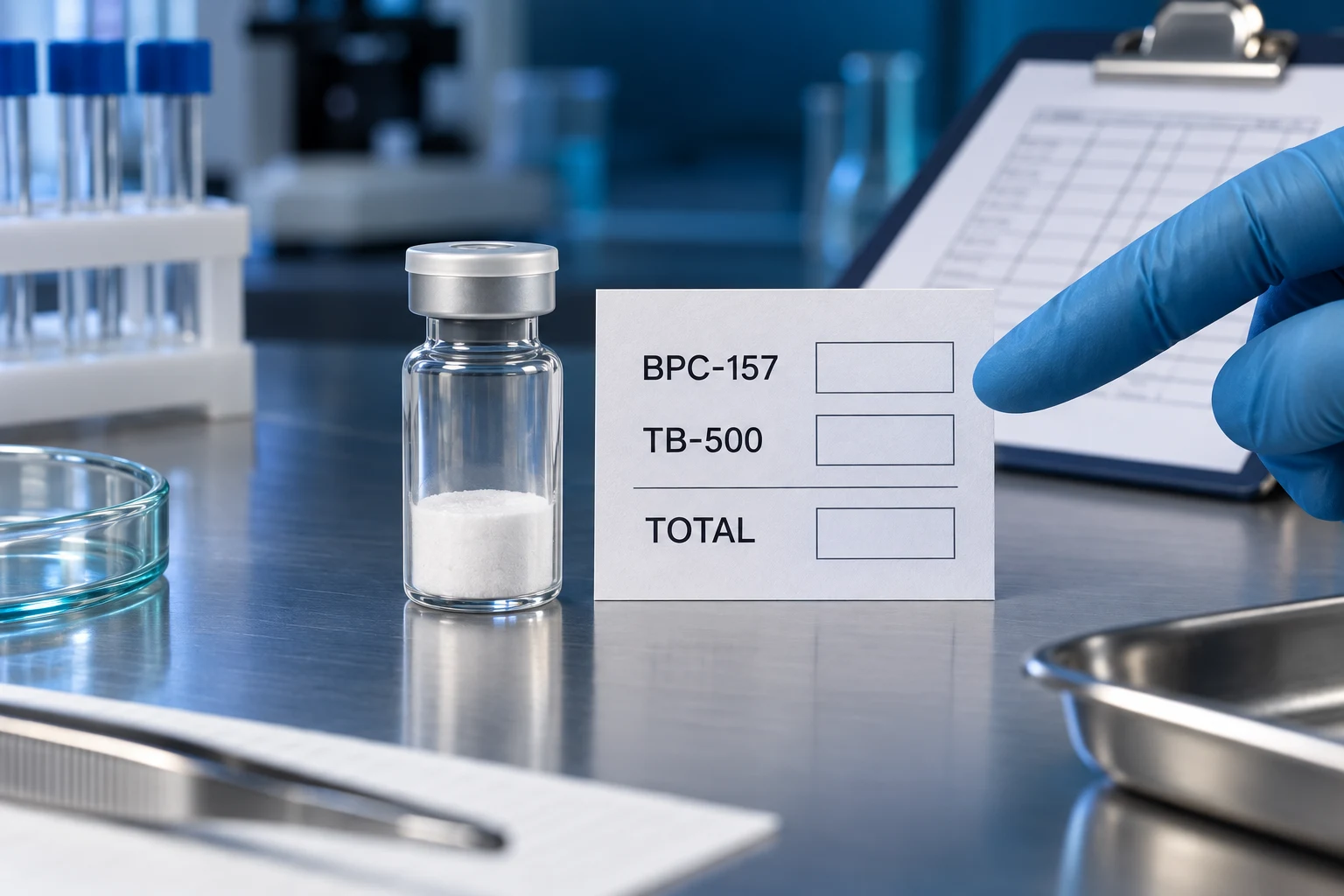
| Total nominal peptide content per vial | ___ mg |
Then require the arithmetic to reconcile. If the first two rows are 5 mg and 5 mg, the total row should say 10 mg. If the first two rows are 10 mg and 10 mg, the total should say 20 mg. If the ratio is unequal, the two component rows should still add to the stated total.
This is a label and purchasing calculation, not a statement about measured fill. Nominal content is what the order claims. A suitable quantitative test is what can support how much of each target was found in the submitted sample.
Purity, identity and content are three different questions
Blend documents often become misleading when one HPLC purity percentage is placed beside a total milligram claim. The two numbers answer different questions, and a two-component blend adds another identity problem.
- Identity: Are both intended molecular targets present?
- Purity: Under the stated method, what does the chromatographic profile show for each target and its related detected material?
- Content or assay: How much of each target is reported in the submitted vial or sample?
ICH Q2(R2) describes validation characteristics for analytical procedures used for identity, assay, purity and other measurements, including specificity/selectivity, accuracy, precision and range.[3] ICH Q14 says an analytical procedure should be fit for its intended purpose and begins with identifying the attribute that needs to be measured.[4] These guidelines apply in regulated development contexts; this article uses the analytical principles as a framework for asking better supplier and laboratory questions, not as a claim that a grey-market report complies with ICH.
For a blend, the method must be able to address the components within that matrix. A method that works for standalone BPC-157 is not automatically proven fit for a combined BPC-157/TB-500 sample. Co-elution, response differences, reference standards, sample preparation and the reportable range may matter. The buyer does not need to design the method, but should ask the laboratory what each reported result actually establishes.
Our peptide COA guide provides a fuller checklist for connecting a report to a sample and batch. For this blend, the key addition is that every component must remain visible in the evidence chain.
What a blend COA should let a buyer trace
A useful document set should allow the buyer to follow the same specification from quotation to result:
- complete product name;
- exact identity of the BPC-157 component;
- exact identity of the TB-500 component;
- nominal amount of each component per vial;
- nominal total per vial;
- batch or lot identifier;
- sample identifier or submission reference;
- identity result for each intended component;
- purity reporting that states whether values are component-specific;
- quantitative result for each component when content is being claimed;
- method names and acceptance criteria;
- dates and laboratory/report identifiers.
If the report contains only “blend purity: 99%,” ask what the number represents. Is it one selected peak, the lower of two component results, a combined calculation or something else? The label cannot answer that question for the laboratory.
A product image cannot supply the missing numbers
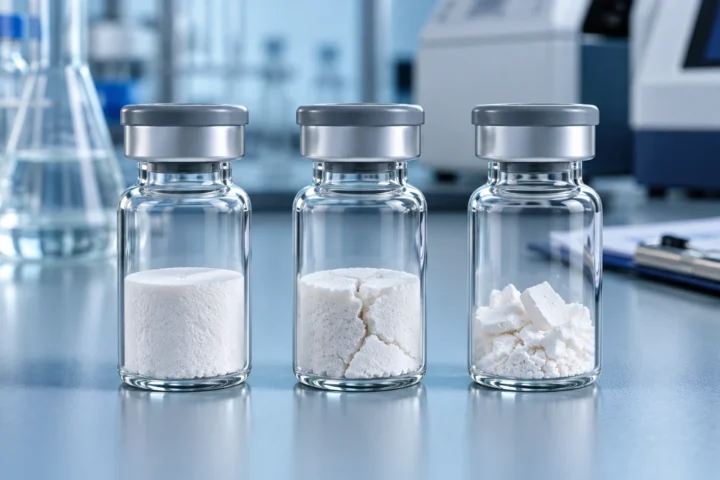
Two blend vials can show similar white lyophilised material even when their stated ratios are different. The visible cake size is not a calibrated measurement of peptide content, and the appearance cannot identify which molecular targets are present.
Product photographs still have a legitimate commercial role: they can show packaging style, label layout and kit presentation. They should not be promoted into analytical evidence. When the listing lacks a component breakdown, a clearer photograph of the same incomplete label does not solve the underlying problem.
How MY PEPTIDE’s kit rule applies to a listed blend
MY PEPTIDE lists BPC-157 + TB-500 Blend as its own product enquiry entry. A listed blend retains its stated formulation; it is different from placing standalone BPC-157 and standalone TB-500 kits in one order.
Under the current MY PEPTIDE wholesale terms, one kit contains ten vials of the same product and the minimum order is one kit per peptide product. An order may contain one complete kit of product A and one complete kit of product B, but five vials of A and five vials of B cannot be combined into one kit.
For a blend enquiry, that means the buyer should request the exact per-vial component specification first, then request a whole-number kit quantity. It does not mean the buyer can choose one component ratio for some vials and another ratio for the remaining vials inside one standard kit. Current formulation options and documentation should be confirmed directly before quotation.
A copyable RFQ for this blend
Please quote BPC-157 + TB-500 Blend in whole kits. For each vial, state separately: (1) nominal BPC-157 content, (2) nominal TB-500 content and (3) total nominal peptide content. Please identify the expected sequence or molecular target for each component, including what your “TB-500” name represents. List the available identity, purity and content/assay documentation for the quoted specification, with the applicable batch reference. Please do not use “10 mg blend” alone without the component breakdown.
Add the number of kits, destination and required documentation timing. If the supplier sends a price list containing only shorthand, copy its original wording into the comparison sheet and place the clarified specification beside it. That preserves what was first offered and what was later confirmed.
How to compare two blend quotations
Use a table that forces unlike quotations apart:
| Comparison field | Supplier A | Supplier B |
|---|---|---|
| BPC-157 target identity | ||
| TB-500 target identity | ||
| BPC-157 nominal mg/vial | ||
| TB-500 nominal mg/vial | ||
| Total nominal mg/vial | ||
| Vials per kit | ||
| Whole kits quoted | ||
| Identity evidence per component | ||
| Purity evidence per component | ||
| Content/assay evidence per component | ||
| Batch/sample linkage | ||
| Shipping and documentation basis | ||
| Total quote |
Do not calculate a per-milligram price until the first five fields are complete. A blank component amount is not zero; it is unknown. A missing identity result is not a failed result; it is missing evidence. Keeping those distinctions visible prevents the spreadsheet from producing a false sense of precision.
Repeat orders need the same definition
A clear first quotation can still drift over time if later purchase orders shorten the name to “BPC/TB 10 mg.” Keep the approved component definition in the reorder template. Ask whether the formulation, source lots, test methods or documentation have changed, and connect each received shipment to its own batch record.
One successful test does not automatically cover later production. Our guide to peptide batch consistency explains why the sample, lot and report connection should remain visible across repeat orders.
Frequently asked procurement questions
Does “BPC-157 + TB-500 10 mg” always mean 5 mg of each?
No. Some sellers use it that way, but the shorthand is not a universal specification. Ask for both component amounts and the total in writing.
Is 10/10 mg a 10 mg blend?
If the notation means 10 mg of each component, the stated total is 20 mg. The supplier should confirm that interpretation rather than leaving the buyer to infer it.
Can one purity percentage prove both components?
Not without a clear explanation of the method and calculation. Ask whether identity and purity are reported separately for BPC-157 and the defined TB-500 target, and what the headline percentage represents.
Why ask for the TB-500 sequence?
Because the commercial name has been used around different molecular descriptions. A published analysis identified an acetylated thymosin beta-4 fragment in the TB-500 product it examined, which demonstrates the need for a precise target without proving anything about every current supplier.[1]
Can a buyer order five standalone BPC-157 vials and five standalone TB-500 vials as one MY PEPTIDE kit?
No. A standard kit contains ten vials of the same product. Complete kits of different products may share an order. A listed BPC-157 + TB-500 blend is its own product and keeps its stated formulation.
The label should do the arithmetic before the buyer does
A blend name tells the buyer which components are supposed to be involved. It does not automatically state the amount of each component, the total, the molecular target behind TB-500 or the scope of the available tests.
The practical standard is straightforward: three quantity lines, two precise identities, component-aware analytical results and one batch connection. With those fields complete, buyers can compare like with like and send a clear enquiry to service@wholesalepeptide.xyz. Without them, “10 mg blend” is a headline—not a purchase specification.
References
- Esposito S, Deventer K, Goeman J, Van der Eycken J, Van Eenoo P. Synthesis and characterization of the N-terminal acetylated 17-23 fragment of thymosin beta 4 identified in TB-500, a product suspected to possess doping potential. Drug Testing and Analysis. 2012;4(9):733–738. doi:10.1002/dta.1402.
- National Center for Biotechnology Information. PubChem Compound Summary for CID 9941957, BPC-157. Accessed 14 September 2026. PubChem record.
- International Council for Harmonisation. Q2(R2): Validation of Analytical Procedures. Final guideline, 2023; effective in the EU 14 June 2024. EMA guideline page.
- International Council for Harmonisation. Q14: Analytical Procedure Development. Final guideline, 2023; effective in the EU 14 June 2024. EMA guideline page.
Community questions used for language discovery
- Reddit, r/bpc_157. “Confused by 5/5 blend…” The post is used only to document how readers interpret 5/5 and a 10 mg total; it does not establish product identity, content or suitability. View discussion.
- Reddit, r/bpc_157. “Bpc 157 /tb 500 blend dosage?” The title and opening question show that an unqualified “10 mg” label creates confusion. No dosing or reconstitution replies are reproduced or relied on. View discussion.
This article is provided for supplier evaluation, research education, and business communication. It is not medical advice and does not provide dosage or treatment instructions.
Need supplier information for your business?
Discuss product availability, documentation, wholesale requirements, and shipping communication with our team.