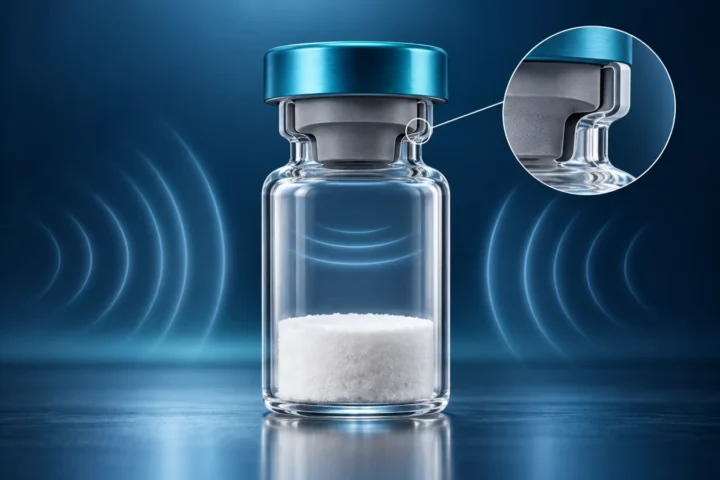
Learn why disappearing BPC-157 clumps and remaining haze are two different observations, what a photo cannot prove, and which batch evidence buyers need.

A buyer photographs a vial twice. In the first image, several white clumps are easy to see. An hour later the large pieces have disappeared, but the liquid still looks foggy under a side light. The supplier replies, “It dissolved.” The buyer replies, “Then why is it still cloudy?”
Both are describing a different visual threshold. Large objects can disappear from ordinary view while smaller suspended material continues to scatter light. That does not identify the suspended material. It also does not establish degradation, contamination, concentration or suitability for use.
Public discussions show the same confusion. One recent post describes BPC-157 becoming noticeably cloudy within an hour, without visible chunks, while the attached COA reportedly listed HPLC purity but no sterility or endotoxin result.[C1] Other posts use “hazy,” “foggy,” “floaters” and “won’t dissolve” as if the words were interchangeable.[C2–C3] These accounts establish the buyer’s vocabulary—not the cause.
The direct answer is: the disappearance of visible BPC-157 clumps only shows that large objects are no longer apparent under the same viewing conditions. Remaining haze is a separate observation caused by light scattering, but a photograph cannot determine what is scattering the light. The investigation must distinguish molecular identity, formulation, content, related substances, visible/subvisible particles and microbial quality.
Three visual states, not one
| Stage | What can be recorded | What cannot be concluded |
|---|---|---|
| Visible clumps | Number, approximate size, position and movement under defined lighting | Chemical identity of the clumps |
| Clumps no longer visible | The previous large features are absent at that time point | Complete molecular dissolution or unchanged potency |
| Uniform haze remains | Fine light scattering is visible through the bulk liquid | Whether the cause is peptide-related material, excipient, container material, bubbles or contamination |
Lighting matters. A sample can appear clear against a dark background and hazy when a narrow beam passes through it. Camera processing can exaggerate or suppress haze. A useful complaint record therefore repeats the same lighting, background, angle and elapsed time.
“Clear” is a visual inspection result. It is not an identity test. “Cloudy” is a visual inspection result. It is not a contaminant identification.
Confirm free base, acetate and exact sequence
The 2026 FDA technical review distinguishes BPC-157 free base from BPC-157 acetate. It lists the free-base sequence as Gly-Glu-Pro-Pro-Pro-Gly-Lys-Pro-Ala-Asp-Asp-Ala-Gly-Leu-Val and notes that submitted nominations and certificates were not always internally consistent about the named substance, CAS number and acetate form.[1]
That is directly relevant to procurement. Two sellers can use the same short label while quoting different chemical forms or incomplete documentation. Before interpreting an appearance difference, the buyer should know which molecular form was ordered, which form was tested, and which form the COA actually describes.
A correct sequence on a document still does not prove that the contents match it. Identity requires an appropriate analytical comparison. The batch number, sample chain and method must connect the result to the supplied lot.
“Stable gastric peptide” does not answer the vial question
BPC-157 is frequently described in the literature as a “stable gastric pentadecapeptide.” Reviews discuss stability in gastric juice and biological experiments.[2] That phrase is sometimes reused online to imply that any prepared vial should remain clear or chemically unchanged.
Those are different questions. Stability in gastric juice under the conditions of a biological study is not a validated in-use stability study for a particular lyophilized research material, formulation, container, concentration or storage system. It cannot identify haze or support a shelf-life claim for an unknown supplier’s vial.
The FDA’s 2026 evaluation reached a similarly cautious quality conclusion: BPC-157 free base and acetate were not well characterized from a physicochemical perspective, and available information was insufficient for the agency’s compounding evaluation.[1] That does not mean every research sample fails. It means broad certainty is not justified by the public record.
Analytical research shows what eyesight misses
Tian and colleagues used stable-isotope labeling with UHPLC-HRMS to study BPC-157 metabolism in two in-vitro incubation models. They identified the parent compound and multiple metabolites generated through different pathways.[3]
This was a doping-control metabolism study, not a vial-cloudiness study. It should not be used to name the material in a hazy sample. Its value here is methodological: related species can require chromatographic separation and high-resolution mass information. A phone photograph has neither.
The FDA review also highlights why peptide-related impurities and aggregation matter to risk evaluation, while noting the lack of sufficient BPC-157-specific information.[1] “Aggregation is possible” is not the same as “this haze is aggregated BPC-157.” The second statement requires evidence from the sample.
Why a purity percentage does not resolve cloudiness
An HPLC area-purity result answers how much of the detected chromatographic signal belongs to the main peak under that method. It may not establish:
- total material per vial;
- identity of the main peak;
- invisible or non-detected components;
- sterility or bioburden;
- endotoxin;
- identity of visible or subvisible particles;
- stability after the release test date.
If a COA says “98.4% purity,” the next questions are: which method, which wavelength or detector, which integration rules, which sample, which lot, and what did the other 1.6% represent? The number cannot turn a cloudy image into a diagnosis.
For a fuller explanation, see how to read a peptide COA.
A structured investigation
1. Preserve the timeline
Record dry-material appearance, the first liquid observation, when large clumps disappeared and when haze became visible. Do not rewrite the sequence as “it was cloudy” if the useful fact is that the appearance changed in stages.
2. Link the complaint to the lot
Capture product form, lot number, vial identifier, order date, transport condition, storage log, container/closure and every documented component introduced. Keep an unopened retained vial where possible.
3. Define the analytical question
- Identity: Is the declared BPC-157 form present?
- Content: How much target material is present per vial?
- Related substances: Did the main compound change relative to a suitable reference or retained sample?
- Particles: What are the visible or light-scattering objects?
- Microbial quality: Do sterility, bioburden or endotoxin results meet a defined requirement?
One test rarely answers every question. A supplier response should not present an HPLC chromatogram as a substitute for particle characterization or microbial testing.
4. Compare retained and affected samples
A retained sample can show whether the same observation appears under controlled inspection, but absence of haze in the retained vial does not invalidate the buyer’s record. Differences in container history or preparation remain possible. The comparison narrows the investigation; it does not end it.
5. State uncertainty in the disposition
A useful written outcome separates what was confirmed, what was excluded, what remains unknown and whether a replacement or further test is offered. “Looks normal” and “must be user error” are not analytical dispositions.
What not to do with the evidence
Community threads often recommend adding more liquid, changing pH, warming, shaking, filtering or transferring the contents. This page does not repeat those instructions. Each intervention changes the sample and may remove or redistribute the very material that needs investigation.
Do not combine anecdotes into a false frequency. Ten posts do not establish that a percentage of BPC-157 vials become cloudy. Do not use a clear comparison vial from another supplier as definitive proof that the cloudy vial is fake; the comparison may differ in form, excipients, concentration, container or history.
Questions to ask a wholesale supplier
Before ordering, request:
- exact BPC-157 form and sequence;
- per-vial specification and acceptance range;
- identity, purity and content methods as separate fields;
- appearance and visible-particle criteria at release;
- applicable formulation components;
- storage and transport conditions;
- retained-sample policy;
- written complaint and replacement process;
- which laboratory method would be used if haze or particles must be characterized.
MY PEPTIDE’s Wholesale Terms explain kit-level ordering. Product availability and batch-document questions can be sent to service@wholesalepeptide.xyz. This page makes no claim about an unpublished MY PEPTIDE BPC-157 formulation or current batch result.
The useful conclusion
The moment large clumps disappear is not the end of the investigation if haze remains. It is a transition from one visible state to another.
For a B2B buyer, the right next question is not “Did it dissolve?” but “Which quality attribute are we trying to establish?” Identity, content, related substances, particles and microbial quality need different evidence. Keeping those questions separate produces a complaint record a supplier or independent laboratory can actually evaluate.
Editorial method and limits
This article uses the FDA’s 2026 BPC-157 technical evaluation, peer-reviewed biological context and a peer-reviewed UHPLC-HRMS metabolism study. Community posts are used only to document wording and uncertainty. No fictional person, MY PEPTIDE customer, batch, result or product specification is included. No independent laboratory review is claimed.
References
- U.S. Food and Drug Administration. BPC-157-Related Bulk Drug Substances: BPC-157 (Free Base) and BPC-157 Acetate. Pharmacy Compounding Advisory Committee meeting materials, 23 July 2026, pp. 32–60. FDA PDF
- Sikiric P, et al. Stable Gastric Pentadecapeptide BPC 157 and Wound Healing. Frontiers in Pharmacology. 2021;12:627533. https://doi.org/10.3389/fphar.2021.627533
- Tian T, Jing J, Li Y, Wang Y, Deng X, Shan Y. Stable Isotope Labeling-Based Nontargeted Strategy for Characterization of the In Vitro Metabolic Profile of a Novel Doping BPC-157 in Doping Control by UHPLC-HRMS. Molecules. 2023;28(21):7345. https://doi.org/10.3390/molecules28217345
Community observations
C1. Reddit, r/sarmssourcetalk. Reconstituted a vial of BPC-157 and the solution went cloudy within an hour. Public post visible 22 September 2026; accessed 24 September 2026. Documents uniform cloudiness, a lot-linked HPLC claim and unresolved cause; not an authenticated batch investigation. Link
C2. Reddit, r/PeptidePathways. Bad Peptide? BPC 157. Public post visible as “6mo ago”; accessed 24 September 2026. Uses “haze-like” language; does not establish sample identity or cause. Link
C3. Reddit, r/Peptidesource. Cloudiness of a Peptide Vial after Reconstitution? Public post visible as “2.1y ago”; accessed 24 September 2026. Contains general aggregation and contamination claims that were not treated as verified BPC-157 causes. Link
This article is provided for supplier evaluation, research education, and business communication. It is not medical advice and does not provide dosage or treatment instructions.
Need supplier information for your business?
Discuss product availability, documentation, wholesale requirements, and shipping communication with our team.