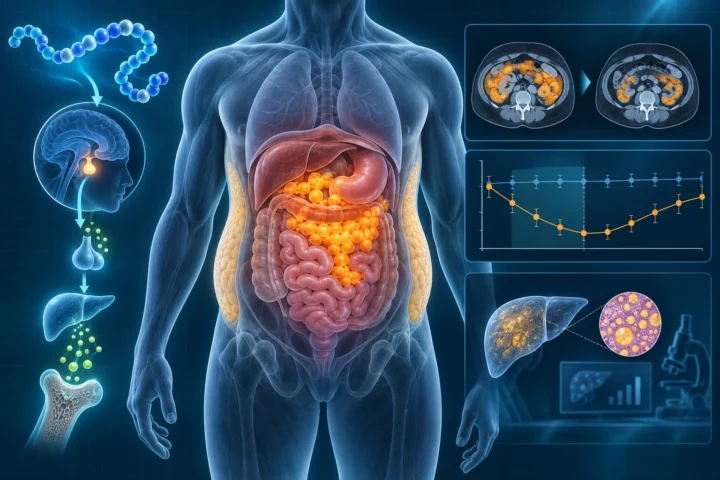
Review AOD-9604 benefits, early human signals, the largest 24-week obesity trial, safety limits and what research buyers should verify.
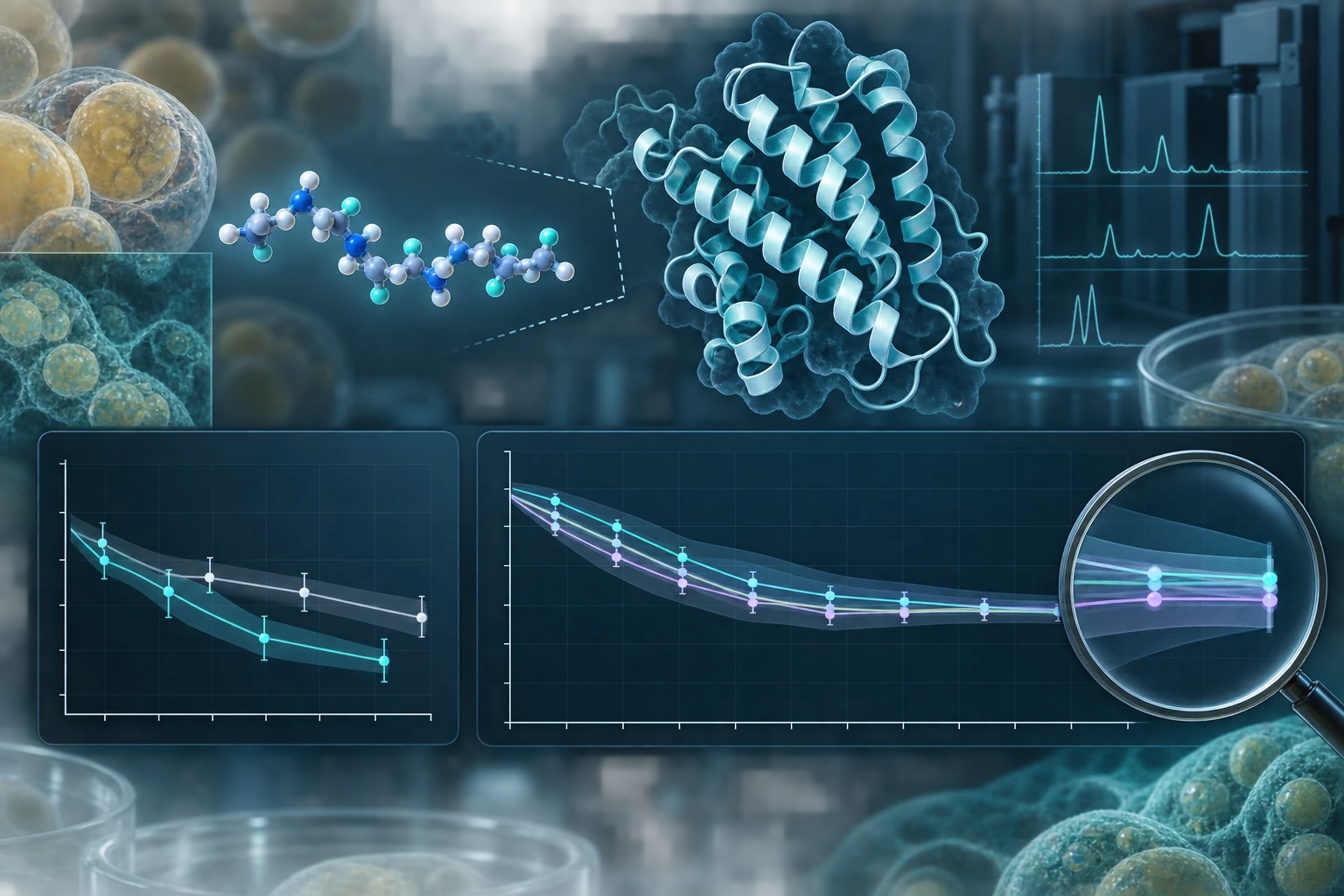
AOD-9604 is usually introduced with one attractive sentence: it is the “fat-burning fragment” of human growth hormone, designed to retain effects on fat metabolism without the broader actions of full-length growth hormone. That sentence explains why the compound attracted serious research interest. It does not prove that it produces meaningful weight loss in people.
The development record is more revealing than the slogan. Animal studies reported effects on body weight and lipid metabolism. Several early human studies were conducted, and one shorter obesity study appeared to produce a modest signal. The programme then advanced to a much larger, 24-week randomised trial. In that trial, AOD-9604 did not produce a statistically significant weight-loss advantage over placebo at the primary 12-week endpoint or at 24 weeks. The sponsor later ended development for obesity.[1–4]
The defensible answer is therefore: AOD-9604 has a genuine preclinical and human-development history, but controlled human research did not establish it as an effective weight-loss treatment. The largest trial deserves more weight than an appealing mechanism, animal findings or a selectively quoted early result.
AOD-9604 evidence at a glance
| Question | What the evidence shows | What it does not show |
|---|---|---|
| Is it related to growth hormone? | It is a synthetic 16-amino-acid peptide based on residues 177–191 of human growth hormone, with an additional N-terminal tyrosine[1] | It is not full-length HGH and cannot be assumed to share every HGH action |
| Did animal research find metabolic effects? | Obese-mouse studies reported changes in weight, fat mass and lipid metabolism[2] | Mouse results do not establish human fat loss |
| Was it studied in people? | Yes. A clinical programme included short pharmacology/safety studies and obesity trials[1,3] | Human exposure alone does not prove efficacy |
| Did an early trial show a signal? | FDA’s review records small between-group differences in a 12-week study, while noting incomplete reporting and unclear clinical meaning[1] | It was not robust confirmation of a weight-loss benefit |
| What did the largest trial find? | The 24-week OPTIONS/METAOD006 trial randomised 502 adults; no dose significantly beat placebo for weight loss[1] | The programme did not validate the “fat-burning” claim |
| Is AOD-9604 FDA-approved for weight loss? | No; FDA found inadequate effectiveness evidence and unresolved quality/safety questions[1] | An FDA committee review is not an approval |
What is AOD-9604?
FDA describes AOD-9604 free base as a hexadecapeptide: a 15-amino-acid C-terminal fragment corresponding to human growth hormone residues 177–191, plus an additional tyrosine at the N-terminus. The molecule contains a disulfide bond between two cysteine residues. FDA lists a molecular formula of C78H123N23O23S2 and a molecular mass of approximately 1,815.1 g/mol for the free base.[1]
Those structural details matter. “AOD-9604,” “HGH fragment 176–191,” free base and acetate may be used loosely in commercial listings, but a buyer should not assume that every label describes the same analytical form or mass basis. Sequence, terminal structure, disulfide state and counter-ion can affect identity and specification.
Nor should the compound be described simply as “HGH without the side effects.” It is not full-length growth hormone, but being shorter does not automatically prove selective benefit, absence of endocrine effects or long-term safety.
Why the early animal results looked promising
In a 2001 Endocrinology paper, researchers studied human growth hormone and AOD-9604 in obese mice and beta-3-adrenergic-receptor knockout mice. Chronic treatment was associated with reductions in body weight and fat mass in obese mice and with changes in beta-3-adrenergic-receptor expression. The experiments suggested that the observed lipolytic actions were not simply dependent on an intact beta-3 receptor.[2]
This was meaningful preclinical work. It helped justify human development and provided a biological hypothesis to test. It was not a human weight-loss result.
Animal obesity models can reveal mechanisms, but they do not reproduce the full complexity of human appetite, behaviour, energy expenditure, treatment adherence or long-term disease. A mechanism becomes clinically persuasive only when a well-designed human trial shows that the expected outcome actually occurs.
What the human development programme contained
A 2013 safety review assembled information from six human studies involving roughly 900 participants. The programme included early single- and repeated-exposure studies, a 12-week obesity trial and a larger 24-week trial. Routes and formulations varied across the programme; much of the obesity development used oral tablets.[3]
That history is often compressed online into “AOD-9604 completed human trials and was safe.” Both halves need qualification.
First, the studies were not all efficacy trials. Some were short pharmacology or tolerability studies. Second, the major obesity trial failed to demonstrate significant weight loss. Third, the published safety synthesis drew heavily on sponsor development data and does not provide the same assurance as successful long-term outcome trials with broad independent replication.
The early 12-week signal—and why it was not enough
The METAOD005 study enrolled approximately 300 adults with obesity and compared several oral AOD-9604 doses with placebo over 12 weeks. FDA’s review notes small differences in weight change at certain doses, but it also found the public reporting insufficient: a complete publication was not located, detailed methodology and results were limited, and the therapeutic meaning of the differences was unclear.[1]
An early signal can be useful. It can inform the dose range and design of a larger trial. It should not be treated as final proof—especially when the next, larger trial fails.
Selecting the most favourable dose or time point after seeing the data also creates a familiar risk: the result may be noise rather than a reproducible effect. The correct test is whether a prespecified outcome survives in an adequately powered confirmatory study.
The decisive 24-week trial
The larger OPTIONS trial, also called METAOD006, enrolled 536 adults with obesity aged 18 to 65 and randomised 502 participants. They received placebo or one of three oral AOD-9604 doses while participating in a diet-and-exercise programme. Treatment continued for 24 weeks, with weight loss at week 12 as the primary endpoint.[1]
No AOD-9604 dose produced a statistically significant weight-loss difference from placebo at week 12. The groups also did not show a significant advantage at week 24. FDA concluded that the study did not support AOD-9604 effectiveness for obesity.[1]
This result changes how every earlier claim should be read. The programme did not stop before a serious test. It reached a relatively large randomised trial—and the curves did not separate meaningfully. According to the regulatory record, the company terminated its obesity-development programme in February 2007.[1]
That does not prove the molecule has no biological activity. It means the proposed activity did not translate into demonstrated clinical weight loss under the tested conditions.
Why mechanism cannot rescue a failed outcome
Marketing often moves through a chain of inference:
- growth hormone is involved in lipid metabolism;
- AOD-9604 is derived from a growth-hormone fragment;
- animal studies found metabolic effects;
- therefore AOD-9604 burns fat in people.
The first three steps can all be discussed scientifically. The fourth requires human efficacy data. Once a large randomised human trial fails its main endpoint, returning to mechanism does not erase the result.
Subgroup stories, isolated dose comparisons and testimonials also cannot substitute for the prespecified analysis. They may generate new hypotheses, but those hypotheses need independent confirmation.
Route matters: the popular research format was not the proven format
FDA’s assessment found no adequate human effectiveness data for subcutaneous or transdermal AOD-9604. The obesity trials discussed above primarily evaluated oral administration, while some early pharmacology work used intravenous exposure.[1]
That route mismatch matters. Data from one route do not automatically establish exposure, efficacy or safety for another. Formulation, absorption and degradation can change what reaches systemic circulation.
This article does not turn that gap into administration advice. It means precisely the opposite: claims about an unstudied route should not borrow confidence from a different clinical programme.
What do the studies say about IGF-1 and glucose?
The 2013 review reported no significant changes in serum IGF-1 and no consistent adverse glucose or oral-glucose-tolerance trends in the studied trials.[3] That is relevant evidence against assuming that the compound simply reproduced every effect of full-length HGH under those conditions.
It is not proof that AOD-9604 is “hormone-free,” metabolically risk-free or safe in every population and route. The trials differed in duration, exposure and purpose, and the obesity programme did not establish a clinical benefit that could be weighed against residual risks.
Safety evidence has important limits
The published safety review described the compound as generally well tolerated across the development studies, with adverse-event rates often similar to placebo.[3] FDA’s later review was more cautious. It highlighted limited long-term exposure, incomplete information, route-specific gaps and uncertainty about serious adverse events. The record included gastrointestinal and chest symptoms and malignancies, but available information was not sufficient to establish that AOD-9604 caused the cancers.[1]
The correct wording is not “AOD-9604 causes cancer,” and it is not “AOD-9604 is proven safe.” Causality was unresolved, and the available programme was not sufficient to establish long-term safety for the uses and routes promoted outside the trials.
FDA also raised concerns about peptide aggregation, degradation, immunogenicity and inadequate characterisation of impurities. These are not abstract manufacturing issues: a clinical paper about one characterised investigational material does not validate every material sold under the same common name.[1]
Is AOD-9604 FDA-approved?
No. AOD-9604 is not an FDA-approved weight-loss drug. FDA’s 2024 Pharmacy Compounding Advisory Committee materials evaluated whether AOD-9604-related bulk drug substances should be placed on the 503A Bulks List. That process is not a drug approval, and FDA’s assessment weighed against inclusion because of insufficient evidence of clinical benefit and unresolved safety and quality concerns.[1]
Phrases such as “FDA reviewed,” “listed in an FDA document” or “once granted GRAS status for food use” should not be converted into “FDA-approved for injection” or “approved for fat loss.” Regulatory categories answer different questions.
What “AOD-9604 benefits” can honestly mean
For a research buyer, the useful “benefits” are better framed as research characteristics rather than promised health outcomes:
- it has a defined peptide sequence and a documented development history;
- it has been studied in both preclinical models and humans;
- the negative large trial provides a valuable boundary for hypothesis development;
- the programme illustrates why mechanism, pharmacology and clinical efficacy must be separated;
- its disulfide-containing structure creates concrete identity and quality-control questions.
None of those points establishes personal fat loss, improved body composition, enhanced athletic performance or a treatment benefit.
Translating the evidence into a B2B specification
For an AOD-9604 research-material enquiry, buyers should define the requested material before comparing quotations:
- exact sequence and terminal structure;
- free base or acetate and the stated counter-ion basis;
- expected molecular mass and confirmation of the disulfide state;
- amount per vial and whether it is expressed as peptide mass, salt mass or another basis;
- identity method, chromatographic purity method and acceptance criteria;
- content or assay information rather than purity alone;
- impurity, aggregate, water and residual-solvent scope where available;
- batch identifier and traceability between label, COA and test sample;
- storage and shipment conditions for the quoted material.
A peptide COA should be read by method and measured attribute. An HPLC area-purity result does not by itself prove identity, content, disulfide connectivity, aggregate control, sterility, safety or a weight-loss benefit.
Under MY PEPTIDE Wholesale Terms, one kit contains 10 vials of the same product and the standard MOQ is one kit per peptide. An order may contain one full kit of AOD-9604 and one full kit of another product, but five vials of each do not make one kit. Quotations depend on product, per-vial specification and quantity.
FAQ
Does AOD-9604 cause weight loss in humans?
Controlled human development did not establish a significant weight-loss benefit. The largest 24-week trial found no statistically significant advantage over placebo at its primary 12-week endpoint or at 24 weeks.[1]
Why is AOD-9604 called a fat-burning fragment?
The name reflects its origin from the C-terminal region of human growth hormone and early mechanistic and animal research. It is a research hypothesis and marketing shorthand, not proof of human fat loss.
Did AOD-9604 reach clinical trials?
Yes. The programme included early pharmacology/safety studies and obesity trials involving hundreds of adults. The existence of trials is real; the major efficacy result was negative.[1,3]
Is AOD-9604 the same as HGH?
No. It is a 16-amino-acid synthetic peptide related to a small region of HGH, while full-length human growth hormone contains 191 amino acids. Their evidence and specifications should not be treated as interchangeable.
Is AOD-9604 FDA-approved for obesity?
No. FDA’s compounding review is not an approval and concluded that the available evidence did not establish effectiveness for obesity.[1]
Does a 99% purity COA prove the material matches clinical AOD-9604?
No. Purity is one analytical measurement. Sequence identity, molecular form, content, disulfide state, impurities, aggregates and traceability remain separate questions.
Bottom line
AOD-9604 is not an invented internet peptide. It has a real molecule definition, credible animal research and a substantial human-development record. That record is precisely why the conclusion should be cautious: the strongest weight-loss test did not confirm the early promise.
For researchers and B2B buyers, the most useful lesson is methodological. Start with the largest controlled human outcome, then work backward to understand mechanism and early signals. Do not start with the slogan and stop before the failed trial.
For AOD-9604 forms, per-vial specifications, kit quantities and batch-document availability, contact service@wholesalepeptide.xyz.
References
- US Food and Drug Administration. AOD-9604-Related Bulk Drug Substances: Evaluation for Use in Compounding Under Section 503A. Pharmacy Compounding Advisory Committee briefing document, 2024. FDA briefing document
- Heffernan MA, Thorburn AW, Fam B, et al. The effects of human GH and its lipolytic fragment (AOD9604) on lipid metabolism following chronic treatment in obese mice and beta(3)-AR knock-out mice. Endocrinology. 2001;142(12):5182–5189. PubMed PMID 11713213
- Stier H, Vos E, Kenley DE. Safety and tolerability of the hexadecapeptide AOD9604 in humans. Journal of Endocrinology and Metabolism. 2013;3(1-2):7–15. Full text
- Wilding JPH. AOD-9604 Metabolic. Current Opinion in Investigational Drugs. 2004;5(4):438–444. PubMed PMID 15134286
This article is provided for supplier evaluation, research education, and business communication. It is not medical advice and does not provide dosage or treatment instructions.
Need supplier information for your business?
Discuss product availability, documentation, wholesale requirements, and shipping communication with our team.