
Review tesamorelin benefits in human trials, its FDA-approved HIV-lipodystrophy use, visceral-fat results, weight-neutral effect and safety limits.
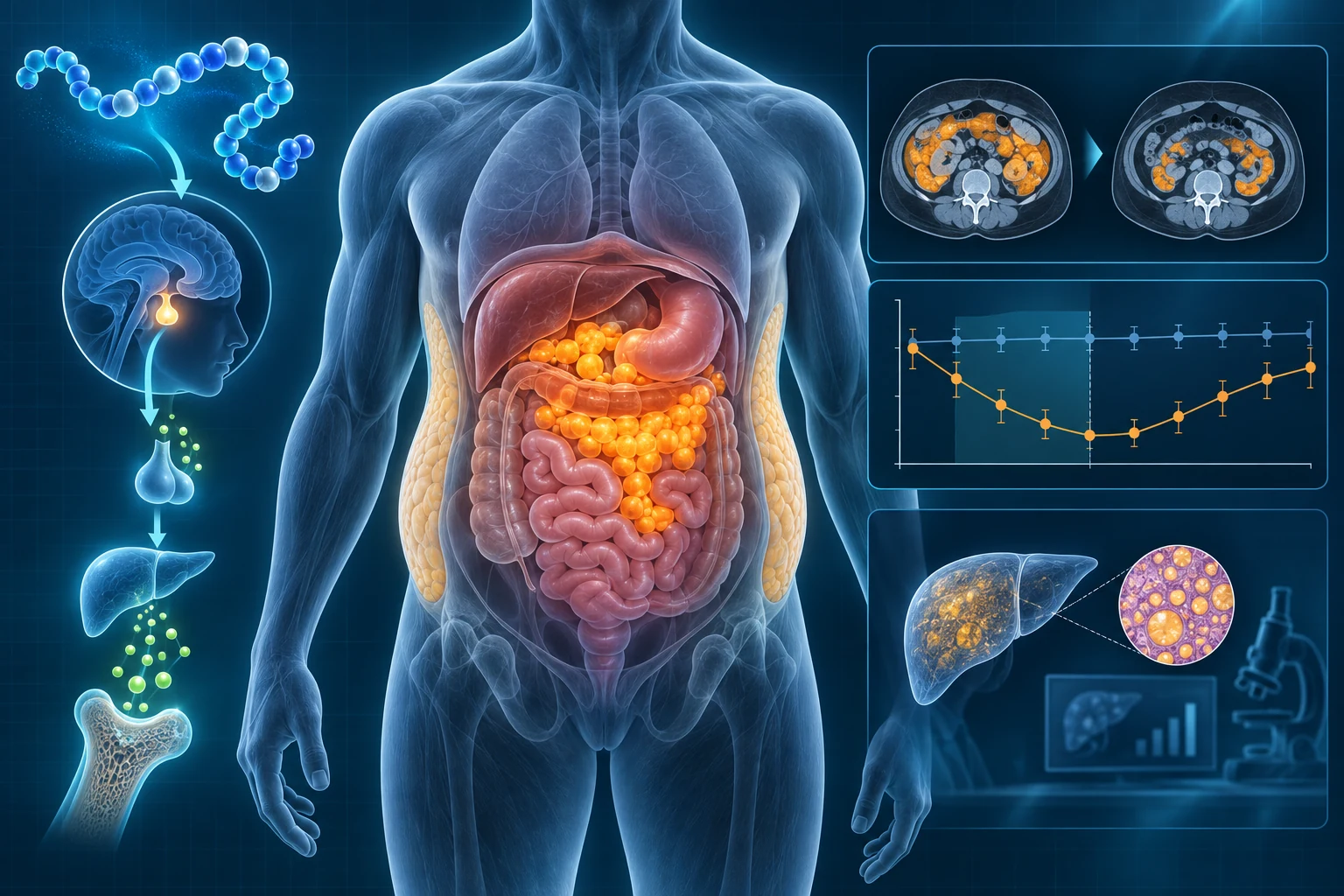
Tesamorelin is unusual in the research-peptide market: it is not supported only by animal experiments, small uncontrolled reports or extrapolation from another molecule. Two large randomised trials enrolled more than 800 adults, and an FDA-approved tesamorelin product has a defined indication.
That makes the common online summary—“tesamorelin burns belly fat”—both partly grounded and seriously incomplete.
The pivotal studies were conducted in adults with HIV and lipodystrophy who had excess abdominal fat. They measured visceral adipose tissue with CT, not simply scale weight or a tape measure. Tesamorelin reduced visceral fat, while average body weight changed very little. When participants stopped treatment during the extension phase, much of the visceral-fat benefit was lost. The current US label therefore states that the product is indicated to reduce excess abdominal fat in HIV-infected adults with lipodystrophy, but is not indicated for weight-loss management because its effect is weight neutral.[1–4]
The direct answer is: Tesamorelin has high-quality human evidence for reducing visceral abdominal fat in a specific HIV-lipodystrophy population. It is not a general obesity drug, and the trials do not prove every fat-loss, bodybuilding, recovery or anti-aging claim attached to it online.
Tesamorelin evidence at a glance
| Claim | What human evidence supports | What it does not establish |
|---|---|---|
| Reduces visceral abdominal fat | Two 26-week multicentre randomised trials in adults with HIV-associated lipodystrophy[1–3] | General weight loss in people without HIV lipodystrophy |
| “Burns belly fat” | CT-measured visceral fat fell; waist circumference and trunk fat also changed modestly[1] | Selective removal of all visible abdominal or subcutaneous fat |
| Causes weight loss | Average weight remained essentially unchanged in the pivotal studies[1] | A scale-weight treatment; the FDA label explicitly says it is not indicated for weight-loss management |
| Improves body composition | Trunk fat decreased and lean body mass increased in the trials[1] | Proven muscle strength, athletic performance or bodybuilding outcomes |
| Reduces liver fat | Smaller randomised studies in people with HIV reported liver-fat reductions[4,5] | FDA approval for fatty-liver disease or proven long-term liver outcomes |
| Works permanently | Continuation helped maintain the effect; stopping was followed by visceral-fat regain[1,3] | A permanent change after a short course |
| “Safer HGH” | Tesamorelin stimulates endogenous GH and raises IGF-1 | Absence of GH-axis risks; the label includes IGF-1, glucose, fluid-retention and malignancy warnings[1] |
What is tesamorelin?
Tesamorelin is a synthetic analogue of growth hormone-releasing hormone, also called growth hormone-releasing factor. Rather than being growth hormone itself, it acts upstream at the pituitary and stimulates pulsatile release of endogenous GH. That, in turn, raises insulin-like growth factor 1 (IGF-1).[1]
Structurally, tesamorelin is based on the 44-amino-acid human GHRH sequence with a modification that increases resistance to enzymatic degradation. Its mechanism is therefore different from directly administering recombinant human growth hormone, but “different” does not mean unrelated to GH biology.
The distinction matters because broad marketing often describes tesamorelin as a targeted fat-loss peptide while omitting the rise in IGF-1 and the monitoring issues that follow from stimulating the GH axis.
The benefit the pivotal trials actually measured
The current FDA label relies on two multicentre, randomised, double-blind, placebo-controlled studies. Study 1 randomised 412 adults; Study 2 randomised 404. Participants had HIV-associated lipodystrophy and excess abdominal fat, were on stable antiretroviral therapy and were generally middle-aged. The primary endpoint in both studies was the percentage change in visceral adipose tissue at week 26, measured by CT at the L4–L5 level.[1]
That endpoint is more specific than “belly size.” Visceral fat lies inside the abdominal cavity around the organs. It is different from subcutaneous fat under the skin, and neither is identical to total body weight.
In Study 1, mean visceral fat changed by approximately -18% with tesamorelin and +2% with placebo. In Study 2, the corresponding changes were approximately -14% and -2%. The between-group treatment effects were about -20% and -12%, respectively.[1]
These are real, replicated effects in the population studied. They support the approved claim. They do not automatically support general obesity treatment, cosmetic spot reduction or use in people outside the trial population.
Why visceral-fat loss was not ordinary weight loss
The scale barely moved. In Study 1, mean body weight changed by about -0.4 kg with tesamorelin and 0.0 kg with placebo. In Study 2, changes were approximately +0.5 kg and +0.3 kg. The confidence intervals for the treatment differences included no meaningful weight effect.[1]
At the same time, trunk fat decreased by roughly 1.0 kg and 0.8 kg across the two tesamorelin groups, while lean body mass increased by approximately 1.3 kg and 1.2 kg. Those opposing body-composition changes help explain why visceral fat could decline without a large change on the scale.[1]
This is the most important correction to popular search results. A person can have less CT-measured visceral fat and almost the same body weight. “Reduced visceral fat” should not be rewritten as “lost a large amount of weight.”
Nor does an increase in lean body mass prove greater strength or better athletic performance. The pivotal trials did not establish bodybuilding outcomes.
Did waist circumference and appearance improve?
Waist circumference decreased modestly compared with placebo. The FDA label reports mean between-group differences of roughly 2 cm in Study 1 and 1 cm in Study 2 at 26 weeks. Patient-reported distress about belly appearance also shifted in a favourable direction.[1]
These findings make the CT result more tangible, but they remain population- and endpoint-specific. Waist circumference can be affected by visceral fat, subcutaneous fat, anatomy and measurement variability. The trials did not show removal of all abdominal subcutaneous fat; one publication reported no change in abdominal subcutaneous fat despite the visceral-fat reduction.[3]
What happened when treatment stopped?
Both pivotal programmes included a 26-week extension. Participants who had received tesamorelin were re-randomised either to continue or to switch to placebo. Those who continued largely maintained the visceral-fat reduction. Those switched to placebo regained visceral fat: the FDA label reports mean percentage changes from the week-26 baseline of +22% and +16% in the two switch groups, compared with 0% and -5% among those who continued.[1]
The extension does not tell us that every individual will follow the same curve. It does show that the effect was treatment-dependent rather than a permanent remodelling after six months.
That is a useful evidence boundary for any article claiming a durable “reset” of metabolism. The clinical record does not support that language.
What about triglycerides and metabolic health?
The first large trial reported improvements in triglycerides and the total-cholesterol-to-HDL ratio alongside the visceral-fat reduction.[2] Pooled analyses have also examined whether people who respond with greater VAT reduction show more favourable metabolic changes.[6]
Those findings are relevant, but they do not establish that tesamorelin prevents heart attacks or improves survival. The current FDA label explicitly states that long-term cardiovascular safety has not been established.[1]
Surrogate changes such as VAT, triglycerides or IGF-1 can be clinically informative. They are not the same as a demonstrated long-term outcome benefit.
The liver-fat research is promising but separate
Tesamorelin has also been studied in people with HIV and fatty liver disease. A 2014 randomised trial of 50 participants found reductions in both visceral fat and liver fat over six months. A later 12-month randomised trial enrolled 61 people with HIV and non-alcoholic fatty liver disease; the tesamorelin group had a greater absolute reduction in hepatic fat fraction than placebo, and a larger proportion fell below the study’s steatosis threshold.[4,5]
The 2019 investigators concluded that tesamorelin might be beneficial in this setting while calling for further work on long-term liver histology. This is not the same as an FDA-approved indication for fatty-liver disease. It is a smaller, secondary clinical-development path in a defined HIV population.
An evidence-led article should present liver-fat data as promising additional research, not quietly add “treats fatty liver” to the approved benefit list.
Why “raises GH naturally” is not a safety guarantee
Tesamorelin stimulates endogenous GH release and increases IGF-1. In the pivotal trials, the FDA label reports substantial proportions of treated participants with IGF-1 standard-deviation scores above 2 or 3. The consequences of prolonged elevation are described as unknown.[1]
The label also warns about:
- active malignancy and possible neoplasm concerns;
- glucose intolerance or diabetes;
- fluid retention, including oedema, arthralgia and carpal-tunnel symptoms;
- hypersensitivity and local reactions;
- uncertainty in acute critical illness;
- long-term cardiovascular safety that has not been established.[1]
In the first 26 weeks, elevated HbA1c into the diabetes range occurred in 5% of tesamorelin-treated participants and 1% of placebo participants; the label reports an increased relative risk of developing diabetes. Injection-site reactions were also more common in the tesamorelin groups.[1]
This does not mean every research exposure produces those events. It means a benefit article should not use “endogenous,” “natural pulse” or “not HGH” to erase a documented safety profile.
FDA approval does not validate every tesamorelin vial
An FDA-approved tesamorelin product exists, but the approval applies to specific finished-drug formulations, manufacturing controls, excipients, presentation and labelled use. It does not certify every product sold under the common name tesamorelin.
The 2025 EGRIFTA WR label itself says that the WR and SV formulations are not substitutable. They differ in strength, recommended regimen, preparation and storage. The label connects WR effectiveness to studies of an earlier formulation plus a bioavailability comparison.[1]
That is a practical lesson for B2B research buyers: even two approved formulations containing the same active peptide are not assumed to be interchangeable. A generic “tesamorelin” label provides much less information than a complete material specification.
What human trials do not prove
The available evidence does not establish tesamorelin as:
- a general weight-loss treatment;
- an obesity medicine for people without HIV lipodystrophy;
- a cosmetic spot-reduction product;
- a proven muscle-building or athletic-performance compound;
- an anti-aging therapy;
- a permanent metabolic reset;
- an approved treatment for fatty-liver disease.
Some of these questions may be biologically plausible or under study. Plausibility and approval are different evidence levels.
Translating clinical evidence into a B2B specification
For a tesamorelin research-material enquiry, the clinical literature should guide what not to assume. A buyer should define:
- exact amino-acid sequence and terminal form;
- tesamorelin base or a stated salt form;
- molecular formula and expected molecular mass for that form;
- amount per vial and the mass basis used;
- identity method and acceptance criteria;
- chromatographic purity method and result;
- content or assay measurement, not purity alone;
- counter-ion, water, residual-solvent, impurity and aggregate scope where relevant;
- batch identifier and traceability between label, COA and sample;
- excipient/formulation status rather than assuming equivalence to EGRIFTA;
- storage and shipment conditions tied to the quoted research material.
A peptide COA must be read by method and measured attribute. A high HPLC area percentage does not prove content, sterility, bioavailability, formulation equivalence or clinical performance.
Under MY PEPTIDE Wholesale Terms, each kit contains 10 vials of the same product and the standard MOQ is one kit per peptide. An order may combine full kits of different products, but five vials of A and five of B do not form one kit. Quotations depend on the product, per-vial specification and quantity.
FAQ
What is the best-supported benefit of tesamorelin?
Reduction of CT-measured visceral abdominal fat in adults with HIV-associated lipodystrophy. Two pivotal 26-week randomised trials support that outcome.[1]
Does tesamorelin cause weight loss?
It was weight neutral in the pivotal studies. Visceral fat decreased, but average body weight changed little. The FDA label says it is not indicated for weight-loss management.[1]
Does tesamorelin reduce subcutaneous belly fat?
The main evidence concerns visceral fat. A major trial reported no significant change in abdominal subcutaneous fat despite reduced visceral fat.[3]
Is tesamorelin FDA-approved?
Specific EGRIFTA tesamorelin formulations are FDA-approved to reduce excess abdominal fat in HIV-infected adults with lipodystrophy. That is not approval for general obesity, bodybuilding, anti-aging or fatty-liver treatment.[1]
Is the effect permanent?
The extension studies showed substantial visceral-fat regain after participants switched from tesamorelin to placebo. Continued exposure was needed to maintain the trial effect.[1,3]
Does tesamorelin improve fatty liver?
Smaller randomised studies in people with HIV reported reduced liver fat, but this remains a separate research area and is not the current FDA-approved indication.[4,5]
Does an FDA-approved product make research tesamorelin equivalent?
No. Approval attaches to a defined finished product and formulation. Identity, content, impurities, excipients, stability and bioavailability cannot be inferred from the common ingredient name.
Bottom line
Tesamorelin is one of the clearest examples of why “benefits” must be written with the population, endpoint and formulation attached. In adults with HIV-associated lipodystrophy, it reduced visceral abdominal fat in two large randomised trials. It did not function as a conventional weight-loss drug, the effect diminished after discontinuation, and its GH/IGF-1 mechanism brings real monitoring and safety limits.
The accurate headline is not “tesamorelin melts belly fat.” It is: tesamorelin has replicated evidence for a specific CT-measured visceral-fat outcome in a specific clinical population.
For tesamorelin forms, per-vial specifications, kit quantities and batch-document availability, contact service@wholesalepeptide.xyz.
References
- US Food and Drug Administration. EGRIFTA WR (tesamorelin) Prescribing Information. Revised March 2025. FDA label
- Falutz J, Allas S, Blot K, et al. Metabolic effects of a growth hormone-releasing factor in patients with HIV. New England Journal of Medicine. 2007;357(23):2359–2370. PubMed PMID 18057338
- Falutz J, Potvin D, Mamputu JC, et al. Effects of tesamorelin, a growth hormone-releasing factor, in HIV-infected patients with abdominal fat accumulation: a randomized placebo-controlled trial with a safety extension. Journal of Acquired Immune Deficiency Syndromes. 2010;53(3):311–322. PubMed PMID 20101189
- Stanley TL, Feldpausch MN, Oh J, et al. Effect of tesamorelin on visceral fat and liver fat in HIV-infected patients with abdominal fat accumulation: a randomized clinical trial. JAMA. 2014;312(4):380–389. PubMed PMID 25038357
- Stanley TL, Fourman LT, Feldpausch MN, et al. Effects of tesamorelin on non-alcoholic fatty liver disease in HIV: a randomised, double-blind, multicentre trial. Lancet HIV. 2019;6(12):e821–e830. PubMed PMID 31611038
- Stanley TL, Kitch D, Grinspoon SK. Reduction in visceral adiposity is associated with an improved metabolic profile in HIV-infected patients receiving tesamorelin. Clinical Infectious Diseases. 2012;54(11):1642–1651. PubMed PMID 22495074
This article is provided for supplier evaluation, research education, and business communication. It is not medical advice and does not provide dosage or treatment instructions.
Need supplier information for your business?
Discuss product availability, documentation, wholesale requirements, and shipping communication with our team.