AOD-9604 gelling and flakes are widely discussed online, but photos cannot identify the cause. Learn which batch facts and tests a B2B buyer should request.
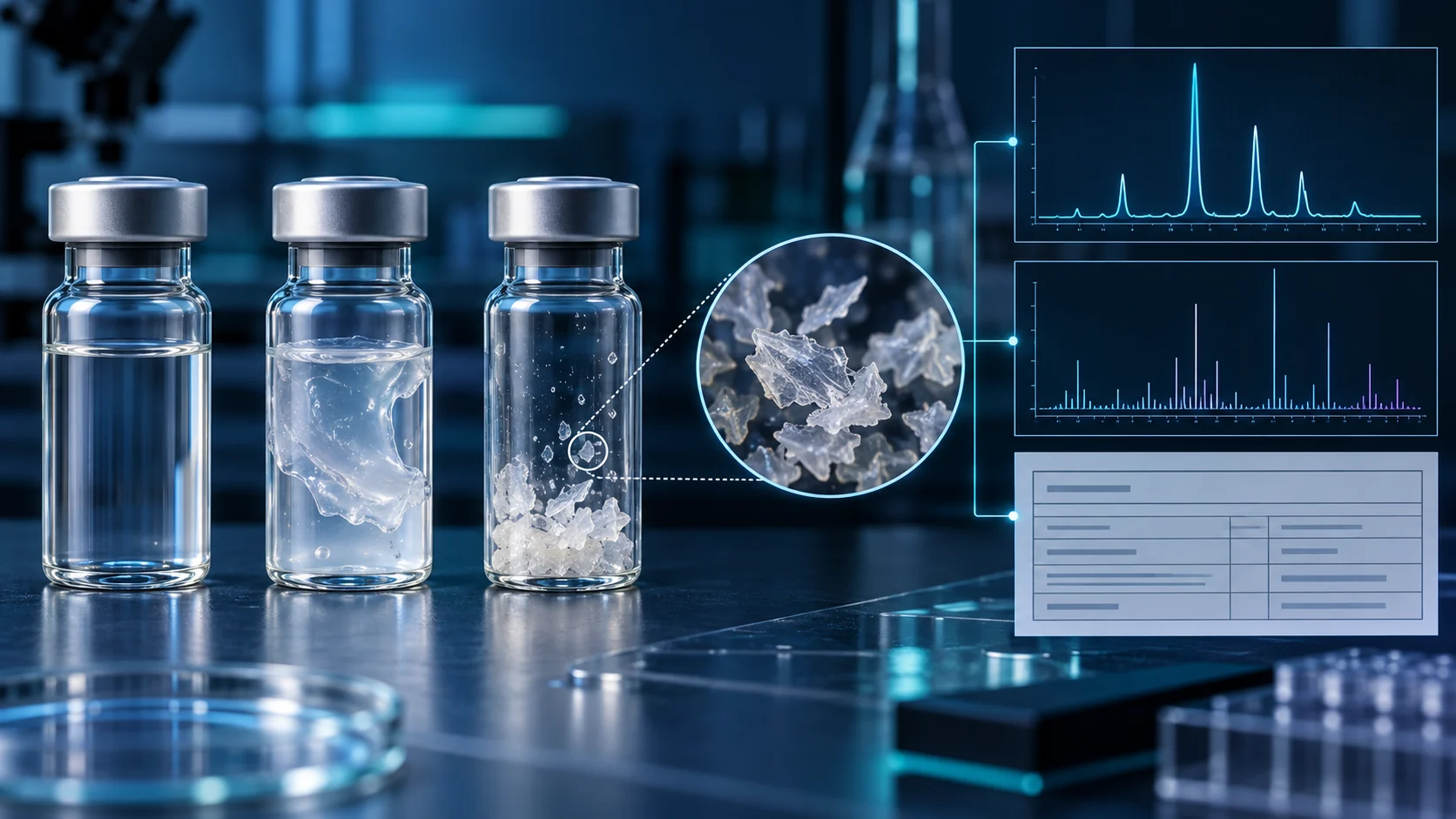
One AOD-9604 vial is described as clear immediately after preparation. By the next morning, a translucent mass clings to the glass. Another photograph shows white flakes rather than a continuous gel. A third owner reports uniform cloudiness. Online replies often treat all three as the same problem and then offer a precise recipe.
The confidence is greater than the published evidence. Public community posts clearly show that people use phrases such as “AOD-9604 gelling,” “jelly-like blob,” “cloudy AOD” and “flakes after reconstitution.”[C1–C4] Those posts document a real search and communication problem. They do not establish sample identity, formulation, cause, safety, frequency or a validated repair method.
The direct answer is: a gel-like phase, flakes and uniform haze are not interchangeable observations, and none proves that the material is authentic AOD-9604, degraded AOD-9604 or contamination. In the peer-reviewed AOD-9604 papers reviewed for this page, we found analytical identity and metabolism work plus clinical safety summaries, but no validated, product-specific study that explains community-reported vial gelation or establishes a universal diluent formula. A B2B investigation therefore has to begin with the exact material, formulation, batch and analytical question.
Describe what changed before asking why
The word “gel” is often used for anything that no longer looks like a thin, clear liquid. That is too broad for a supplier complaint.
| Reported appearance | Better description | What the photograph cannot prove |
|---|---|---|
| A continuous translucent mass | Gel-like phase that moves or clings as one body | Molecular identity or mechanism |
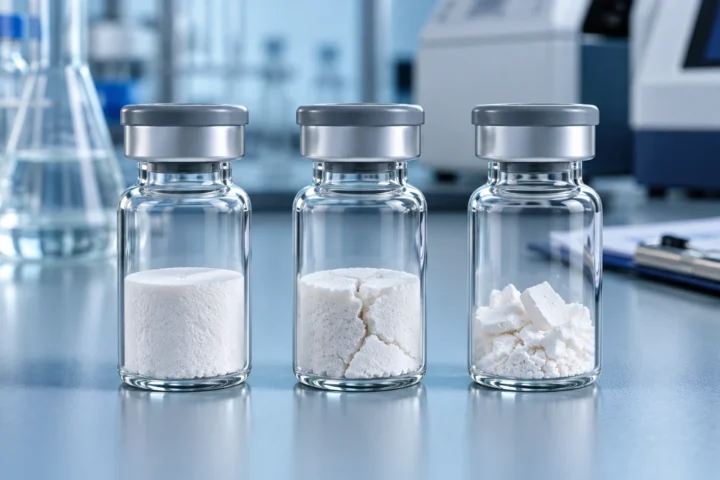
| Irregular white pieces | Flakes or visible particles | Whether they are peptide, excipient, container material or foreign matter |
| Uniform milkiness | Haze distributed through the liquid | Whether the source is aggregation, bubbles, another phase or contamination |
| Material at the bottom | Settled phase or sediment | Whether it began as flakes, precipitate or something introduced later |
| Clear at first, changed later | Time-dependent appearance change | Which storage or composition variable caused it |
Record whether the material stretches, breaks into pieces, settles, floats or coats the glass. Use the same lighting and background for sequential photographs. The purpose is not to diagnose chemistry by eye; it is to create a reproducible complaint record.
Confirm which molecule is being discussed
AOD-9604 is described in the published clinical literature as Tyr-hGH177–191, a 16-residue peptide with the sequence YLRIVQCRSVEGSCGF.[1] Online catalogues sometimes use “HGH fragment 176–191” as if it were an exact synonym, even though names, sequences and molecular references can be handled inconsistently across sellers.
That identity distinction matters in an appearance complaint. A supplier should state the intended sequence, disulfide form, molecular reference, counterion or salt basis where applicable, and formulation components. “AOD” on a label is not enough to show that two vials contain the same chemical and excipient system.
Cox and colleagues developed mass-spectrometric detection for AOD-9604 and studied its in-vitro metabolism. Their work identified the parent compound and several metabolites using analytical mass information.[2] It does not explain gelation, but it demonstrates a central point: identity is established by a method directed at the molecule, not by a vial’s visual behaviour.
What the published clinical material tells us
Stier and colleagues summarized six sponsor-associated clinical trials. For the two intravenous studies, the paper says the investigational material was supplied lyophilized and reconstituted with a designated volume of sterile water.[1] The oral studies used different excipient systems for capsules or tablets.
This historical detail is sometimes tempting to turn into a current handling instruction. It should not be. The paper does not provide a validated recipe for an unknown research vial, does not characterize a gel event and does not establish that every current AOD-9604 supplier uses the same solid-state form, excipients, concentration or manufacturing process.
It does, however, challenge a broad online claim that AOD-9604 always requires one particular acidic mixture. A formulation statement must be tied to the actual product and supporting development data. A community recipe is not a universal specification.
Why common online explanations remain hypotheses
Community discussions propose several mechanisms: high concentration, pH, rapid liquid addition, temperature, agitation, hydrophobic clustering, disulfide exchange or excipients. Some posts then recommend adding acid, warming, filtering, transferring or changing the liquid.[C1–C4]
For the actual vial, those explanations are hypotheses until the material and conditions are measured. More importantly, changing the sample can erase evidence. Adding another component changes pH, ionic strength and concentration. Heating changes temperature history. Filtering removes visible material without identifying it. Transferring can introduce a new container and new contamination opportunities.
This article therefore does not reproduce those procedures. A supplier investigation should preserve an unopened retained sample and document the affected sample before any experimental manipulation.
“Gelling is normal” and “gelling means fake” are both unsupported shortcuts
Frequent discussion does not establish a normal specification. A phenomenon can be widely reported because a name is used for different formulations, because similar images are grouped together, or because a community repeats the same explanation.
The opposite conclusion is also too strong. A gel-like appearance does not by itself prove that the labelled peptide is absent. It also cannot prove content, area purity, sterility or endotoxin status.
A defensible release specification would define the solid’s appearance, the intended preparation or analytical solution, its concentration and container, the inspection time, the acceptance criteria and the method used. Without those conditions, “should be clear” is incomplete.
Which evidence answers the buyer’s questions?
Is it the intended AOD-9604 sequence?
Use identity evidence capable of distinguishing the declared molecule from related fragments or altered forms. A mass result should include expected and observed values, method context and sample link. Chromatographic retention may support identity when interpreted with an appropriate reference, but a retention time alone is not a full structural proof.
How much target material is in each vial?
Per-vial content or assay is separate from HPLC area purity. A batch can show a high main-peak percentage while containing less total material than declared. The buyer should request the quantitative method, reference standard, units, acceptance rule and sampling plan.
Did related substances increase?
A stability-indicating method should separate the parent compound from relevant degradation or transformation products under validated conditions. The Cox metabolism paper shows that AOD-9604-related species can be distinguished analytically in biological matrices,[2] but that method is not automatically a release or stability method for a commercial vial.
What is the gel or flake?
That is a material-characterization question. The laboratory may need to compare the visible phase with the remaining liquid and with an unopened control using microscopy, chromatography, mass spectrometry or other suitable techniques. The exact approach depends on sample amount and plausible components. A photo cannot choose the method by itself.
Does chemical purity prove microbial quality?
No. Sterility, bioburden, endotoxin and visible-particle control are separate questions. An HPLC purity result does not answer them. Nor can a filter recommendation in a forum retroactively prove that an unknown sample is suitable for any use.
A batch-linked complaint record
Before contacting the supplier, collect:
- exact product name, sequence or molecular reference shown in the purchase record;
- lot number, vial identifier and order date;
- nominal amount and any declared formulation components;
- photographs at the first clear state and at the first observed change;
- elapsed time, temperature and transport/storage log;
- container and closure details;
- whether the same change appears in one vial, several vials or an unopened retained sample;
- every component introduced to the affected vial, recorded without turning it into a recommended recipe;
- which question the buyer wants the laboratory to answer: identity, content, related substances, particle identity or microbial quality.
The supplier should compare that record with release data and retained samples. A statement such as “our COA passed” is not enough unless the COA belongs to the lot and its tests actually address the complaint. See how to read a peptide COA for the difference between identity, purity and content.
What to ask before buying AOD-9604 wholesale
Ask the supplier to provide the intended molecular identity, per-vial specification, appearance criteria, release methods, transport conditions and written formulation statement. If a special analytical preparation is required, ask for the supporting development basis and make sure it refers to the quoted product rather than a generic forum practice.
MY PEPTIDE’s Wholesale Terms explain kit-level ordering. Product availability and batch-document questions can be sent to service@wholesalepeptide.xyz. No unpublished MY PEPTIDE AOD-9604 formulation or batch result is asserted on this page.
The useful conclusion
AOD-9604 gelling is a strong SEO phrase because it describes a visually memorable problem. It is not yet a scientific diagnosis.
The most useful buyer response is to name the appearance accurately, confirm the molecule and formulation, preserve the time course, link the observation to the batch and choose a test that answers one defined question. That gives the supplier something it can investigate—and prevents a forum recipe from becoming an unsupported quality standard.
Editorial method and limits
This page uses peer-reviewed AOD-9604 identity, clinical-material and analytical-metabolism papers. Public community posts are included only to document search language and conflicting claims. No fictional person, customer, batch, test result or MY PEPTIDE formulation is included. The literature search for this draft did not locate a peer-reviewed, AOD-9604-specific vial-gelation mechanism or validated universal repair protocol; absence from this search is not proof that no proprietary formulation data exist.
References
- Stier H, Vos E, Kenley DE. Safety and Tolerability of the Hexadecapeptide AOD9604 in Humans. Journal of Endocrinology and Metabolism. 2013;3(1-2):7–15. https://www.jofem.org/index.php/jofem/article/view/157/194
- Cox HD, Smeal SJ, Hughes CM, Cox JE, Eichner D. Detection and in vitro metabolism of AOD9604. Drug Testing and Analysis. 2015;7(1):31–38. https://doi.org/10.1002/dta.1715
Community observations
C1. Reddit, r/Peptidesource. AOD + bacteriostatic water = gelation? Public post dated 11 December 2025; accessed 24 September 2026. Records a gel-like report and conflicting diluent advice; does not verify identity or cause. Link
C2. Reddit, r/PeptideGuide. Aod-9604. Public post dated 15 April 2026; accessed 24 September 2026. Records flakes and community handling suggestions; not analytical evidence. Link
C3. Reddit, r/PeptideDiscussion. Cloudy Aod-9604. Public post dated 6 February 2026; accessed 24 September 2026. Records uniform cloudiness and conflicting interpretations. Link
C4. Reddit, r/Biohacking. Reconstituted AOD yesterday, looked fully dissolved, woke up to a jelly-like blob. Public post dated 4 August 2026; accessed 24 September 2026. Records a time-dependent gel-like description; does not establish mechanism. Link
This article is provided for supplier evaluation, research education, and business communication. It is not medical advice and does not provide dosage or treatment instructions.
Need supplier information for your business?
Discuss product availability, documentation, wholesale requirements, and shipping communication with our team.