
Cloudy retatrutide, clumps or floating particles? Understand what appearance can reveal, what remains uncertain and which details help a supplier enquiry.
For a research-peptide buyer, the questions do not always end when a parcel arrives. With retatrutide supplied in freeze-dried form, a later concern may be how the material looks after reconstitution. That term means dissolving the dry material in a suitable liquid for laboratory work. [1]
When a buyer sends a photograph asking why the liquid looks wrong, the seller has more to address than whether the order arrived. There may be a uniform haze, clumps at the bottom, or a change that only appeared later. Both sides need to know what warrants investigation and what to ask the supplier.
Two public Reddit discussions illustrate how different those observations can be. They help frame the questions; they do not establish the answers.
One Reddit poster described a vial labelled retatrutide that looked clear at first, then became cloudy about a week later. A friend’s separate vial, reportedly prepared with the same diluent, had stayed clear. The poster had stopped using their vial and wanted to understand what had changed. The account supplied a timeline, but no verified explanation. [Community observation A]
In another discussion, the problem started much earlier. A poster described persistent clumps and cloudiness across three vials from one supplier. They later blamed the diluent. That was their conclusion, not an independently verified finding. [Community observation B]
If you sell research peptides, those are two different complaints to investigate. In one, the appearance changed over time. In the other, visible material remained from the outset. Answering both with “it’s normal” skips the detail that might help explain the problem.
Retatrutide that looks cloudy after reconstitution cannot be diagnosed by appearance alone. Haze, clumps and floating particles describe what someone sees; they do not establish the material’s identity, the cause of the change or its suitability for use. Protein-formulation literature makes the same distinction between observing particles and identifying them. [2, 3]
This article concerns research-material observations and supplier quality enquiries. It is not a preparation guide or advice on human use.
Start with what “cloudy” means in this particular vial
A photograph of a hazy liquid and a photograph of a solid lump at the bottom may arrive with exactly the same caption: “My retatrutide is cloudy.” Keep the photographs, but make the description more precise before asking anyone to explain it.
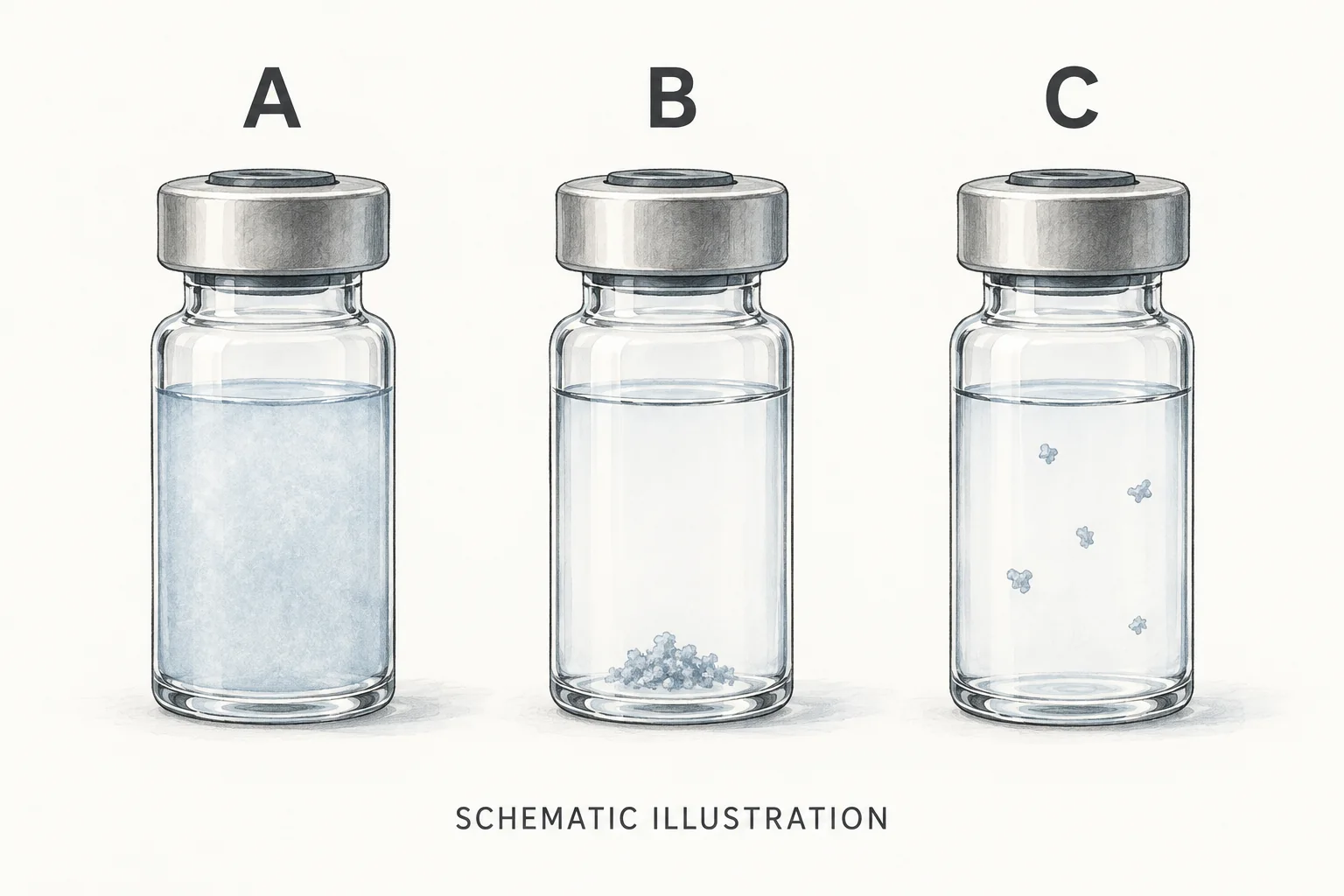
| What was reported? | What to record | What remains unresolved |
|---|---|---|
| A fairly uniform haze | Whether it was present from the first observation or appeared later | What is producing that appearance |
| Clumps or material at the bottom | When they were first seen and whether the rest of the liquid looked clear | Whether the material is peptide, another component or something else |
| Separate floating particles | Their visible appearance and the time they were noticed | Their composition and origin |
| Clear initially, cloudy later | The last recorded clear appearance and the first recorded change | Which event or process caused the change |
This is a record of observations, not a home identification test. It also avoids building an assumption into the complaint. “Visible material remains at the bottom” is a better starting description than “the peptide will not dissolve” when nobody has identified that material.
“Undissolved” and “aggregated” are not opposites, either. One describes a material’s state; the other describes molecules associating. A photograph does not reliably sort a sample into one category or the other. [2]
Clear on day one, cloudy later: keep the timeline
Return to the first account. The important detail is not that the friend’s vial looked better. It is that the poster described a change after an initially clear appearance.
For a supplier enquiry, ask for the last dated image showing the earlier appearance, the first image showing the change, and the available handling and storage record between them. A recollection that it “looked fine last week” is useful context, but it is less specific than two dated observations.

The friend’s vial can be noted as a comparison. It does not settle the cause. Without matched material, documented conditions and appropriate analysis, two separately handled vials are not a controlled experiment.
The same applies in the other direction. A later change does not, by itself, establish microbial contamination. Do not turn a timeline into a diagnosis simply because an online comment gives a confident explanation.
Three similar vials are worth investigating—but “same supplier” is not “same batch”
The second poster’s experience raises another useful question: what did the three vials actually have in common?
The account mentions the same vendor and the same diluent. It does not provide independently verified evidence isolating one of those factors. Repeating an observation tells you to look for shared conditions; it does not tell you which shared condition caused it.
Start with the labels and order records. Do the vials carry the same batch reference? Are they the same stated specification? Did the supplier provide a batch mapping, or are you assuming they belong together because they arrived in one parcel?
Record how many vials were examined, how many were affected and how many remain unopened. “Three out of three examined” and “three out of thirty examined” are different descriptions. Neither supports a claim about every vial the supplier has ever sold.
For a distributor, that distinction has a practical use: it helps identify the stock involved in an unresolved complaint without accusing unrelated batches or dismissing a repeated problem.
Why the solution conditions belong in the record
There is a scientific reason to ask about conditions, even when they do not yet explain the complaint.
In experiments with glucagon—a different peptide—Caputo and colleagues varied solution pH and followed aggregation-related signals over time. The signals developed differently under different conditions. That is evidence that the surrounding solution and elapsed time can matter for the peptide studied. It does not establish a suitable pH, a storage period or a cause of cloudiness for retatrutide. [4]
This makes “it must be the pH” an unfinished explanation. Was anything measured? Which sample was measured? Is there evidence connecting that result to the observed material? The same questions apply when a supplier names temperature or a diluent as the cause.
Preserve the conditions already documented by the laboratory or research team. Do not invent missing values, and do not treat an experiment on another peptide as a recipe for changing this sample.
What can a laboratory establish that a photograph cannot?
Seeing a particle is not the same as identifying it.
In a 2020 model-system study, Winters and colleagues used holographic measurements to distinguish protein aggregates from other subvisible particles, including oil droplets. Their samples involved human IgG and selected comparison materials—not retatrutide. The relevant lesson is the need for material characterisation, not that those same particle types must be present in your vial. [5]
A phone photograph records an appearance. An investigation may need to establish what the visible material is and, separately, what explains its presence. The appropriate methods depend on the question and the sample; a list of impressive instrument names is not a test plan. [3]
When contacting a laboratory, describe the observation first. Ask whether it can investigate that type of material, what the proposed analysis would establish, and what would remain unanswered. Agree how the sample should be documented and submitted before altering or sending it. Do not assume that a routine purity test includes particle identification.
“But the COA says it passed”
A report and an appearance complaint can concern different questions.
Before treating a COA as an answer, establish which sample was tested, which batch it represents, when it was tested and what the method measured. A result from another batch does not, by itself, establish what happened in this vial. A report that predates the reported change does not, by itself, establish the cause of that later change.
For this enquiry, the useful question is narrower: does the evidence address the observation being reported?
A supplier might send back the original report. Keep it in the enquiry, but ask for the connection to the current sample and a response to the appearance question. Equally, an unresolved appearance question is not proof that the report was fabricated. Check the document and investigate the material as separate tasks.
What a useful supplier response should contain
“We have never had a complaint” tells you little about the vial in front of you. So does an explanation that names pH, transport or the diluent without showing how that conclusion was reached.
For a research business, we suggest keeping the affected material separate from stock awaiting release under your quality procedure while the concern is unresolved. Avoid improvising a way to make the liquid look clear; that can also change the sample you want investigated. This is a quality-enquiry approach, not a method for making a product suitable for human use.
Send the supplier a short, specific record:
- Product name, stated per-vial specification, order reference and batch markings.
- What was seen, when it was first seen, and whether the appearance changed.
- Original photographs or video, labelled with dates and the relevant vial.
- The number examined, number affected and available unopened material.
- Available preparation, diluent and storage records; mark gaps as unknown.
- The particular question you want answered and the written next step requested.
If you are corresponding with MY PEPTIDE, our wholesale kit and quotation requirements explain the commercial order details. A kit count, however, is not a laboratory sample count or a batch identifier—include the actual vial and batch information in a quality enquiry.
You can keep the message straightforward:
We are reporting an appearance issue with the material identified in the attached order and batch records. Please review the dated observations and confirm which batch the supplied vials belong to. What investigation do you propose, and what evidence would support the explanation? Please distinguish confirmed findings from possible causes and confirm the next step in writing.
This is a suggested enquiry template, not a description of a service or remedy already agreed by MY PEPTIDE or another supplier.
Before closing the enquiry
A replacement shipment can resolve a commercial disagreement while leaving the original cause unknown. Record both outcomes accurately. Do not change “replacement received” to “quality issue disproved,” or “cause unknown” to “confirmed counterfeit.”
The two community accounts at the beginning end differently: one leaves the question open; the other gives an explanation the poster accepted. Neither supplies verified analytical evidence establishing the cause.
That is where a research business can make its own process more useful. Keep the timeline, the batch connection, the unanswered question and the eventual evidence together. The next time someone writes “it’s cloudy,” you will have more to work with than a photograph and a guess.
References
The first source provides background on peptide reconstitution; the remaining sources concern broader protein formulations and particle analysis. They do not provide a validated explanation for a particular research-supply retatrutide vial. No formulation-matched retatrutide stability study establishing the cause of the observations above was identified in this article’s source review.
- Invitrogen. Custom Peptide Storage and Dissolution. Technical manual, Part No. 12543000.pps; revision date 6 June 2003. Used only for general terminology on freeze-dried peptides and dissolution, not as a retatrutide preparation or storage protocol.
- den Engelsman J, et al. Strategies for the Assessment of Protein Aggregates in Pharmaceutical Biotech Product Development. Pharmaceutical Research. 2011;28:920–933. DOI: 10.1007/s11095-010-0297-1. Full text. Professional review/commentary.
- Das TK. Protein Particulate Detection Issues in Biotherapeutics Development—Current Status. AAPS PharmSciTech. 2012;13(2):732–746. DOI: 10.1208/s12249-012-9793-4. Full text. Professional review.
- Caputo N, et al. Biochemical Stabilization of Glucagon at Alkaline pH. Diabetes Technology & Therapeutics. 2014;16(11):747–758. DOI: 10.1089/dia.2014.0047. Full text. Original experimental study of glucagon, not retatrutide.
- Winters A, et al. Quantitative Differentiation of Protein Aggregates From Other Subvisible Particles in Viscous Mixtures Through Holographic Characterization. Journal of Pharmaceutical Sciences. 2020;109(8):2405–2412. DOI: 10.1016/j.xphs.2020.05.002. PubMed; author manuscript. Original experimental study.
Community observations
These public posts are sources for the questions described, not verified customer cases or scientific evidence of cause. Their comments are not preparation or treatment recommendations endorsed by this article. Accessed 9 September 2026.
A. Reddit, r/RetatrutideTalk. A report of a vial becoming cloudy after about a week. Public self-report; material identity and storage history not independently verified.
B. Reddit, r/Peptidesource. A report of clumping and cloudiness across several vials. Public self-report; the poster’s later attribution to the diluent was not independently verified.
This article is provided for supplier evaluation, research education, and business communication. It is not medical advice and does not provide dosage or treatment instructions.
Need supplier information for your business?
Discuss product availability, documentation, wholesale requirements, and shipping communication with our team.