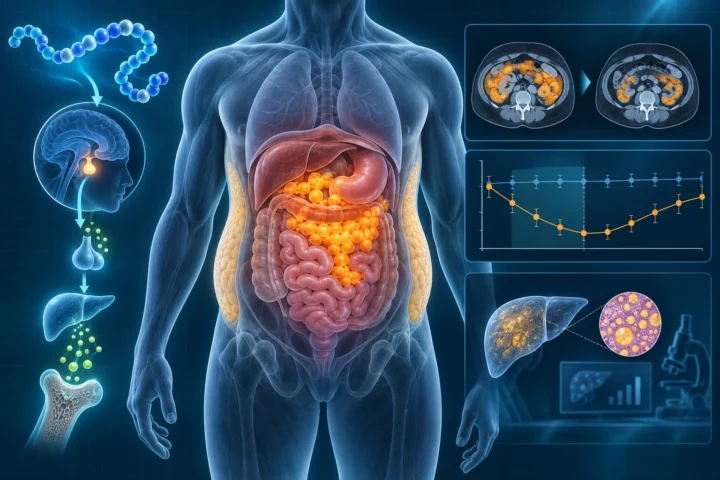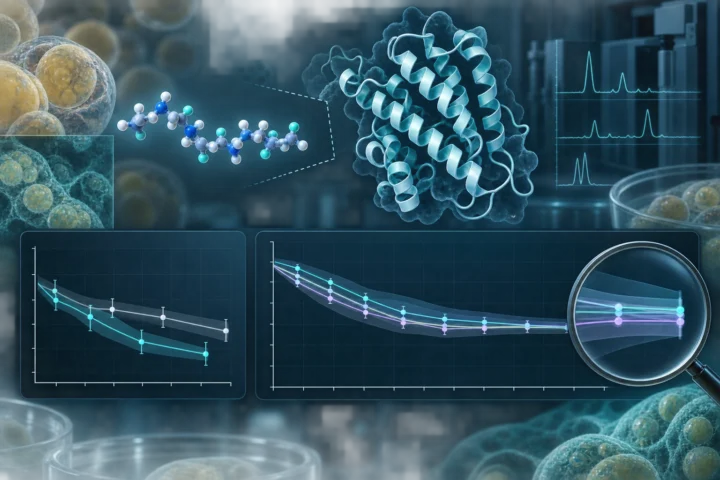
Review TB-500 benefits, the seven-amino-acid fragment, thymosin beta-4 studies, FDA findings and the evidence human research has not established.
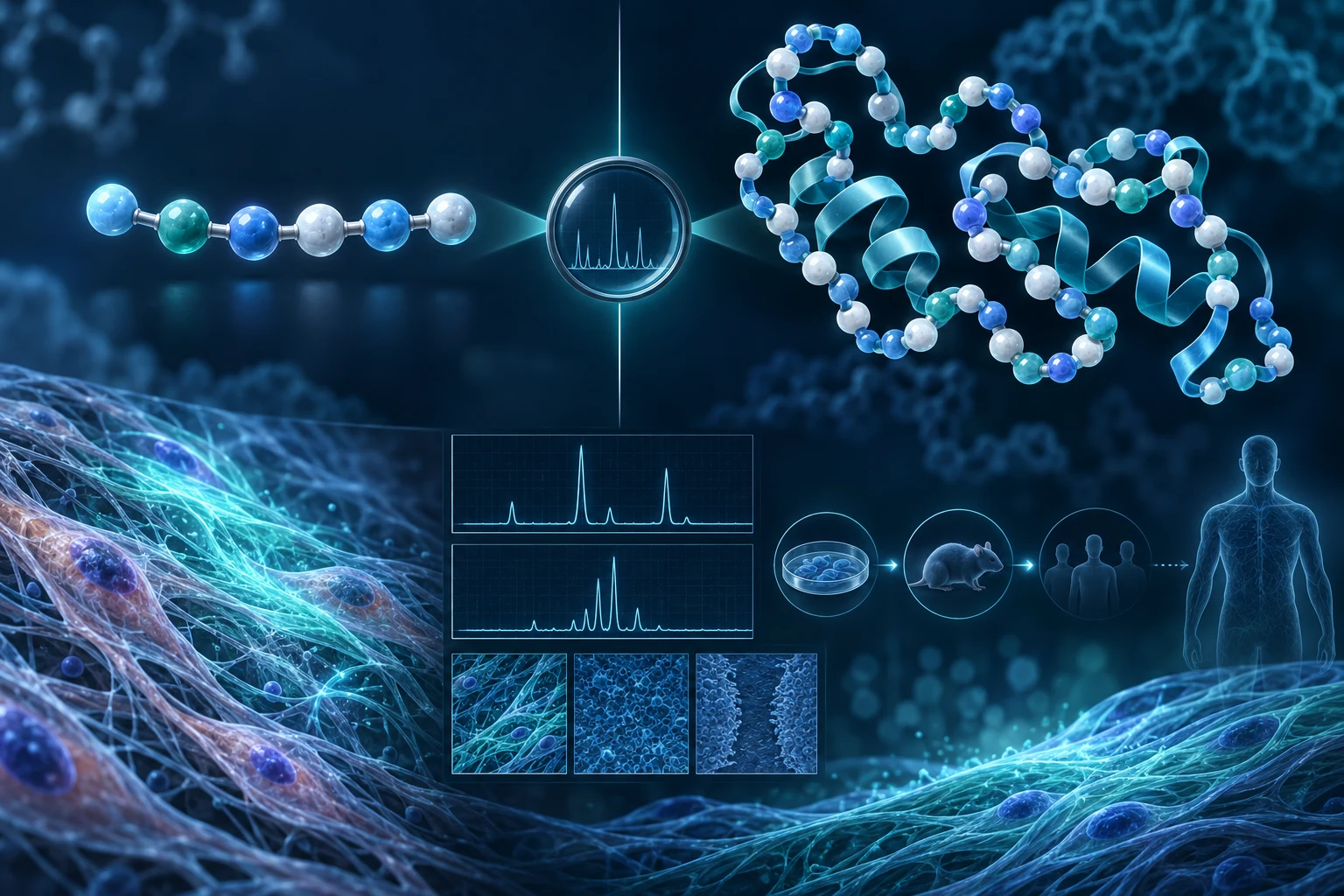
Search for “TB-500 benefits” and the same promises appear repeatedly: faster wound closure, tendon or ligament repair, less inflammation, better flexibility, new blood-vessel growth and quicker recovery. The list sounds settled. The underlying evidence is not.
The central problem is an identity problem. TB-500 is now commonly understood as an N-terminally acetylated seven-amino-acid fragment corresponding to residues 17–23 of thymosin beta-4. Full-length thymosin beta-4 is a 43-amino-acid protein. A non-acetylated seven-residue sequence, LKKTETQ, is another research object again. These materials are related, but they are not interchangeable.[1]
That distinction changes the answer to almost every benefit question. Cell, mouse and ophthalmic trials involving full-length thymosin beta-4 cannot automatically establish a human benefit for TB-500. Studies that detect TB-500 or its metabolites in horses are useful for analytical science, not proof that the material repairs a human tendon. In its July 2026 review, FDA reported that it found no human clinical studies in which TB-500 was administered to treat a disease or condition, and no human exposure data adequate to establish its safety.[1]
The defensible conclusion is therefore narrower than online marketing: TB-500 has a proposed biological rationale and a small amount of fragment-specific laboratory evidence, but human benefits have not been established. Much of the positive narrative is extrapolated from full-length thymosin beta-4, a non-acetylated fragment, animal work or mechanism.
TB-500 evidence at a glance
| Common claim | What the evidence actually contains | What it does not establish |
|---|---|---|
| “Promotes wound healing” | Full-length thymosin beta-4 and non-acetylated LKKTETQ have preclinical wound-repair literature; FDA found one TB-500 fibroblast scratch study with no significant closure effect at the tested condition[1,2] | A clinically meaningful wound-healing benefit from TB-500 in humans |
| “Repairs tendons and ligaments” | Broader thymosin beta-4 biology and animal or cell-model reasoning | Controlled TB-500 trials measuring human tendon or ligament healing |
| “Reduces inflammation” | Thymosin beta-4 literature describes anti-inflammatory pathways in experimental systems[2] | A proven anti-inflammatory indication, effective human exposure or benefit-risk profile for TB-500 |
| “Improves recovery and performance” | Online anecdotes and mechanism-based extrapolation | Robust human trials establishing recovery, strength or performance benefits[7] |
| “Human trials prove it works” | Human ophthalmic studies used full-length thymosin beta-4 formulation RGN-259[3,4] | Those trials were not trials of the seven-amino-acid TB-500 fragment |
| “A high-purity COA settles quality” | HPLC purity can describe one measured attribute under one method | Exact identity, peptide content, salt form, aggregates, endotoxin, sterility, safety or benefit |
What is TB-500?
FDA’s 2026 chemistry review describes TB-500 free base as Ac-Leu-Lys-Lys-Thr-Glu-Thr-Gln-OH: seven amino acids with an acetyl group on the N-terminal leucine. The agency lists a molecular formula of C38H68N10O14 and a molecular mass of approximately 889.01 g/mol for the free base.[1]
“TB-500” is a common name, not a United States Adopted Name. FDA reported finding multiple salts, derivatives and even different active moieties sold under that label. It also found that the withdrawn nomination it reviewed called the nominated substance free base while supplying a COA for acetate; some CAS, formula and molecular-weight details did not agree.[1]
For procurement, this is not an academic footnote. A buyer comparing two quotations marked “TB-500 10 mg” may not yet know whether both sellers mean the same chemical form, whether the stated mass includes a counter-ion, or whether the reference standard matches the quoted material.
1. TB-500 is not full-length thymosin beta-4
Thymosin beta-4 is a naturally occurring 43-amino-acid peptide involved in actin binding and studied in cell migration, inflammation, tissue protection and repair. Researchers identified residues 17–23—LKKTETQ—as a region associated with some activities. TB-500 adds N-terminal acetylation to that short sequence.[1,2]
Shortening a 43-residue molecule to seven residues is not like abbreviating its name. It changes molecular size, shape, stability, distribution and possible interactions. Acetylation can also change charge, hydrophobicity, lifespan and binding behaviour. FDA therefore warned that findings for non-acetylated LKKTETQ cannot be directly extrapolated to N-acetylated TB-500.[1]
This creates three evidence buckets that should remain separate:
- full-length thymosin beta-4 research;
- non-acetylated LKKTETQ fragment research;
- N-acetylated TB-500 research.
When a benefit article moves freely among those buckets without naming the material, it may sound comprehensive while answering the wrong question.
2. Where the wound-healing story comes from
The wound-healing story is not invented from nothing. Full-length thymosin beta-4 has been studied across multiple experimental models. A 2003 mouse study also examined non-acetylated LKKTETQ in aged animals with punch wounds and reported measures consistent with improved repair.[1,2]
But that study did not test the N-acetylated material now commonly called TB-500. FDA highlighted this distinction and noted that the experiment did not establish a dose-response relationship and could not show that findings generalise across wound types.[1]
The most relevant fragment-specific result was less encouraging. FDA identified a 2024 in-vitro study in which confluent fibroblast cultures were scratched and exposed to TB-500 free base at 50 micrograms per millilitre. Under that condition, wound closure was not significantly different from vehicle. A shorter metabolite, N-acetylated LKKTE, produced a small significant signal, but whether metabolism could create meaningful activity in vivo remained unknown.[1]
One negative cell condition does not prove that TB-500 can never have biological activity. It does show why the confident statement “TB-500 has been proved to heal wounds” is not supported.
3. What FDA found—and did not find
FDA evaluated TB-500 free base and acetate for possible inclusion on the section 503A bulk-drug-substances list, focusing on the nominated use of wound healing. This was a compounding-policy assessment, not a product approval.[1]
The agency reported that:
- neither free base nor acetate is a component of an FDA-approved drug;
- no applicable USP or National Formulary drug-substance monograph was identified;
- the nomination’s three supporting references concerned thymosin beta-4, not TB-500 administered to humans;
- its literature search found no clinical studies of TB-500 use in humans;
- it found no nonclinical in-vivo pharmacology study assessing whether TB-500 promotes wound healing;
- nonclinical toxicity, genotoxicity, reproductive-toxicity and carcinogenicity data were missing;
- no clinical studies or human-exposure data established safety by any route;
- potential human safety risks therefore remained unknown.[1]
FDA ultimately said the evaluated criteria weighed against placing TB-500 free base or acetate on the 503A list. That conclusion should not be distorted into “FDA proved TB-500 is harmful.” The more accurate point is that effectiveness, characterisation and safety evidence were insufficient, with specific unresolved quality risks.
4. Why thymosin beta-4 eye studies do not prove TB-500 benefits
Human trials do exist for a thymosin beta-4 product. Small and larger phase 2 dry-eye trials evaluated RGN-259, an ophthalmic formulation of full-length thymosin beta-4.[3,4]
The smaller study included nine patients with severe dry eye and reported encouraging signs and symptoms. A later randomised study included 72 subjects. Its primary endpoints at the prespecified main visit were not statistically significant, although some secondary measures showed signals.[3,4]
Those trials matter to the development history of full-length thymosin beta-4. They are not human TB-500 trials. The molecule, formulation, route, target tissue and clinical question are different.
Using those papers under a heading such as “TB-500 proven in human clinical trials” erases the most important variable: what was actually administered.
5. What anti-doping studies can tell us
TB-500 appears in sports drug-testing research. Scientists have developed methods to study its metabolism and detect the parent peptide or metabolites in biological samples. In-vitro liver and kidney preparations, animal studies and mass-spectrometry workflows help laboratories identify analytical targets.[5,6]
These papers can support statements about metabolism, hydrolysis and detection windows under their study conditions. They do not demonstrate faster recovery, increased performance or injury repair.
This is a recurring search-result error: a paper that mentions a compound is treated as a paper proving its benefit. Study purpose matters. Analytical detection, pharmacokinetics and efficacy are different research questions.
6. What is known about tendon, ligament and muscle repair?
The strongest online TB-500 claims often concern tendons, ligaments and muscle. Yet FDA’s search found no human clinical study of TB-500 for any disease or condition and no nonclinical in-vivo pharmacology study testing TB-500 for the nominated wound-healing use.[1]
Broader thymosin beta-4 literature can supply a hypothesis: actin biology, cell migration, angiogenesis and inflammatory signalling may be relevant to tissue repair. A hypothesis is the beginning of a programme, not its clinical conclusion.
To establish a tendon-repair benefit, researchers would need a defined TB-500 substance, adequate characterisation, a controlled population, meaningful imaging or functional outcomes, suitable comparators, and safety follow-up. The current public evidence does not provide that chain.
A 2026 sports-medicine review reached a similar high-level caution for emerging peptide supplements: promising animal findings did not translate into substantiated recovery or performance claims in current human trials.[7]
7. Does “no adverse-event report” mean safe?
No. FDA searched adverse-event and complaint systems. Its FAERS search through March 2025 retrieved no TB-500 reports, while another system contained two reports involving a TB-500/BPC-157 blend without enough information for safety assessment.[1]
Absence of a report is not evidence of absence. Voluntary reporting misses events, product identity may be uncertain, and an unapproved grey-market material may not be named consistently. Most importantly, FDA found no clinical studies or human-exposure data with which to characterise risk.
The agency also raised peptide-specific concerns about aggregation, impurities and immunogenicity. Those risks depend not only on the sequence but on synthesis, purification, formulation, storage and the final product. They cannot be resolved by popularity or anecdotes.
8. Why the COA needs more than a purity number
FDA’s chemistry discussion offers a practical quality lesson. A representative public COA it reviewed listed appearance, LC-MS/HPLC identity and peptide purity, but did not control assay, impurities, bacterial endotoxins or aggregates. The agency could not rule out immunogenicity risks linked to impurities and aggregation.[1]
For a B2B buyer, “99% purity” should trigger follow-up questions:
- Does the identity method distinguish the intended sequence and form?
- Is the quoted material free base or acetate?
- Is purity an HPLC area percentage, and what method was used?
- Is there a separate quantitative assay or peptide-content result?
- What impurity, water, residual-solvent and counter-ion information exists?
- Are endotoxin, bioburden or sterility claims being made, and by which validated method?
- Does the batch number connect the document, sample and supplied lot?
Our separate guide explains how to read a peptide COA without treating one HPLC figure as the whole specification.
9. Translating the evidence into a TB-500 buying specification
For a TB-500 research-material enquiry, the request should define the material before price comparison:
- exact sequence and N-terminal modification;
- free-base or acetate form;
- molecular formula and expected molecular mass;
- counter-ion and mass basis where applicable;
- stated amount per vial and how that amount is calculated;
- lot identifier and document traceability;
- identity, purity and content methods with acceptance criteria;
- relevant impurity and residual-solvent scope;
- storage and shipment conditions tied to the quoted form;
- availability of batch-specific documentation.
Under MY PEPTIDE Wholesale Terms, one kit contains 10 vials of the same product and the standard MOQ is one kit per peptide. A single order may contain one full kit of product A and one full kit of product B; five vials of each do not make one kit. Quotations depend on product, per-vial specification and quantity.
FAQ
What are the proven benefits of TB-500 in humans?
No human clinical benefit has been established. FDA’s 2026 review found no information in the medical literature where TB-500 was administered to patients to treat a disease or condition.[1]
Is TB-500 the same as thymosin beta-4?
No. TB-500 is commonly described as an N-acetylated seven-amino-acid fragment corresponding to residues 17–23. Full-length thymosin beta-4 contains 43 amino acids.[1]
Do thymosin beta-4 dry-eye trials prove TB-500 works?
No. Those trials evaluated an ophthalmic formulation of full-length thymosin beta-4, not the seven-residue TB-500 fragment.[3,4]
Is TB-500 FDA-approved?
No. FDA stated that neither TB-500 free base nor acetate is a component of an FDA-approved drug.[1]
Does TB-500 have evidence for tendon repair?
The public human evidence reviewed here does not include a controlled TB-500 tendon-repair trial. Mechanistic and thymosin beta-4 research cannot substitute for one.
Does a 99% HPLC purity result prove the material is safe?
No. It describes one analytical attribute under a stated method. It does not by itself establish exact identity, quantity, sterility, endotoxin status, aggregate control, safety or efficacy.
Bottom line
TB-500 is a useful example of how peptide claims grow faster than peptide evidence. The short fragment, the non-acetylated sequence and full-length thymosin beta-4 are often discussed as though they were one material. They are not.
There is a scientific rationale for investigating the fragment and its metabolites. There is not yet a human evidence base that supports the familiar list of wound-healing, tendon-repair, anti-inflammatory, recovery or performance benefits. A responsible buyer should ask two questions before all others: What exact molecule is being quoted, and which study actually tested that molecule?
For TB-500 form, per-vial specifications, kit quantities and batch-document availability, contact service@wholesalepeptide.xyz.
References
- US Food and Drug Administration. Evaluation of TB-500-Related Bulk Drug Substances (TB-500 Free Base and TB-500 Acetate) for Inclusion on the 503A Bulks List. Pharmacy Compounding Advisory Committee, July 2026. FDA briefing document
- Goldstein AL, Hannappel E, Kleinman HK. Thymosin beta4: actin-sequestering protein moonlights to repair injured tissues. Trends in Molecular Medicine. 2005;11(9):421–429. PubMed
- Sosne G, Ousler GW. Thymosin beta 4 ophthalmic solution for dry eye: a randomized, placebo-controlled, Phase II clinical trial conducted using the controlled adverse environment model. Clinical Ophthalmology. 2015. PubMed
- Sosne G, et al. Thymosin beta4 significantly improves signs and symptoms of severe dry eye in a phase 2 randomized trial. Cornea. 2015;34(5):491–496. PubMed
- Ho ENM, et al. In vitro metabolism of TB-500 and its detection in doping control. Drug Testing and Analysis. 2017. PubMed
- Thomas A, et al. In vitro models for metabolic studies of small peptide hormones in sport drug testing. Bioanalysis. 2015;7(1):119–129. PubMed
- Peptide Supplements and Their Therapeutic Applications in Sports Medicine. 2026 review. PubMed
This article is provided for supplier evaluation, research education, and business communication. It is not medical advice and does not provide dosage or treatment instructions.
Need supplier information for your business?
Discuss product availability, documentation, wholesale requirements, and shipping communication with our team.