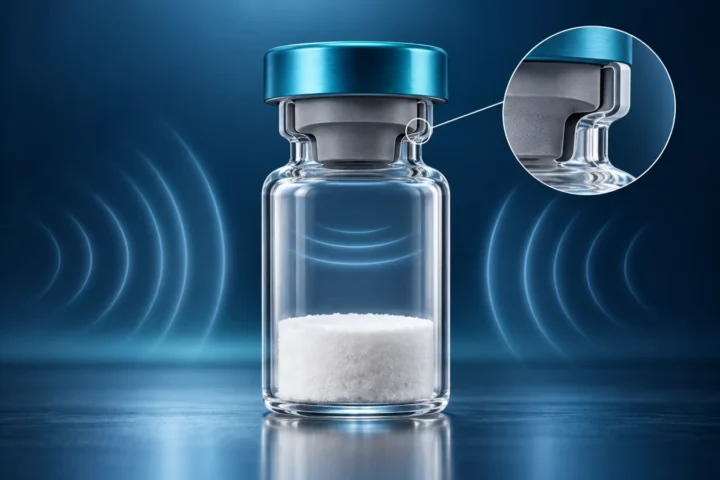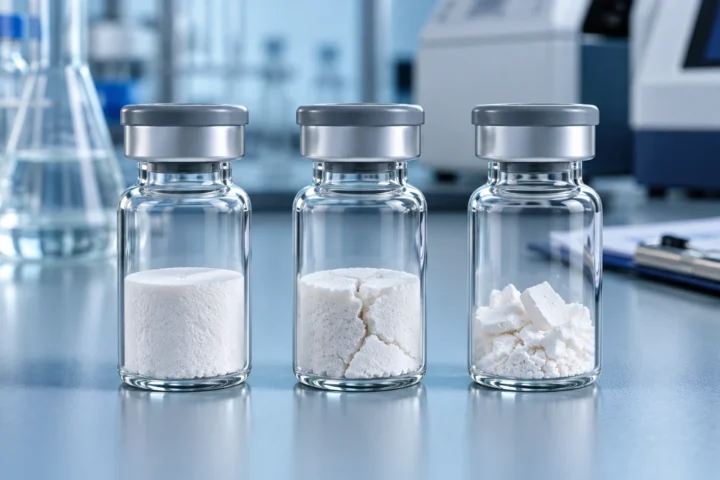
Learn what clear, yellow, cloudy or sedimented NAD+ may indicate, why appearance cannot prove quality, and which batch records and tests a B2B buyer should request.

A buyer opens two cartons marked NAD+. One vial appears almost colourless under a white inspection light. Another has a pale straw tint. A third photograph from a downstream customer shows haze and material at the bottom. Within minutes, the group chat produces three confident answers: “normal buffer,” “degraded,” and “fake.”
Those answers cannot all be established from the picture. The disagreement is useful, however, because it exposes the real procurement problem: the word NAD+ may refer to different supplied forms, formulation systems, concentrations and stages of preparation. The vial colour may also alter what the eye sees.
The direct answer is: NAD+ powder may fall within a white-to-yellow appearance range under some reagent specifications, while the same specification can require a dilute aqueous solution to be clear and colourless. A slight yellow tint therefore does not prove degradation, and a clear solution does not prove identity or content. Cloudiness, visible particles or new sediment are separate observations that require batch-linked records and appropriate analysis; appearance alone cannot establish purity, potency, sterility or suitability for use.[1]
Start by naming the observation correctly
“Off-colour” is too vague for a supplier investigation. A useful record separates at least five observations:
| Observation | What it literally describes | What it does not prove |
|---|---|---|
| White, cream or pale-yellow dry material | Colour of the supplied solid under stated lighting | Identity, purity, content or stability |
| Clear and colourless solution | Light passes through without obvious colour or haze | Correct molecule, correct amount or microbial quality |
| Clear and pale-yellow solution | Transparent liquid with visible tint | Cause of the tint or whether the batch changed |
| Uniform haze/cloudiness | Light scattering throughout the liquid | Contamination, precipitation or degradation without testing |
| Flakes, crystals or bottom sediment | Visible discrete material or a settled phase | Chemical identity of that material |
The time point matters just as much. “It was yellow immediately” is different from “it changed from colourless to yellow after several days.” “Powder looked cream” is different from “a prepared solution developed sediment.” A photograph without those details is not a complete complaint record.
NAD+ is not NADH—and neither is a peptide
Nicotinamide adenine dinucleotide exists in oxidised and reduced redox forms. NAD+ is the oxidised form; NADH is the reduced form. Their spectra and stability behaviour differ. In UV-visible measurements, NAD+ has a strong region around 260 nm, while the reduced dihydropyridine ring in NADH adds a characteristic response around 340 nm.[2]
This distinction matters because online discussions often use “NAD” as if it were one visual material. A specification should identify the exact form, hydrate or salt basis where relevant, molecular reference and assay basis. The buyer should not assume that an NADH colour discussion, a nicotinamide riboside paper or a finished compounded formulation describes the NAD+ research material being quoted.
NAD+ is also a dinucleotide cofactor, not a peptide. It may be listed beside peptides in a supplier catalogue, but that commercial placement does not change its chemistry or justify copying a peptide test panel without review.
Can NAD+ powder normally be yellow?
There is no universal answer without an exact specification. A current Thermo Fisher reagent specification for beta-nicotinamide adenine dinucleotide hydrate lists the powder colour range as white to yellow. In the same document, a 1% solution in water is specified as clear and colourless.[1]
That single example establishes two useful limits. First, a yellowish solid can fall inside a legitimate supplier’s specification. Second, a solid-colour range cannot automatically be transferred to every solution. It does not establish that all yellow powders, all yellow solutions or any MY PEPTIDE batch meet a specification.
Other products may use a different hydrate form, water limit, assay, excipient or formulation. A buyer therefore needs the specification that actually applies to the quoted material—not a screenshot from a different catalogue item.
Why “yellow means buffered” is not a sufficient answer
Recent community threads show how quickly visual claims become circular. Some commenters describe pale-yellow NAD+ as normal or “buffered.” Others insist that authentic material must be colourless, must arrive in amber glass or must never show haze. These posts establish that buyers ask the question; they do not identify the material, formulation or cause.[C1–C3]
“Buffered” should be a documented composition statement. It should name the buffer or excipient system and explain which specification applies. It should not be an after-the-fact explanation based only on colour.
Likewise, amber glass can be a packaging choice for light protection, but bottle colour is not an identity test. A clear vial does not prove that the contents are fake, and an amber vial does not prove that the contents are NAD+. Packaging, formulation and material identity must be documented independently.
What cloudiness and crystals change
A transparent tint and cloudiness are not the same observation. Tint concerns light absorption; cloudiness usually reflects light scattering from suspended material, droplets, bubbles or another non-uniform feature. Bottom sediment adds a time and phase-separation element.
A photograph can help distinguish “uniform haze” from “large visible particles,” but it cannot identify the particles. Possible explanations depend on the full system: exact compound and form, concentration, excipients, water quality, pH, container, temperature history and elapsed time. Without those facts, naming a cause is speculation.
Community discussions sometimes recommend warming, shaking, adding more liquid or transferring the material. Those steps are not repeated here. They alter the sample and can destroy the evidence needed for a useful complaint investigation. For B2B quality communication, the appropriate next action is to preserve the observation and collect the batch record—not to improvise a repair method.
What stability research actually tells us
NAD+ stability is condition-dependent. Wolfe and colleagues studied NAD+ and NADH in Tris, HEPES and sodium-phosphate buffers at pH 8.5 for up to 43 days. Under their cell-free biocatalysis conditions, NAD+ showed much slower spectral change in Tris than in phosphate or HEPES. The authors also emphasised that buffer system and temperature affected cofactor stability.[2]
This is useful mechanistic context. It demonstrates why “NAD+ in water” is not a complete description of a stability experiment. It does not diagnose a commercial vial, validate a particular storage condition or prove that visible yellowing represents the degradation measured in that study.
Forrow and Shabir developed a stability-indicating RP-HPLC method that separated NAD from decomposition products in buffered solutions. They identified ADP-ribose and nicotinamide as important decomposition products, with amounts depending on the buffer.[3] The practical lesson is not that a buyer should infer those compounds from colour. It is the opposite: a separation method can distinguish parent material from related products in a way that eyesight cannot.
Analytical work also shows why “one HPLC purity number” needs context. Yoshino and Imai described an HPLC method for measuring NAD+ and separating related metabolites, using a reference standard and controlled mobile-phase conditions.[4] Method, reference, sample preparation and system suitability matter. A chromatogram image without a batch link or method conditions is not the same as a quantitative batch result.
Four different questions need four different kinds of evidence
1. Is the material actually NAD+?
Identity may require a fit-for-purpose combination of chromatographic retention, spectroscopic evidence and mass or another orthogonal technique. Colour does not answer this question.
2. How much NAD+ is present?
Quantitative content or assay needs a calibrated method and a clearly stated basis. The nominal “mg per vial” and chromatographic area purity are not interchangeable.
3. What else is present?
Related-substance or degradation-product analysis requires a stability-indicating separation with meaningful detection and reporting limits. A clear solution can still contain dissolved impurities; a cloudy one does not reveal what the suspended material is.
4. What happened to this batch?
The batch number, fill or lyophilisation record, formulation, packaging, storage and transport history create the chain needed to investigate a visual change. A generic COA detached from the vial’s lot number cannot close the case.
A practical supplier enquiry for yellow or cloudy NAD+
When a customer reports an appearance difference, a supplier should be able to collect consistent information. A useful enquiry includes:
- exact label name and supplied form;
- lot or batch number and photographs of the label and material;
- whether the observation concerns dry material or a prepared solution;
- the colour, clarity and type of visible material, described separately;
- when the difference was first noticed and whether it changed over time;
- the applicable product specification and release result;
- formula, excipient or buffer declaration where relevant;
- packaging type and documented transport/storage history;
- identity, assay/content and related-substance methods used for the batch;
- retained-sample review and complaint-investigation status.
The request should avoid conclusions such as “oxidised,” “contaminated” or “fake” unless testing supports them. It should also avoid relying on smell, vial colour or a social-media consensus as a release test.
For a MY PEPTIDE NAD+ research-material enquiry, state the product, required per-vial specification and number of kits. The peptide COA guide explains why identity, area purity, assay/content and microbiological claims must be read separately. The existing NAD+ benefits evidence review covers biological claims; it does not diagnose vial appearance.
Under MY PEPTIDE Wholesale Terms, one kit contains ten vials of the same product, and the standard MOQ is one kit per product. Separate full kits of different products can share one order, but different products cannot be mixed within one kit. Pricing is quotation-based and depends on product, per-vial specification and quantity.
FAQ
Is yellow NAD+ automatically degraded?
No. Some reagent specifications allow white-to-yellow solid material, while a dilute solution under the same specification may be required to be clear and colourless.[1] The applicable formulation, specification, time course and analytical results are needed.
Does clear NAD+ prove that it is pure?
No. Dissolved impurities may be invisible, and a clear liquid does not prove identity or quantity. Those claims require suitable analytical methods.
Can cloudiness prove contamination?
No. Cloudiness is an observation, not an identification. It should trigger documentation and investigation, but a photograph alone cannot determine microbial status, chemistry or cause.
Are visible crystals always NAD+?
No. Appearance cannot identify the solid phase. The system composition and appropriate analysis are required. Do not use an online “dissolve it again” suggestion as proof of identity.
Is amber glass proof of authentic NAD+?
No. Packaging may be selected for light protection, but container colour is not a chemical identity test. Request the packaging rationale and batch-linked evidence.
Bottom line
NAD+ appearance questions are worth recording precisely, but they should not be answered with a colour rule. White-to-yellow powder can fit one reagent specification; a clear colourless solution can be required by that same specification. Stability studies show that formulation conditions matter, while chromatographic methods show why degradation products cannot be identified by eye.
For B2B buyers, the useful response is a batch-linked investigation: exact material form, specification, time course, packaging, identity, quantitative content and related substances. For availability, documentation, kit quantities and shipping communication, contact service@wholesalepeptide.xyz.
References
- Thermo Fisher Scientific. Product Specification: beta-Nicotinamide adenine dinucleotide hydrate, 98+%, CAS 53-84-9. Printed 3 September 2026. Specification PDF
- Wolfe KD, Alahuhta M, Himmel ME, Bomble YJ, Jennings GK, Cliffel DE. Long-Term Stability of Nicotinamide Cofactors in Common Aqueous Buffers: Implications for Cell-Free Biocatalysis. Molecules. 2024;29(22):5453. DOI 10.3390/molecules29225453
- Forrow NJ, Shabir GA. Development and Validation of a HPLC Method for NAD: Application to Stability Studies in Buffered Solutions and Dry Test Strips. J Liq Chromatogr Relat Technol. 2009;32(19):2805–2821. DOI 10.1080/10826070903288680
- Yoshino J, Imai S. Accurate Measurement of Nicotinamide Adenine Dinucleotide (NAD+) with High-Performance Liquid Chromatography. Methods Mol Biol. 2013;1077:203–215. DOI 10.1007/978-1-62703-637-5_14
Community observations used only to define the question
- C1. Reddit, r/PeptidePathways. nad+ issue. Read 23 September 2026. Commenters disagreed about yellow colour, cloudiness, buffering and vial colour; the thread is not chemical verification. Thread
- C2. Reddit, r/PeptidePathways. NAD+. Read 23 September 2026. The post asks whether a slight transparent-yellow tint is normal and notes a same-lot difference. Thread
- C3. Reddit, r/PeptidePathways. NAD+ Forming Crystals. Read 23 September 2026. Used only as evidence that buyers report crystal-like material; its preparation and repair suggestions are not reproduced or endorsed. Thread
This article is provided for supplier evaluation, research education, and business communication. It is not medical advice and does not provide dosage or treatment instructions.
Need supplier information for your business?
Discuss product availability, documentation, wholesale requirements, and shipping communication with our team.