What does NAD+ do? Review its roles in energy metabolism, DNA repair and cell signalling—and why human anti-ageing benefits remain unproven.
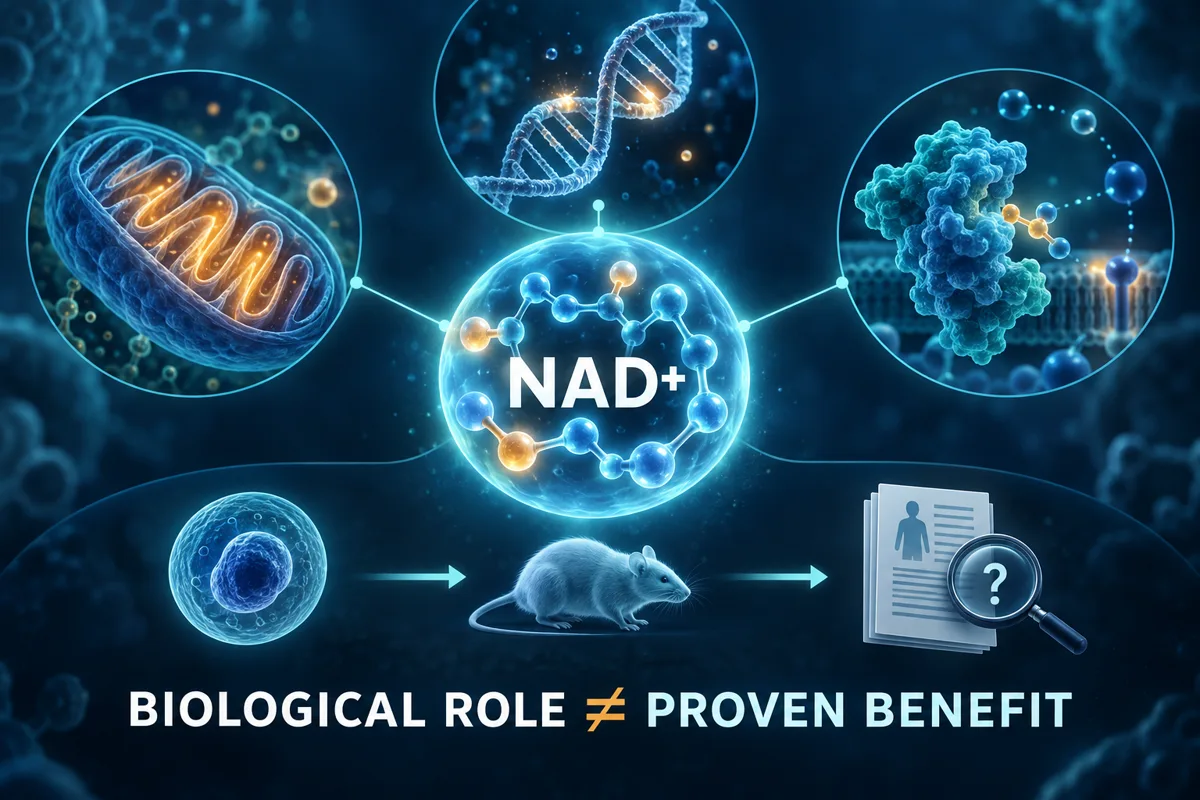
NAD+ is often introduced with a dramatic promise: more energy, sharper thinking, faster recovery or slower ageing. The first half of that conversation rests on serious biology. NAD+ is indispensable to cellular metabolism and is used by enzymes involved in signalling and DNA-damage responses. The second half—whether adding NAD+ or raising it through a precursor reliably produces those outcomes in people—is far less settled.
That gap matters. A molecule can be essential inside every cell without becoming a proven treatment when supplied from outside the body. “NAD+ has an important function” and “this NAD+ intervention benefits humans” are two different claims requiring two different kinds of evidence.
The short answer: what are the benefits of NAD+?
The word benefits needs to be divided into biological roles and demonstrated intervention outcomes.
NAD+ has established roles in:
- transferring electrons in redox reactions that support cellular energy metabolism;
- serving as a substrate for enzymes involved in DNA-damage responses, chromatin regulation and cell signalling;
- linking metabolic state with mitochondrial and broader cellular homeostasis.[1,2]
Research in animals has made NAD+ augmentation an important ageing and metabolic-research field. In humans, NAD+ precursors such as nicotinamide riboside (NR) and nicotinamide mononucleotide (NMN) can often change circulating or cellular NAD-related biomarkers. However, improvements in physical function, metabolism, vascular measures and other health-related outcomes have been mixed, endpoint-specific or absent across trials.[3,4]
For direct intravenous or intramuscular NAD+, the clinical evidence is thinner. A 2026 systematic review found no eligible outcomes trials of intravenous or intramuscular NAD+ itself for anti-ageing or wellness indications.[3] It is therefore not accurate to present energy, cognitive, recovery or longevity benefits as established effects of direct NAD+ administration.
1. NAD+ helps cells extract energy from nutrients
NAD+ is an electron carrier. During reactions involved in processing carbohydrates, fats and amino acids, NAD+ accepts electrons and is reduced to NADH. NADH can then donate electrons into processes connected with mitochondrial ATP production, returning to the oxidised NAD+ form.
This NAD+/NADH cycle is central to energy metabolism. Without enough available NAD+, many redox reactions cannot continue normally. That is the scientifically sound basis behind the phrase “NAD+ is involved in energy production.”[1,2]
It does not automatically follow that supplying more NAD+ gives a person a perceptible energy boost. The body regulates NAD+ in different tissues and cellular compartments, and an intervention must be absorbed, distributed and metabolised before it can affect a relevant pool. A change in a blood biomarker is also not the same as improved fatigue, exercise capacity or daily function.
For research buyers, the outcome should therefore be named precisely: was the study measuring NAD metabolites, mitochondrial respiration, ATP-related markers, exercise performance, fatigue scores or something else? Calling all of them “energy” hides important differences.
2. NAD+ is consumed by enzymes involved in DNA-damage responses
NAD+ does more than move electrons. Poly(ADP-ribose) polymerases, commonly called PARPs, use NAD+ as a substrate during cellular responses to DNA damage. NAD+-dependent sirtuins are linked to protein deacetylation, chromatin regulation and metabolic signalling. Other enzymes, including CD38, also consume NAD+ in signalling pathways.[1]
This is why NAD+ frequently appears in discussions of DNA repair and cellular ageing. The careful statement is that NAD+ availability is connected to enzymes participating in these processes. It would be an overreach to translate that mechanism directly into “NAD+ repairs your DNA” or “NAD+ reverses ageing.”
Mechanistic evidence identifies a pathway. A human benefit requires controlled studies showing that a defined intervention changes a meaningful endpoint with an acceptable safety profile.
3. NAD+ connects metabolism, mitochondria and cell signalling
Cells do not maintain one undifferentiated tank of NAD+. NAD-related metabolism is compartmentalised across the cytosol, nucleus and mitochondria, and the pools interact through regulated pathways. NAD+ availability can influence redox balance, enzyme activity, mitochondrial homeostasis, inflammatory signalling and stress responses.[1,2]
This systems role explains why NAD+ research spans metabolic disease, neurodegeneration, muscle function, immune biology and ageing. It also explains why a single universal “NAD+ effect” is unlikely. An intervention may change one tissue, biomarker or pathway without producing the same change elsewhere.
The more realistic question is not “Does NAD+ work?” but:
Which NAD-related intervention, in which population, changes which tissue or biomarker, over what period—and does that change improve a clinically meaningful outcome?
4. NAD+ levels and ageing: promising biology, incomplete translation
Studies have reported age-associated changes in NAD+ metabolism across model organisms and in several human tissues. Reviews connect lower NAD+ availability with mitochondrial dysfunction, altered inflammation, impaired stress responses and other features studied in ageing biology.[1,2]
Animal experiments have often produced encouraging results when NAD+ metabolism is altered. Depending on the model, researchers have reported effects on metabolic, mitochondrial, inflammatory and functional endpoints. These results justify further research; they do not establish the same effect in humans.[3]
Human ageing is more heterogeneous than a laboratory model. Age, health status, tissue, baseline NAD metabolism, intervention, duration and endpoint can all change the result. A mouse lifespan finding cannot be turned into a human longevity claim, and a short-term biomarker change cannot demonstrate slower ageing.
What human studies show—and do not show
The most developed human literature is not about direct NAD+ itself. It largely concerns precursors that the body can use in NAD metabolism, especially NR and NMN.
A 2026 PRISMA-guided systematic review included 33 human intervention studies and 80 rodent studies. In humans, oral NR and NMN generally showed biochemical target engagement and were usually tolerated over study periods of weeks to months. But functional, metabolic, vascular and other healthspan-related results were heterogeneous and were often null or limited to particular endpoints.[3]
A 2025 review in Nature Metabolism reached a similarly cautious position: precursor studies can raise NAD-related measures, but clinical efficacy is limited and varies by tissue and context.[4] This is the evidence pattern readers should remember:
| Evidence question | Current answer |
|---|---|
| Does NAD+ have essential cellular functions? | Yes; this is established biology. |
| Can some precursors raise NAD-related biomarkers in humans? | Often yes, depending on compound, sample and study. |
| Does a higher biomarker reliably improve how a person feels or functions? | Not established across outcomes; results are mixed. |
| Is direct NAD+ proven to slow ageing or extend human lifespan? | No. |
| Are direct IV/IM NAD+ wellness benefits supported by robust outcomes trials? | No eligible outcomes trials were identified in the 2026 systematic review.[3] |
Direct NAD+ is not the same intervention as NR or NMN
Marketing pages often combine NAD+, NADH, NR, NMN and niacin under one “NAD benefits” heading. They are related to the same metabolic network, but they are not interchangeable research interventions.
- NAD+ is the oxidised coenzyme itself.
- NADH is its reduced redox partner.
- NR and NMN are precursors used in NAD biosynthetic pathways.
- Niacin and nicotinamide enter NAD metabolism through other routes.
An outcome from an oral NR trial cannot prove the same outcome for direct NAD+, another route, or another precursor. Even studies of the same molecule can differ in population, duration, formulation and endpoint.
The distinction is especially important for direct NAD+ evidence. A small 2019 pilot followed plasma and urine NAD-related metabolites during a six-hour intravenous NAD+ infusion. It was a pharmacokinetic/metabolome study, not a controlled efficacy trial proving anti-ageing, energy, cognitive or recovery benefits.[5] The paper also disclosed commercial connections to an organisation using IV NAD+, which should be considered when interpreting the work.
Common NAD+ benefit claims, graded by evidence
“Supports cellular energy metabolism”
This is a well-supported biological description. NAD+/NADH redox cycling is central to energy metabolism. It should not be rewritten as a guaranteed energy boost for a person.
“Supports DNA repair and healthy ageing pathways”
NAD+ is a substrate for PARPs and sirtuins involved in DNA-damage responses, chromatin and metabolic regulation. The pathway is real; broad anti-ageing efficacy in humans remains unproven.
“Improves exercise performance or fatigue”
Some human precursor trials have reported endpoint-specific signals, while others have not. Systematic reviews describe heterogeneous evidence. The claim needs the exact compound, population, endpoint and result, not a general NAD+ headline.[3,4]
“Improves cognition or brain health”
NAD metabolism is relevant to neuronal biology and neurodegeneration research, but this does not establish a general cognitive benefit from commercial NAD+ products. Direct NAD+ efficacy evidence is insufficient.
“Detoxes, repairs cells or reverses ageing”
These phrases are too broad to be scientific outcomes. They should be replaced with a measurable endpoint—or not used.
“Extends lifespan”
Preclinical longevity research cannot establish increased human lifespan. There is no robust human evidence supporting this claim for direct NAD+.
How to read an NAD+ study without being misled
Before repeating a result, identify six details:
- Intervention: NAD+, NADH, NR, NMN, niacin, nicotinamide or a multi-ingredient combination?
- Model: isolated cells, animals, healthy volunteers or people with a defined condition?
- Route and formulation: were they the same as the material being discussed?
- Comparator: was the study randomised and placebo-controlled, or only measured before and after?
- Endpoint: NAD metabolite level, molecular pathway, questionnaire, physical performance or clinical outcome?
- Duration and scale: was it a short pilot or a sufficiently powered longer trial?
A study can be valid and still answer only a narrow question. Raising a biomarker shows biological engagement; it does not by itself establish a felt or clinical benefit.
Why product identity still matters in an efficacy article
Evidence can be interpreted only when the research material is defined. A report or catalogue should distinguish NAD+ from NADH and from precursors. Identity, purity and content answer different questions, and one result should not be made to stand in for all three.
Researchers comparing NAD+ wholesale kits should specify the exact material, per-vial specification, number of whole kits and documentation required. Under the MY PEPTIDE wholesale terms, one kit contains ten vials of the same product, with a standard minimum of one kit per product. Complete kits of different products can share an order; different products cannot be mixed five-and-five inside one kit.
For document review, the peptide COA guide provides a practical sample-to-batch evidence chain. NAD+ is not a peptide, but the same traceability principle applies: the report must connect the named material and test result to the relevant sample and lot.
Frequently asked questions
What does NAD+ do in the body?
NAD+ participates in redox reactions that support energy metabolism and is consumed by enzymes involved in cell signalling, chromatin regulation and DNA-damage responses.
Does NAD+ give you more energy?
Its cellular role in energy metabolism is established. A reliable subjective or functional energy benefit from direct NAD+ administration has not been established by robust human outcomes trials.
Is NAD+ anti-ageing?
NAD+ metabolism is an important ageing-research target, and animal findings are promising. Human anti-ageing effectiveness—especially for direct NAD+—remains inconclusive.
Does NAD+ improve brain function?
NAD+ is relevant to neuronal metabolism and signalling, but that biological relevance does not prove a general cognitive benefit from supplementation or direct administration.
Are NMN and NR evidence the same as NAD+ evidence?
No. They are precursors with different pharmacology. Their trial outcomes cannot automatically be transferred to direct NAD+.
What is the strongest human finding so far?
Some NAD+ precursors can raise NAD-related biomarkers. Whether those changes consistently improve meaningful health or functional outcomes remains uncertain.
The useful answer is more precise than “NAD+ works”
NAD+ is essential biology: it supports redox metabolism and supplies enzymes involved in signalling and DNA-damage responses. That is why it attracts serious interest in metabolism, mitochondrial function and ageing research.
The responsible conclusion is equally clear. Human studies have not yet shown that direct NAD+ reliably delivers the broad anti-ageing, energy, cognitive or recovery benefits often claimed online. Researchers and buyers should name the exact intervention, separate biomarkers from outcomes and connect every result to the material, model and method that produced it.
For current research-product availability and documentation, send the product name, per-vial specification and number of whole kits to service@wholesalepeptide.xyz.
References
- Covarrubias AJ, Perrone R, Grozio A, Verdin E. NAD+ metabolism and its roles in cellular processes during ageing. Nature Reviews Molecular Cell Biology. 2021;22:119–141. doi:10.1038/s41580-020-00313-x.
- Xie N, Zhang L, Gao W, et al. NAD+ metabolism: pathophysiologic mechanisms and therapeutic potential. Signal Transduction and Targeted Therapy. 2020;5:227. doi:10.1038/s41392-020-00311-7.
- Gallagher C, Emmanuel OO. NAD+ supplementation for anti-aging and wellness: A PRISMA-guided systematic review of preclinical and clinical evidence. Ageing Research Reviews. 2026;116:103057. doi:10.1016/j.arr.2026.103057.
- Vinten KT, Trętowicz MM, Coskun E, et al. NAD+ precursor supplementation in human ageing: clinical evidence and challenges. Nature Metabolism. 2025;7:1974–1990. doi:10.1038/s42255-025-01387-7.
- Grant R, Berg J, Mestayer R, et al. A Pilot Study Investigating Changes in the Human Plasma and Urine NAD+ Metabolome During a 6 Hour Intravenous Infusion of NAD+. Frontiers in Aging Neuroscience. 2019;11:257. PubMed PMID 31572171.
This article is provided for supplier evaluation, research education, and business communication. It is not medical advice and does not provide dosage or treatment instructions.
Need supplier information for your business?
Discuss product availability, documentation, wholesale requirements, and shipping communication with our team.