Review Ipamorelin benefits, GH-release studies, the failed postoperative-ileus trial, FDA findings and claims human research has not proved.
Ipamorelin is often described online with a neat chain of promises: it releases growth hormone, therefore it builds muscle, reduces fat, improves sleep, accelerates recovery and slows ageing. The first link in that chain has human evidence. The rest largely does not.
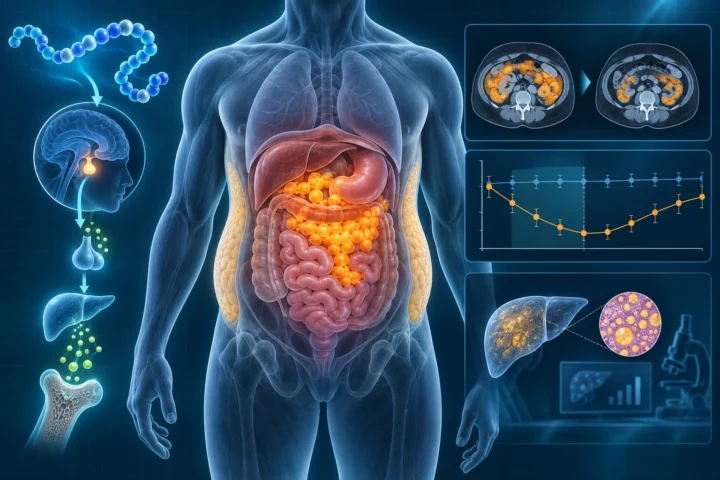
A controlled study in healthy male volunteers showed that ipamorelin produced a short growth-hormone pulse. A later randomised phase 2 trial tested it in 117 bowel-resection patients for postoperative ileus. That trial did not find statistically significant improvement in its main or secondary efficacy analyses. FDA’s 2024 review found limited effectiveness evidence for growth-hormone deficiency or postoperative ileus, no evidence supporting the proposed subcutaneous route for those conditions, and significant unresolved safety and characterisation questions.[1–3]
The defensible summary is: Ipamorelin is a ghrelin-receptor agonist with demonstrated short-term growth-hormone-releasing activity, but human studies have not established the broad body-composition, recovery, sleep, anti-aging or performance benefits commonly attached to it.
Ipamorelin evidence at a glance
| Claim | What the evidence contains | What it does not establish |
|---|---|---|
| “Releases growth hormone” | A controlled dose-escalation study in healthy men measured a single GH pulse after intravenous exposure[2] | Long-term benefit, better body composition or clinical treatment effect |
| “Selective secretagogue” | Early animal pharmacology found GH release with less ACTH/cortisol release than comparator secretagogues[4] | Selective does not mean side-effect-free or clinically superior |
| “Improves gut recovery” | Rodent postoperative-ileus models showed promotility signals; a human phase 2 trial followed[3,5] | The human trial did not meet efficacy comparisons |
| “Builds muscle and burns fat” | Mechanistic reasoning from the GH axis and reviews of growth-hormone secretagogues | No controlled Ipamorelin trial demonstrating those outcomes |
| “Improves sleep or recovery” | Marketing claims and extrapolation from GH physiology | No direct controlled human Ipamorelin evidence establishing those benefits |
| “Safe because it is only five amino acids” | Limited human exposure plus FDA review of reported adverse events and quality risks[1,3] | A complete human safety profile, especially for the nominated subcutaneous route |
What is Ipamorelin?
Ipamorelin is a synthetic pentapeptide that acts at the growth-hormone secretagogue receptor, now commonly called the ghrelin receptor or GHS-R1a. Activation of that receptor can stimulate the pituitary to release growth hormone. It is not growth hormone itself.[1,2]
Its structure includes unnatural amino-acid components. FDA lists the free-base sequence as H-Aib-His-D-2Nal-D-Phe-Lys-NH2 and a molecular mass of about 711.9 g/mol. Ipamorelin free base and ipamorelin acetate are distinct bulk drug substances. FDA found that nomination packages had mixed names, CAS information, formulas and COA descriptions in ways that made the proposed substance unclear.[1]
That distinction matters to a B2B buyer. “Ipamorelin” alone does not define whether a quotation is for free base or acetate, how the counter-ion is accounted for, or what mass basis is used for a stated vial amount.
1. What the healthy-volunteer study proved
The clearest human pharmacology study was published in 1999. Researchers enrolled groups of healthy male volunteers in a controlled dose-escalation design and measured circulating ipamorelin and growth hormone. Across the tested exposures, ipamorelin produced a single episode of GH release, followed by a decline toward negligible concentrations. The researchers used those data to model its pharmacokinetic and pharmacodynamic relationship.[2]
This supports a narrow statement: ipamorelin can acutely stimulate GH release under the conditions studied.
It does not show that participants gained lean mass, lost fat, slept better, recovered faster, became stronger or lived longer. Those outcomes were not the purpose of the study. A transient hormone measurement is a pharmacodynamic marker, not a package of clinical benefits.
The distinction is especially important because endogenous GH secretion is pulsatile and influenced by age, sex, sleep, nutrition and illness. Observing one induced pulse does not reveal the long-term effect of repeated exposure or the benefit-risk balance in another population.
2. What “selective growth-hormone secretagogue” means
The phrase “first selective growth hormone secretagogue” comes from a 1998 pharmacology paper. In rat and pig experiments, ipamorelin stimulated GH release while producing less ACTH and cortisol release than GHRP-2 or GHRP-6 under the tested conditions.[4]
That was a useful development finding. It suggested that ipamorelin’s acute endocrine profile differed from earlier secretagogues. But “selective” is frequently stretched beyond what the experiments established.
It does not mean that only GH biology is affected in every species, exposure pattern or clinical context. The ghrelin receptor is involved in more than pituitary GH release, including gastrointestinal and central signalling. Nor does selectivity prove that increasing GH produces a desirable outcome in people without diagnosed deficiency.
A careful article should therefore say “showed relative endocrine selectivity in early animal pharmacology,” not “has no cortisol, prolactin or metabolic side effects.”
3. Why researchers studied postoperative ileus
Ghrelin-receptor activation can affect gastrointestinal motility. In rodent models involving abdominal surgery and intestinal manipulation, ipamorelin accelerated gastric emptying or gastrointestinal transit and altered contractile responses.[5,6]
Those results created a plausible development path for postoperative ileus—the temporary impairment of gastrointestinal function after surgery. The animal studies were not evidence for muscle gain or sports recovery. They were a model-specific signal leading to a hospital-based clinical trial.
This history is useful because it shows how drug development should work: mechanism, animal model, then a controlled human test. It also shows why the human result matters more than the attractive preclinical narrative.
4. What happened in the human phase 2 trial
The 2014 publication reported a multicentre, double-blind, placebo-controlled phase 2 study in adults undergoing small- or large-bowel resection. A total of 117 patients were enrolled; 114 formed the safety and modified intention-to-treat populations. The intervention was given intravenously in hospital, not by the route commonly promoted online.[3]
The key endpoint was time from the first study treatment to tolerating a standardised solid meal. The median was 25.3 hours in the ipamorelin group and 32.6 hours with placebo, but the difference was not statistically significant. The publication reported no significant differences in the key or secondary efficacy analyses.[3]
That result should not be rewritten as “ipamorelin shortened recovery by more than seven hours.” A numerical difference that fails the prespecified statistical comparison is not demonstrated efficacy. The study was also small and included patients with varied underlying conditions.
The trial does prove something useful: ipamorelin reached phase 2 human testing for a defined medical problem. It does not prove that the product worked, and it says nothing direct about body composition, sleep, injury recovery or anti-aging.
5. Reconciling the paper’s safety wording with FDA’s review
The trial publication described the studied regimen as well tolerated and reported treatment-emergent adverse events in both groups. FDA later examined the same development programme in more detail during its 503A review.[1,3]
FDA noted reports of hypokalaemia, insomnia, hyperglycaemia, nausea, vomiting, abdominal distention and two deaths among ipamorelin-treated subjects. Both fatal serious adverse events occurred after bowel-resection surgery in patients with colon cancer and major postoperative complications. FDA stated that it was unclear whether the deaths were related to ipamorelin.[1]
Two errors must be avoided. It would be wrong to say ipamorelin caused those deaths, because causality was unresolved. It would also be wrong to omit them and call the human safety profile established.
FDA further found no safety data for the subcutaneous route proposed by nominators and insufficient information to rule out concerns associated with GH stimulation, including glucose intolerance. The agency also highlighted aggregation, peptide-related impurities, endotoxin and immunogenicity questions.[1]
6. What evidence exists for muscle, fat loss, sleep and recovery?
The broad online benefits are usually constructed by borrowing from general GH physiology. Growth hormone participates in growth, metabolism and body-composition regulation. That does not mean every GH-releasing substance has demonstrated every GH-associated outcome.
For Ipamorelin specifically, the reviewed human literature does not establish that it:
- increases muscle mass or strength;
- reduces body fat or produces durable weight loss;
- improves sleep quality or sleep duration;
- accelerates tendon, ligament or muscle recovery;
- improves athletic performance;
- reverses ageing or extends lifespan;
- treats diagnosed growth-hormone deficiency.
Reviews may discuss growth-hormone secretagogues as a class, but class-level mechanism cannot replace compound-specific trials. Studies of ghrelin, anamorelin, ibutamoren, GHRP-2 or GHRP-6 are not Ipamorelin trials.
7. What the 2024 FDA review concluded
FDA evaluated Ipamorelin free base and acetate for possible inclusion on the US 503A Bulks List, focusing on growth-hormone deficiency and postoperative ileus. Neither form was a component of an FDA-approved drug, and FDA found no applicable USP/NF monograph.[1]
The agency concluded that:
- effectiveness evidence for the evaluated conditions was limited;
- there were no data supporting effectiveness for the proposed subcutaneous route;
- professional society guidelines did not discuss Ipamorelin for those uses;
- important physical and chemical characterisation information was missing;
- available clinical and nonclinical information left safety concerns unresolved;
- the balance of evidence weighed against adding free base or acetate to the 503A list.[1]
This was a compounding-policy evaluation, not a drug approval. A nomination, advisory-committee discussion or appearance in an FDA document does not mean Ipamorelin is FDA-approved.
What Ipamorelin research does not prove
The evidence does not justify saying that Ipamorelin is a proven treatment for growth-hormone deficiency, a clinically validated bodybuilding compound, a fat-loss therapy, a sleep aid, a recovery treatment or an anti-aging intervention.
“GH release was measured” is accurate. “Therefore all downstream benefits occur” is an inference. Human outcome trials would be needed to determine whether any benefit is meaningful, durable and worth the risks.
Translating the evidence into a B2B Ipamorelin specification
For an Ipamorelin research-material enquiry, a buyer should define the material before comparing prices:
- exact peptide sequence and terminal form;
- free base or acetate;
- molecular formula and expected molecular mass for the stated form;
- counter-ion and mass basis where relevant;
- stated amount per vial and whether it is expressed as peptide, salt or another basis;
- batch identifier and document traceability;
- identity method and acceptance criteria;
- chromatographic purity method and result;
- content or assay information, where available;
- impurity, residual-solvent, water and counter-ion scope where relevant;
- storage and shipment conditions tied to the quoted material.
A COA should be read by method and measured attribute. HPLC area purity does not by itself establish identity, vial content, sterility, safety or a human benefit. FDA’s finding that even nomination materials mixed free-base and acetate information is a practical warning against relying on the common name alone.[1]
Under MY PEPTIDE Wholesale Terms, each kit contains 10 vials of the same product and the standard MOQ is one kit per peptide. Different products may be combined as complete kits within one order, but five vials of A and five of B do not form one kit. Quotes depend on the product, per-vial specification and quantity.
FAQ
What is the main demonstrated effect of Ipamorelin?
A controlled healthy-volunteer study demonstrated an acute growth-hormone pulse after intravenous exposure. That is a pharmacodynamic effect, not proof of broader clinical benefits.[2]
Does Ipamorelin build muscle or reduce fat?
The reviewed evidence does not include controlled Ipamorelin trials establishing increased muscle mass, strength or durable fat loss.
Was Ipamorelin tested in humans?
Yes. Human studies include a healthy-volunteer PK/PD study and a phase 2 postoperative-ileus trial. The latter did not show significant differences in its key or secondary efficacy analyses.[2,3]
Is Ipamorelin FDA-approved?
No. FDA’s 2024 503A review stated that neither Ipamorelin free base nor acetate was a component of an FDA-approved drug.[1]
Are Ipamorelin free base and acetate interchangeable?
They share the same active moiety but are distinct bulk drug substances. Buyers should confirm the quoted form, formula, counter-ion and mass basis rather than treating the names as analytically interchangeable.
Does a high-purity COA prove Ipamorelin is safe or effective?
No. Purity is one analytical attribute under a stated method. It cannot establish clinical safety, vial content, sterility or a claimed human benefit.
Bottom line
Ipamorelin has real human pharmacology and a real clinical-development history. Those facts make it more interesting than a molecule supported only by internet anecdotes. They also make the evidence boundary unusually clear: it can trigger an acute GH response, while the major human efficacy trial did not demonstrate significant clinical benefit.
For B2B research buyers, the useful approach is to separate mechanism from outcome, clinical material from supplier material, and free base from acetate. That produces a better specification—and a more honest article—than a list of borrowed GH benefits.
For Ipamorelin forms, kit quantities and batch-document availability, contact service@wholesalepeptide.xyz.
References
- US Food and Drug Administration. Evaluation of Ipamorelin-Related Bulk Drug Substances for Inclusion on the 503A Bulks List. Pharmacy Compounding Advisory Committee, 29 October 2024. FDA briefing document
- Gobburu JV, Agersø H, Jusko WJ, Ynddal L. Pharmacokinetic-pharmacodynamic modeling of ipamorelin, a growth hormone releasing peptide, in human volunteers. Pharmaceutical Research. 1999;16(9):1412–1416. doi:10.1023/A:1018955126402
- Beck DE, Sweeney WB, McCarter MD; Ipamorelin 201 Study Group. Prospective, randomized, controlled, proof-of-concept study of the ghrelin mimetic ipamorelin for the management of postoperative ileus in bowel resection patients. International Journal of Colorectal Disease. 2014;29(12):1527–1534. doi:10.1007/s00384-014-2030-8
- Raun K, Hansen BS, Johansen NL, et al. Ipamorelin, the first selective growth hormone secretagogue. European Journal of Endocrinology. 1998;139(5):552–561. PubMed
- Venkova K, Mann W, Nelson R, Greenwood-Van Meerveld B. Efficacy of ipamorelin, a novel ghrelin mimetic, in a rodent model of postoperative ileus. Journal of Pharmacology and Experimental Therapeutics. 2009;329(3):1110–1116. PubMed
- Greenwood-Van Meerveld B, et al. Efficacy of ipamorelin, a ghrelin mimetic, on gastric dysmotility in a rodent model of postoperative ileus. Journal of Pharmacology and Experimental Therapeutics. 2016. PubMed
This article is provided for supplier evaluation, research education, and business communication. It is not medical advice and does not provide dosage or treatment instructions.
Need supplier information for your business?
Discuss product availability, documentation, wholesale requirements, and shipping communication with our team.